
The landscape of strategy is littered with the wreckage of businesses that went awry. Indeed, many firms have closed their doors at an alarming rate in the first quarter of this year in the US retailing sector alone. The industry is facing one of its worst crises in recent times. In fact, 2,880 stores have been announced to shut doors, and at this rate of closure, 8,640 will be closed by the end of 2017.
Payless Inc. closed 400 stores in its announced bankruptcy plan, becoming the 10th retailer to do so in the first quarter. Ralph Lauren’s flagship store in New York City and the 131-year-old department-store chain Sears, which has lost more than $10 billion in recent years, are among the casualties. Retailers with legacy business models combined grew 47%, while Amazon’s eCommerce grew 53% in 2016.
This problem is not limited to the US alone. In fact, our findings suggest that more than 25,000 businesses are in distress in Japan, in addition to the 8,381 firms that filed for bankruptcy last year. That is, more than two to three years of negative Shareholder Return (TSR) with 35% below the industry average and negative cash flow for years, etc.
Many Japanese companies have not yet joined the “bankruptcy club” because of the Bank of Japan’s (BoJ) monetary policies. Other major banks are keeping many of these zombie firms afloat for the time being through relaxed credit policies. In other words, these firms pay interest on their debts but would have difficulty paying the principal.
My experience suggests that businesses often exhibit symptoms of failure long before any crisis hits, such as sales falling below expectations for several quarters, cash flow problems developing when customers pay more slowly than expected, and when major creditors respond to economic conditions by tightening their terms for payment, etc.
However, it is crucial to differentiate between the symptoms and the causes of the distress or crisis. My findings point to many causes, such as a failed or flawed strategy, profitability, debt hangover, market share, credit rating, liquidity, delays in publishing accounts (Toshiba), failures of new products, high senior management turnover, declining industries, etc. Thus, numerous causes can be categorized as internal, external, or both simultaneously.

The usual corporate suspects for a turnaround are often stagnant with underutilized assets, with profit performance regarding the return on capital (ROC) below expectations and ineffective management. They are often in stable and matured industries with a competitive advantage that exists for historical reasons, such as high barriers to entry but eroding below the radar, such as large US retailers. Thus, by adopting turnaround strategies early enough, sustainable recovery can take place without the traumas usually associated with a crisis.
However, given the emotional luggage associated with a turnaround and the bias towards the status quo, managers often kick the can down the road until it is too late. Many firms became captive of their glorious past rather than explorers of a brave new future. In other words, complacency spells trouble.
“The tragedy of top management in large corporations is that it is so much more reassuring to stay as you are, even though you know the result will be a certain failure, than to try to make a fundamental change when you cannot be certain that the effort will succeed.” The Asian Head of a large Japanese company
Just downsizing your way to success in a strategy turnaround is a flawed approach with devastating future consequences for employees’ morale, the firm’s future innovative capability, and above all, this band-aid solution leads to the feared outcome—bankruptcy. For instance, American firms alone laid off more than 8 million workers from the end of 2008 to the middle of 2010. Thus, consistent with recent research comprising 4,710 publicly traded firms in 83 industries, downsizing firms are twice as likely to declare bankruptcy as firms that did not downsize. While downsizing may not always be destructive and may produce positive outcomes in the short term, such as savings, it increases the firm’s likelihood of bankruptcy. That is the opposite outcome of a successful turnaround goal. Thus, a firm in its turnaround can be lean without being mean. This article provides a systematic and winning approach for firms in distress or crisis to renew their failing strategies before it is too late.
Diagnosing Your Strategic Challenges: Are you Distressed or in a Crisis?

The distressed firm, in our experience, has an abundance of resources. However, it may be losing its competitive advantage, the competitors may steal the firm’s revenues, the demand may shift dramatically, etc. At the same time, the expenses could be increasing at a faster rate than sales.
On the other hand, in a crisis, the firm will have scarce resources while losing market share and pressure on the contribution margin, including its competitive advantage. Above all, it would be cash-strapped.
The Basic Diagnostic Review Questions are:
- Is the board effective as a team?
- Is the organizational structure effective and efficient?
- Do the board members have the skills and competencies to help bring the change?
- Who is part of the problem, and who is part of the solution?
- Is there anyone on the board who will be a hindrance? Who needs to go?
- Asset Reduction or Cost Reduction: Are your challenges internal, external, or both?
- Do the board members have the capabilities to execute the new strategy?
- How did the firm perform in its past change management or turnaround?
- Is everybody on the same page with the same objective?
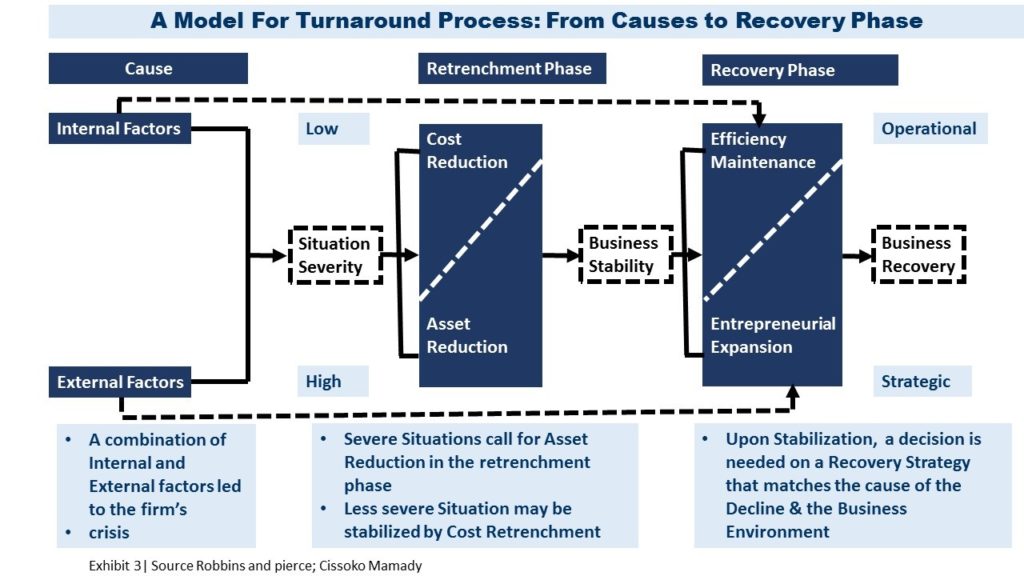
How severe is your firm’s situation with respect to the internal and external factors mentioned above? The answer to this question would be the strategist’s guide to take the proper actions with respect to cost reduction, asset reduction regarding the shrinkage of your balance sheet, or a combination of both.
The key Processes for Stabilization to Stop the Bleeding
“The transformation of an enterprise begins with a sense of crisis or urgency.”
—former CEO of IBM Lou V. Gerstner, Jr
- Short-term cash flow management, in other words, cash is king! Six to twelve weeks of ongoing reporting and forecasting of the minimum needed, etc.
- Financial controls through cash rationing and new management (if needed). In other words, ban all cash expenditure, freeze all hiring, bonuses, etc.
- Retrenchment is a first-stage cost reduction (expenses or assets or both). When demand deepens, and the firm is overstaffed, adjustments to overheads and purchasing may be necessary before moving the other idle or non-operating assets to shrink the firm’s balance sheet.
- Compliance with regulatory and legal matters at all levels such as wrongful trading in the UK Insolvency Act of 1986.
The severity of the crisis facing the turnaround business is a function of the causes of the failure and what stage the crisis has reached. The fact that a company has been losing money for years means that it is clearly a potential for a turnaround—but does not necessarily mean that it is in a crisis. Moreover, crisis management and particularly financial restructuring must be prioritized over other strategies in a severe crisis. And long-term viability can’t be sensibly assessed until short-term survival has been protected.
This first step is essential to achieving a quick win in the process. It involves solving the cost-volume-profit equation at the income statement level and reducing the asset at the balance sheet level to remain viable in the medium term.
These steps above entail authentic leadership with respect to integrity, listening, the ability to make tough decisions that may be unpopular, confidence in his competencies, having the necessary experience, etc. Such a leader or strategist can foster a sense of accountability across the entire organization.
Communicating extensively is Imperative to win
Similarly, the turnaround strategists must constantly communicate through the proper channels with all stakeholders, including the customer-facing managers and staff. In other words, do not just communicate with stakeholders, but over-communicate to diffuse uncertainty, confusion, and rumors while treating everyone with respect and dignity.
To do that, they must link the macro plan to each individual’s tasks and contributions. For example, at ABB, a whole portfolio of new communication channels and decision-making forums was designed to give front-line managers access to and influence the company’s vital decisions. Similarly, the turnaround strategist must rebuild his credibility through constant engagement with external stakeholders through clear communication to assuage their anxieties about the prospect of the firm.
These steps (above) would lead the manager to the stability phase of his restructuring. Given the findings, the last step in your restructuring plan would finally lead you to stability through effective management and an expansion plan through a revised strategy by considering the causes of your crisis or distress that you ascertained in the previous steps.
Avoiding Turnaround Blind Spot: Pay Attention to the Cultural and Human Aspects
“An effective change process needs to focus simultaneously on the company’s “hardware”—its business configuration and organization structure—and on its “software” — the motivations, values, and commitments of the company’s employees. In other words, together with the changes in structure and systems, managers also need to change the behavioral context of the company.” —Ghoshal & Bartlett, 1996
Our experience suggests that successful turnaround strategists focused their attention beyond the conventional concern about restructuring the hierarchy and re-engineering its processes and devoted most of their attention to the more subtle, demanding task of changing individual attitudes, assumptions, and behaviors.
Thus, the cultural elements may be the biggest hindrance to the turnaround process—as such, the management needs to pay closer attention to this soft side of the equation to get the job done. The successful cases of GE under Jack Welch and IBM under Lou Gerstner are classic examples. In 1985, Jack Welch acknowledged to a group of employees at GE that:
“A company can boost productivity by restructuring, removing bureaucracy, and downsizing, but it cannot sustain high productivity without cultural change.”—Jack Welch, former CEO of General Electric (GE)
Similarly, former IBM CEO Lou Gerstner, Jr. reflecting on his experience when he took over as CEO of then-troubled IBM—when he achieved one of the most successful turnarounds in corporate history said:
“Until I came to IBM, I probably would tell you that culture was just one among several important elements in any organization’s makeup and success…I came to see, in my time at IBM, that culture isn’t just one aspect of the game—it is the game.” former IBM CEO Lou Gerstner, Jr.
The problem with most companies that have failed in their turnaround efforts is not that they tried to change too little but too much. In contrast, we observed that the most successful companies transforming themselves into more flexible, responsive organizations pursued a much simpler, more focused sequence of actions.
Follow the Right Steps by Using the Right KPIs
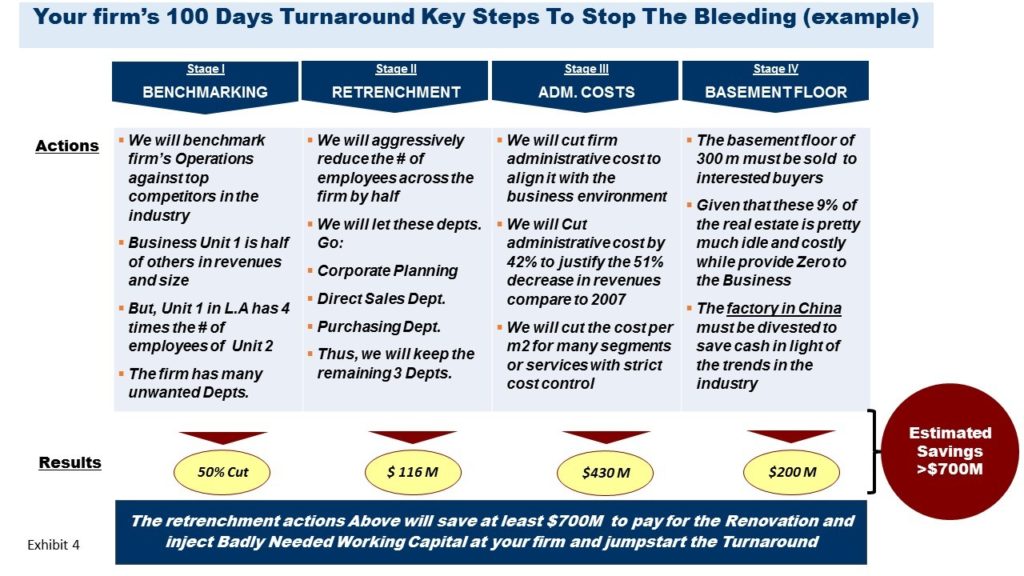
A firm using cost reduction and asset reduction (balance sheet) must be market-driven and engage in these processes with customers and the competition in mind. Focusing on just one side of the equation will result in a strategic blind spot. For example, in Exhibit 4 above, I started with a benchmarking process, followed by the retrenchment phase regarding the administrative costs and other idle assets on the firm’s balance sheet.
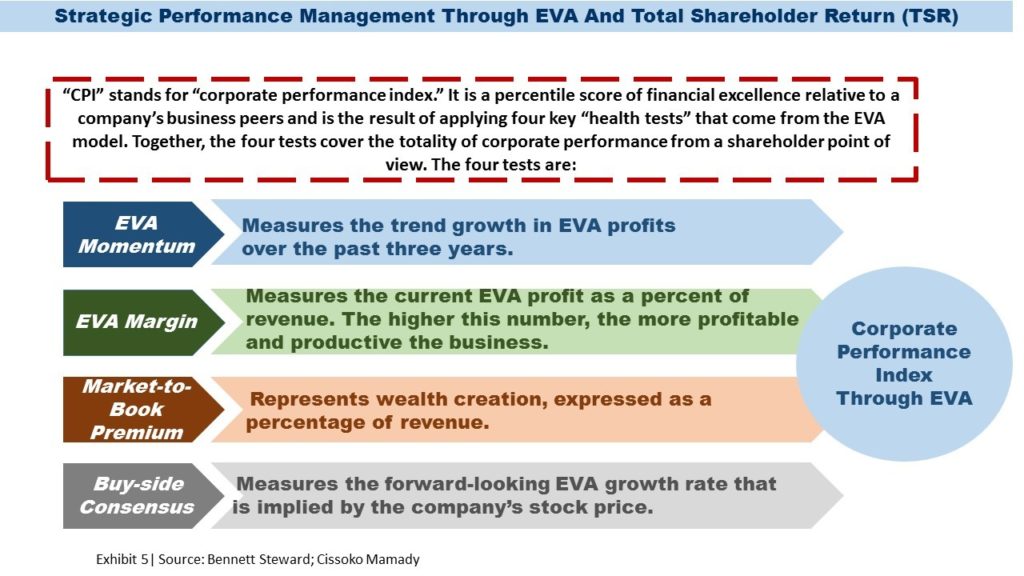
Finally, the firm needs to monitor and align its renewal with four KPIs: the EVA momentum, the EVA margin, the market-to-book premium, and the buy-side consensus (Exhibit 4). For example, the first KPI (EVA momentum) will provide a clear-eyed view of the company’s economic value-added (EVA) trends for the past three years, and the EVA margin measures the current EVA as a percentage of revenue. Thus, the higher this number, the more profitable and productive the firm.
Unlike transformation projects, which aim to achieve a high absolute and relative performance over the medium term, turnarounds seek to achieve sustained viability quickly. Again, the turnaround goal is not a short-term cost reduction but to address strategic and operational issues, including cultural ones. Thus, the goal is to achieve a sustainable recovery through a viable and defensive business strategy by developing a competitive advantage.
Again, as in the earlier turnaround stages, the challenge of the regeneration phase is not just changing the structure or processes but fundamentally altering the way managers think and act. Trust is an organizational characteristic built slowly, carefully, and with time and effort. Among the most common behaviors exhibited by managers in organizations that succeeded in developing this vital contextual element biased toward inclusion and involvement, a sense of fairness and equity, and a belief in the competence of colleagues.
Forget the Flawed Practices of the Past That led you Into Trouble.
This final stage (exhibit 2) of self-renewal is when organizations can free themselves from the embedded practices and conventional wisdom of their past and continually regenerate from within. Indeed, at this last stage of a turnaround, integrating entrepreneurial performance-driven behaviors is vital to an organization’s success through a cross-unit integrative learning model such as the Japanese firm Kao under Kao’s Maruta.
One of the world’s most sophisticated corporate information systems was central to this environment. Instead of designing it to support top management’s need for control, as most such systems were, Maruta had spent more than twenty years ensuring its primary purpose was to stimulate operating-level creativity and innovation.
For example, one internal network linked the company directly with thousands of retail stores, allowing marketing managers to monitor market activity and trends directly and give those retailers analyses of store-level data. Similarly, the system analyzed problems reported by consumers and consumer data and applied the findings to the firm’s new product development. As a result, the firm introduced a stellar product, Success Step Color, in October 2009.
From Turnaround to Transformation
In our experience, many retailers are plagued by legacy business models and IT infrastructure. They must seize this opportunity to transform their businesses digitally. They need to focus their transformation on three areas: business model, customer experience, and business process. Indeed, executives must understand that strategy, not technology, drives digital transformation.
Get in Touch
We will respond to your message as soon as possible.
Insights to Win
Subscribe to our newsletter for in-depth analysis, reports, and our perspectives on business and economic issues related to the Japanese market and the global economy.