
Japan’s Fastest-Growing Industries in the $11.3 Trillion Japanese Market– Japan Growth Report
The Japanese economy is vast and evolving rapidly in this age of global competition in artificial intelligence, both within and across industries. Indeed, the total sales of Japanese companies (excluding the finance and insurance industry) grew by 3.6% to reach $11.3 trillion – equivalent to 2.6 times Japan’s gross domestic product (GDP) of $ 4.3 trillion in the fiscal year 2024-25. DOWNLOAD THE 80-PAGE REPORT HERE
However, there is a significant gap in players’ growth rates across the manufacturing and non-manufacturing sectors. The question is: what do the industries’ growth rates look like? In other words, which industries are growing the fastest in the Japanese market? That is, the industries that grew faster than the average growth rate of 3.6%. This is where our Japan Special Growth Report “Flagship Edition #2″ comes in.
Executive Summary
Japan’s total market reached $11.3 trillion in sales (gross output) in FY2024-25, a figure strategically distinct from GDP ($4.3 trillion) and critical to avoid misreading market opportunity through misguided conflation. The national average sales growth rate reached 3.6% over the past two fiscal years, with a 5-year average of 2.9%, establishing the baseline for competitive benchmarking.
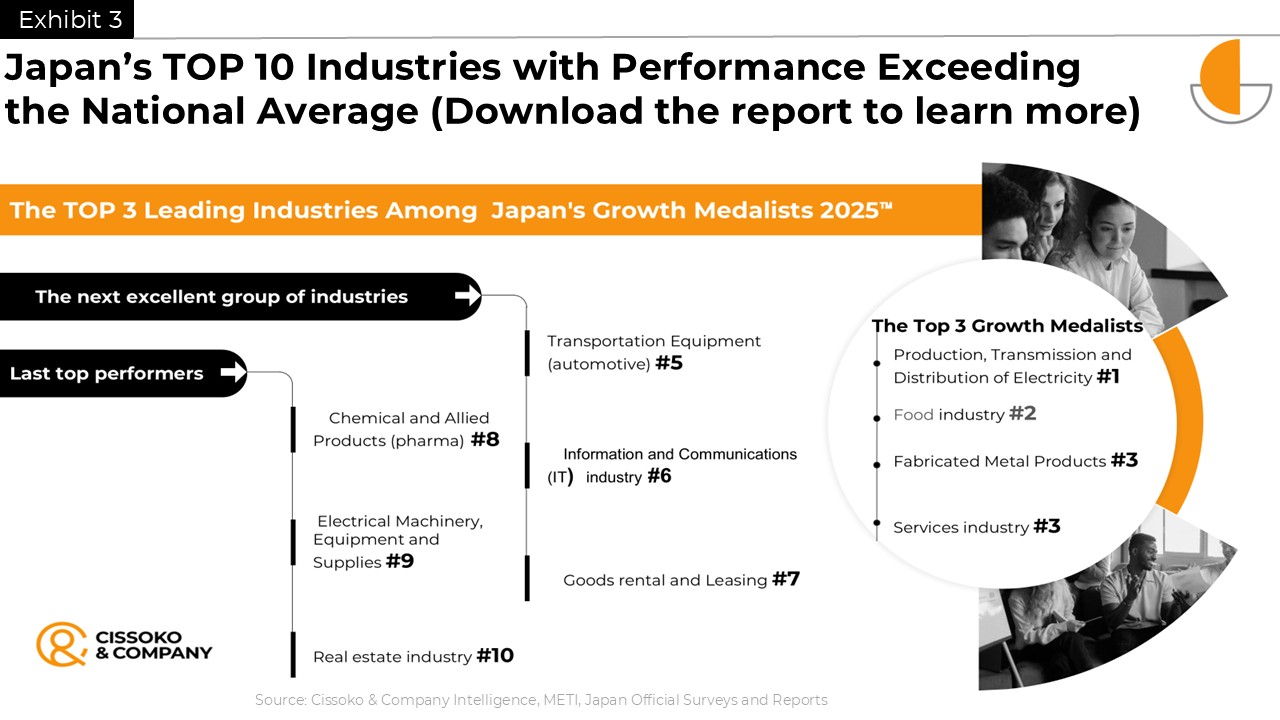
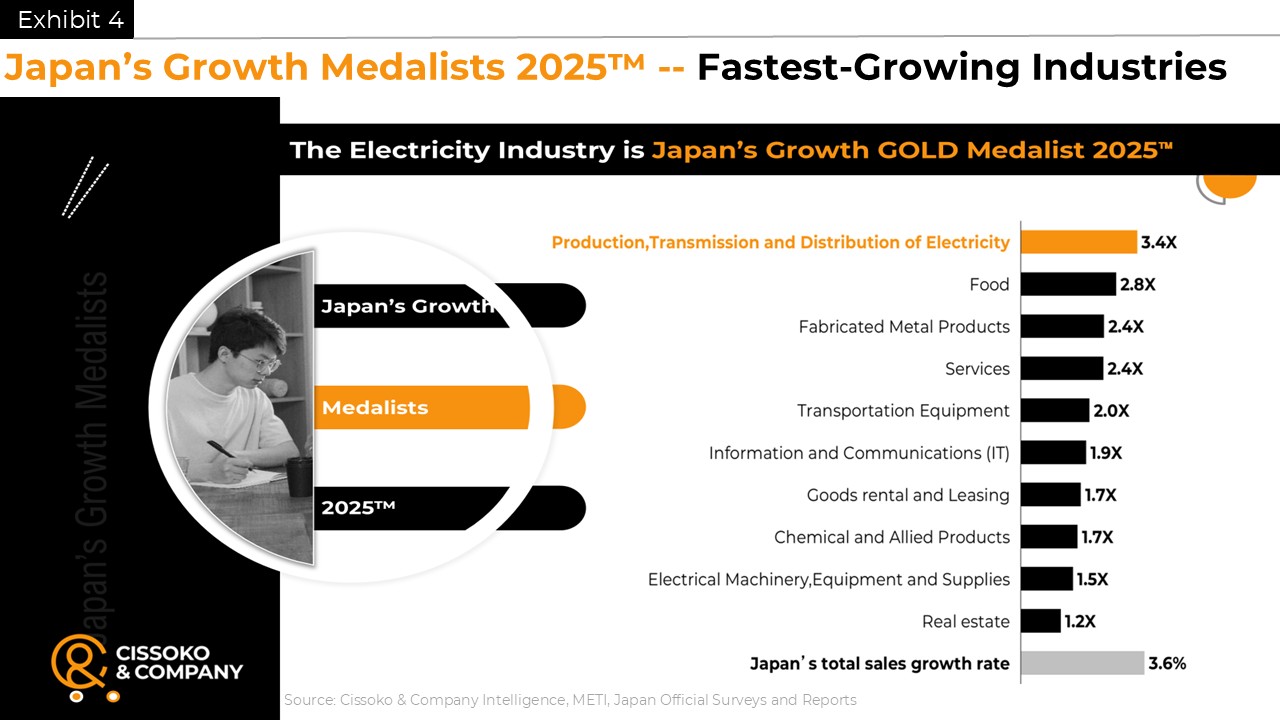
The manufacturing sector outperformed the non-manufacturing sector in FY2024-25, growing at 4.5% versus the non-manufacturing sector’s 3.3% — the latter declining 13% year-over-year. The Electricity industry claimed Japan’s Growth Gold Medal 2025™, expanding at 3.4 times the national average (3.6%) in FY2024-25 and sustaining double-digit average growth over five years.
The Food industry earned the Growth Silver Medal 2025™, surging 10% in FY2024-25 — far exceeding its 5-year average — and growing in line with the broader manufacturing sector. Fabricated Metal Products and the Services industry jointly secured the Growth Bronze Medal 2025™, each growing at approximately 2.4 times Japan’s national average.
Ten industries in total outperformed the national average, including Transportation Equipment (7.2%), Information & Communications (6.9%), Real Estate, Chemicals, and Electrical Machinery. The Transportation Equipment industry posted its third-best growth year (7.2%) in FY2024-25, consistently outpacing the manufacturing sector both annually and over the 5-year period.
The Electrical Machinery and Supplies industry recorded its fastest growth year at 5.5% in FY2024-25, a sharp acceleration from its modest 5-year average of just 0.9%. Underperformers include General-Purpose Machinery (-7.1% in FY2024-25), Transport & Postal Services (0% growth), and Petroleum & Coal (negative growth for two consecutive years). The IT Hardware industry nearly matched Japan’s average growth rate (3.4% vs. 3.6%) in FY2024-25, but fell well short of its own 5-year average of 6.1%, signaling a deceleration.
The Iron & Steel industry struggled in recent fiscal years but maintained a strong 5-year average of 6.4%, reflecting high volatility rather than structural decline. Japan’s total net assets stood at $30.4 trillion in FY2024-25, with total sales (gross output) of $11.3 trillion, of which manufacturing accounted for $3.06 trillion and non-manufacturing for $8.24 trillion.
Strategic prioritization should focus on the top-tier growth medalists — Electricity, Food, Fabricated Metals, and Services — as the winning growth opportunities in Japan’s evolving AI-era economy, at the time of this report’s publication.
Japan’s Growth Strategy Rule #1
Do not conflate Japan’s GDP (value added) with the Japanese market, which refers to total sales (gross output). While Japan’s GDP per capita is increasingly declining, given the outrageous exchange rates against the US dollar, sales per capita are a different story. In other words, Japan produces a lower value added as a percentage of the total sales occurring across the nation. But the two should never be confused.
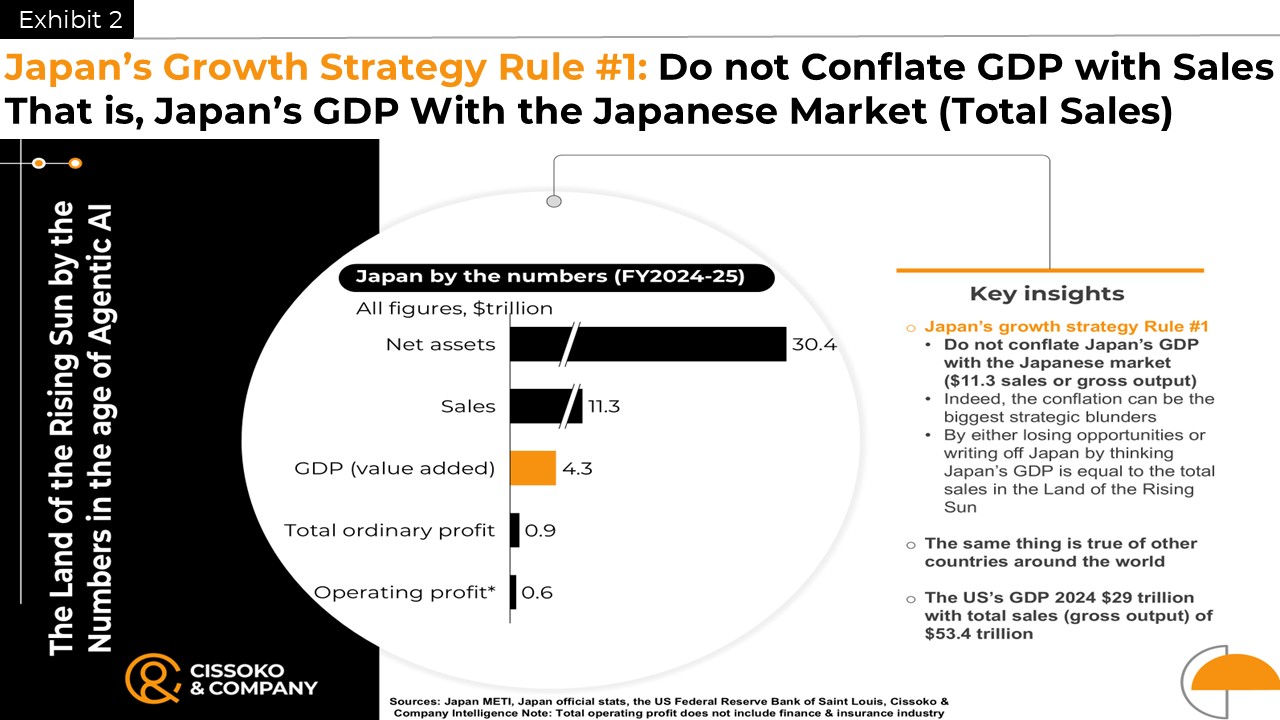
By contrast, the United States produces higher GDP ($29 billion) as a percentage of the sales ($53 billion). The opposite is also true: compared with Japan (in FY2024) – with a per capita GDP of $34,700 versus $91,500 in sales per capita – the United States sells less as a percentage of its per capita GDP ($ 84,500), given its sales per capita of $157,000. In other words, Japan’s sales per capita are 163% of its per capita GDP, whereas the US’s are 86% — that is, nearly 50% of Japan’s ratio.
Japan’s Growth Medalists™ 2025
In our annual rankings, to be considered a growth medalist, an industry’s growth rate must exceed the national average. Among the growth medalists, the top performers are categorized into three groups – gold, silver, and bronze – with the growth gold medalist being Japan’s fastest-growing industry for the given year.
Again, the question is: who’s who in Japan’s $11.3 trillion market in the age of agentic AI? In other words, how large was the gap between Japan’s Growth Medalists 2025™ and the industry average?
Growth Insights Beyond the Growth Medalists 2025™ and Their Growth Rates
Through a comparative analysis, the report investigates and compares growth across industries within their respective sectors over five years. For example, knowing the growth rate of the real estate industry in 2025 alone is important, but many other questions remain, such as the industry’s growth trends over the past five years and how it performed relative to the non-manufacturing sector as a whole.
Similarly, knowing the growth rate of the manufacturing or non-manufacturing sector is useful, but understanding the sector’s performance relative to Japan as a whole over five years is more insightful and provides a comprehensive picture of each industry and sector of the Japanese economy in this age of artificial intelligence. That’s what we did in this Japan Special Growth Report.
Get in Touch
We will respond to your message as soon as possible.
Insights to Win
Subscribe to our newsletter for in-depth analysis, reports, and our perspectives on business and economic issues related to the Japanese market and the global economy.