
The Number Game: Winning Japan’s Startup Competition in the age of GenAI — Report CEO Brief
In this era of artificial intelligence, Japan’s startup scene has been quietly evolving, with meaningful implications for success in startup competitions both domestically and internationally. We refer to this shift as “The Number Game: Winning Japan’s Startup Competition in the age of GenAI” because the trends depend on distinctive strategic numerical data that startup founders must utilize to develop effective strategies in Japan during this era of GenAI.
In the second part of this Founder Brief, we discuss Japan’s startup trends, including solopreneurs versus teampreneurs, male versus female entrepreneurs, and startup trends related to business legal entities.
The third installment is titled “Japan’s Entrepreneurship: The 10 Trends Shaping Japan’s Startup Competition.”

Indeed, technological expertise, talent, and innovation proficiency constitute essential elements of the narrative. Nevertheless, business performance—assessed through metrics such as sales, profits, innovation productivity, or total shareholder returns (TSR), including a company’s valuation—is ultimately quantifiable. In essence, the realm of business (including startup entrepreneurship) is fundamentally a Number Game. This perspective frequently separates winning players from their competitors.
We analyze important insights from decades of trends in various aspects of Japan’s startup lifecycle, going beyond just the business idea and model. For instance, how have startups’ initial expenses evolved over time, and what are the implications for the competitive landscape?
Trend 1: Cost of starting a business in Japan
Launching a business incurs costs. However, not all expenses are equal, and the initial expenses founders must cover to get started matter. Arguably, these costs are some of the most scrutinized by entrepreneurs when weighing their options. In this context, the founder’s choice of company structure can act as a barrier to entry when resources are limited or when the uncertainties and risks associated with the idea are considered.
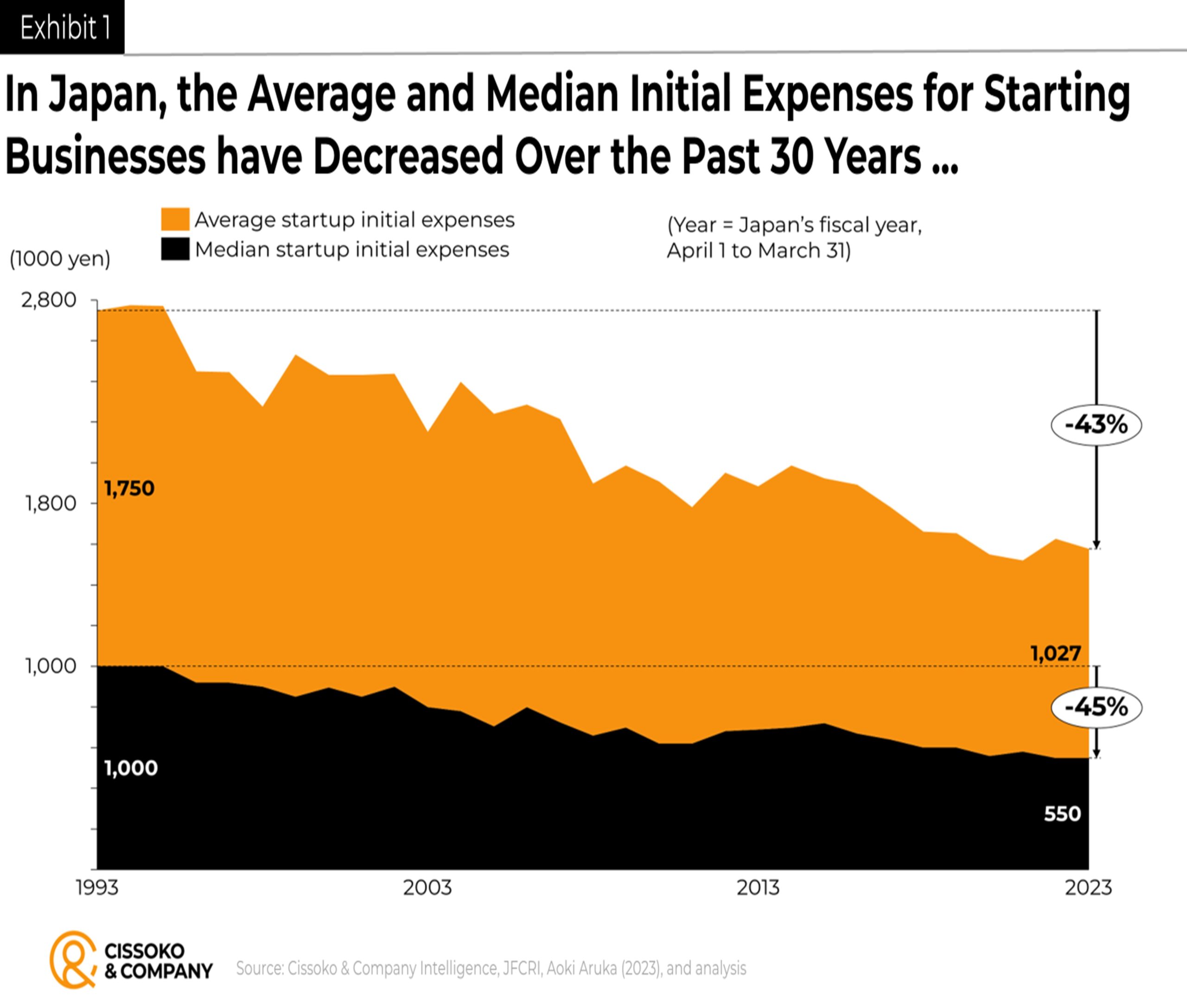
Furthermore, as the world becomes more digitally connected and most businesses see themselves, in some way or another, as digital firms, establishing a native digital startup with almost no physical presence has gained momentum. Unlike baby boomers decades ago, these trends partly explain why initial startup costs for many millennials and Gen Z founders (digital natives) are decreasing in the Land of the Rising Sun and beyond.
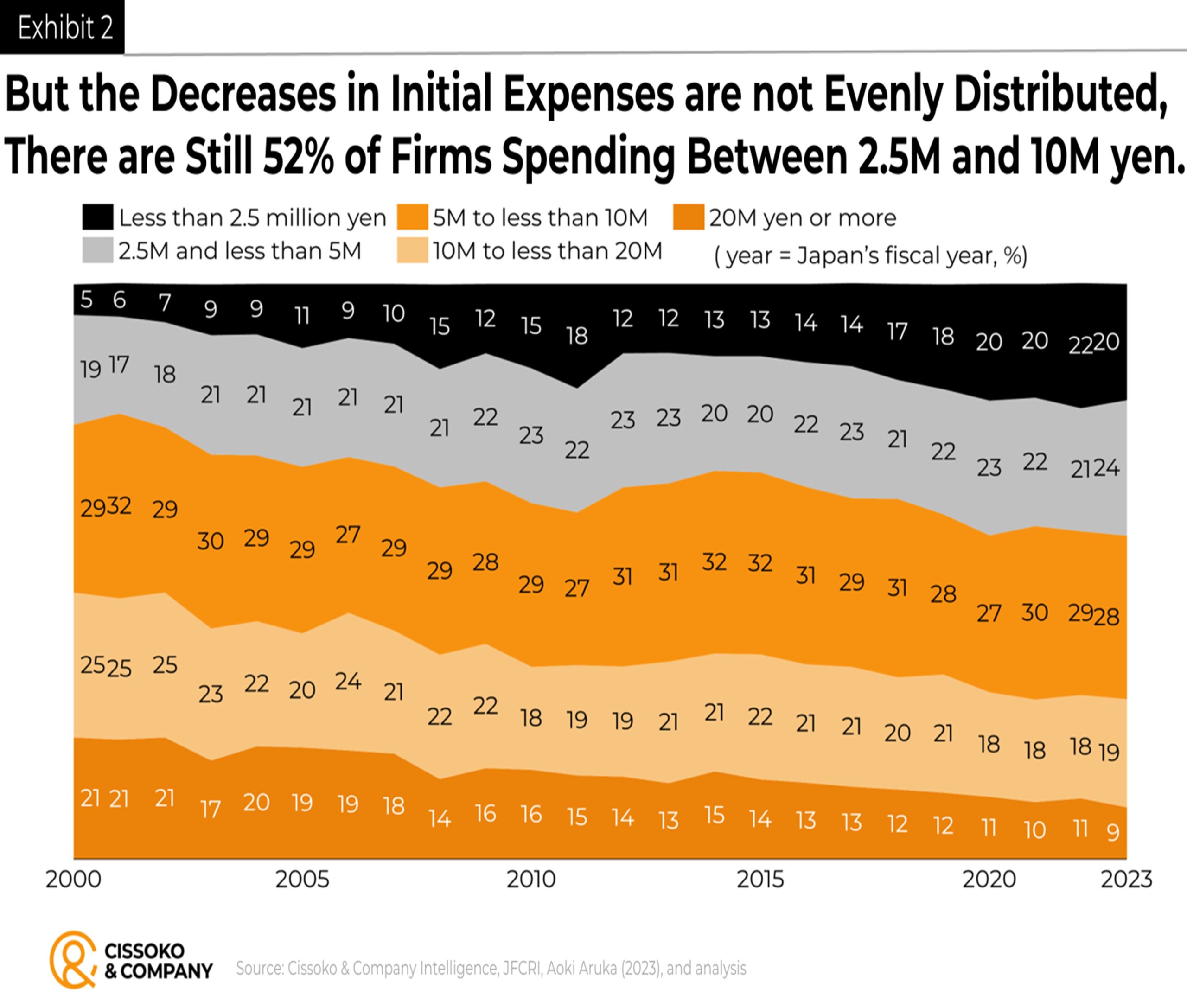
Although overall cost trends are decreasing, it is essential to recognize that 52% of firms within specific industries, characterized by distinctive cost structures and barriers to entry, continue to incur expenditures ranging from 2.5 million to 10 million yen. Nevertheless, the aggregate and median initial expenditure trends provide more substantive insights into the evolution of cost structures within and across Japanese industries over the past decade.
Trend 2: Age of Startup (Founding) Entrepreneurs
Japan’s average startup founder age hit a milestone on March 31, 2024, marking a notable achievement for entrepreneurship. In fact, a 2019 study from MIT Sloan (before the rise of GenAI) showed that the average age of founders in the top 0.1% of high-growth businesses (in the tech sector, backed by VC(s), and holding a patent) in the US is about 45. A 50-year-old founder is 1.8 times more likely to reach upper-tail growth than a 30-year-old. One reason is that older entrepreneurs often have more management experience, more profound industry knowledge, access to greater financial resources, and stronger social networks.
While the stereotype of the young, tech-savvy founder persists, it’s essential to recognize that young founders can still succeed, as youth often brings sharper cognitive skills, fewer family distractions, and a stronger affinity for technology. Bill Gates and Steve Jobs are prime examples.
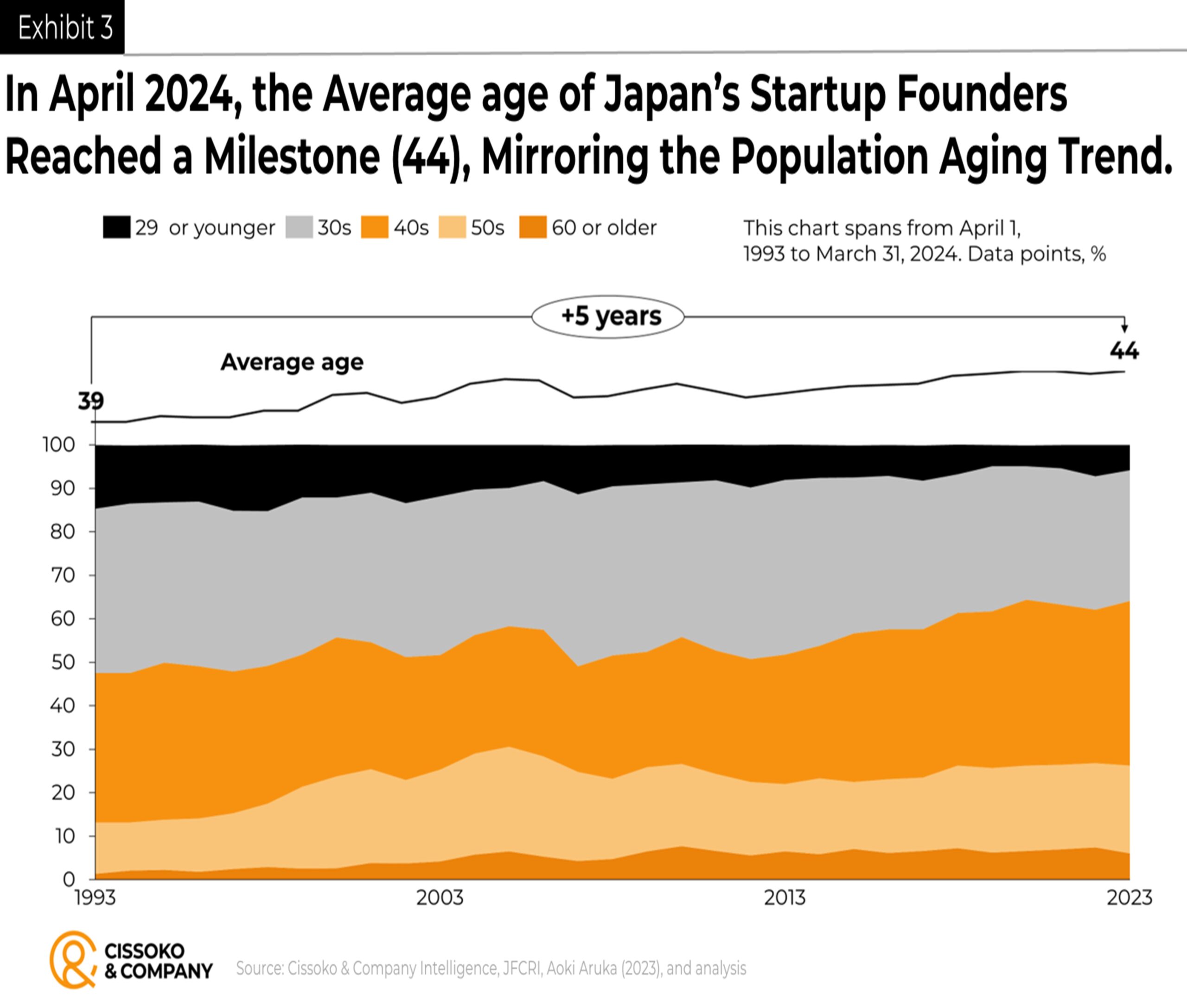
However, recent studies show that the chance of achieving high-growth success increases with age and experience. The good news is that in the real world, many things can be tested with ample data and evidence. All else being equal, with the average age of Japan’s startup founders reaching 45 and soon surpassing that, we should expect many high-growth companies to emerge from the Land of the Rising Sun if players get solid VC backing and have patents under their belts, as a recent MIT study based on US firms suggests.
Trend 3: Startup Founders’ Educational Background
The successful stories of college dropouts that circulate online are mostly those we refer to as statistical outliers. They seem to be exceptions to the usual rules. Mark Zuckerberg of Facebook, Michael Dell, and Richard Branson are common examples demonstrating these myths. For every successful college dropout, thousands of dropouts fail, but few share their stories of failure. This survivorship (survival) bias can mislead many aspiring entrepreneurs.
Our experience, supported by recent research, indicates that founders’ educational backgrounds are correlated with success in fundraising, resilience of startups, and ultimately, their long-term accomplishments. This is one of the reasons for the growing popularity of entrepreneurship education globally, as individuals recognize that a combination of skills, knowledge, and experience is essential for navigating the high-pressure, resource-scarce, and high-risk environment of modern entrepreneurship in our disrupted global economy.
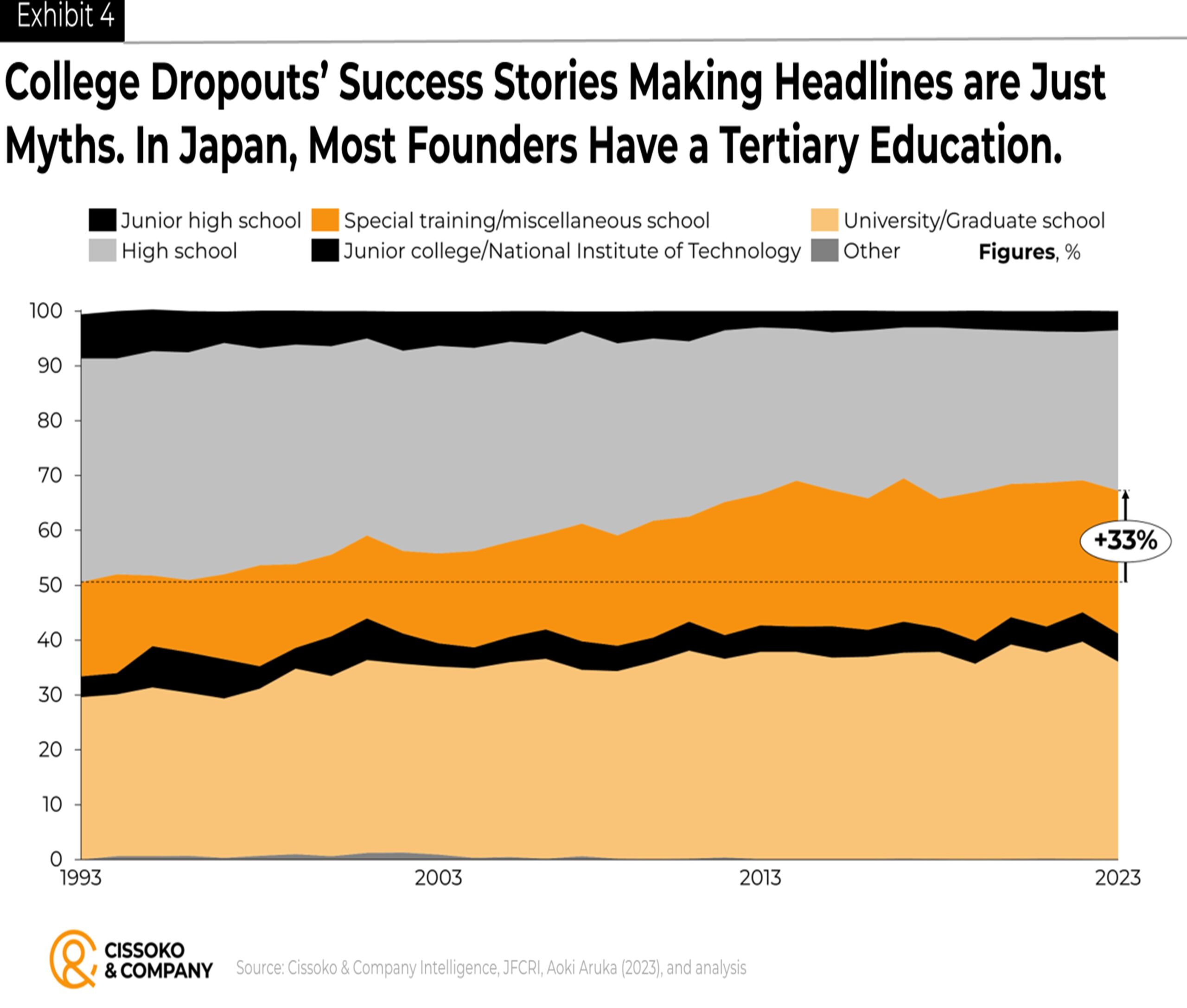
Moreover, the level of education is strongly associated with entrepreneurs’ credibility, social networks, and other superficial indicators of trust requisite for a successful startup, particularly given the technical and technological complexities introduced by the era of Generative AI. Furthermore, it has been found that startups with at least one founder from top schools such as the Ivey League have a significant impact on first-round funding.
In Japan, most startup founders hold tertiary credentials, ranging from technology and technical schools to colleges, including graduate school qualifications. In other words, the trends suggest that being highly educated is crucial in Japan to remain competitive in light of rapidly changing skill requirements that meet sky-high customer expectations and the technical imperatives of the moment, while exceeding expectations across most competitive industries of the future.
Trend 4: Founders’ Prior Work Experience
Having pertinent work experience is essential for a founder. However, work experience encompasses a broad spectrum, including internships, managerial and non-managerial roles, as well as full-time and part-time positions. Furthermore, the duration spent in a role significantly influences the applicability of that experience to new challenges. Often, when individuals learn that someone they know is planning to initiate a new enterprise, their primary concern—apart from financial resources—is: What does he know about that industry? Does he possess the requisite experience and skills to succeed? Moreover, the third question typically is: Does he have an experienced team on board?
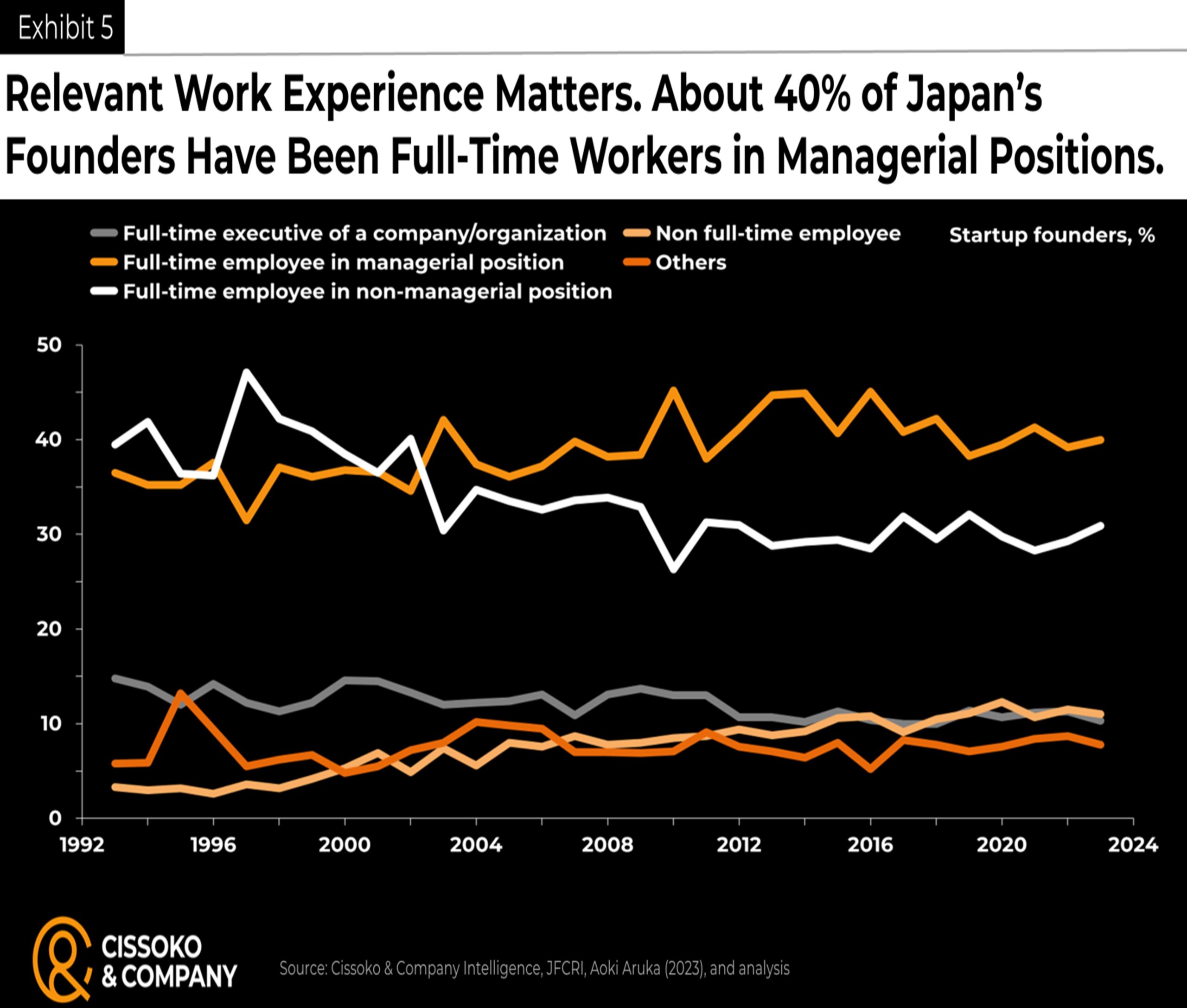
Indeed, in recent years, leading venture capital firms have prioritized a combination of passion, entrepreneurial spirit, and professional experience as prerequisites before investing in any startup. For one thing, familiarity with customer pain points, market and technological challenges, and a comprehensive understanding of the evolving competitive landscape are crucial for addressing real-world needs. In this context, beyond entrepreneurial experience, how has the professional background of Japan’s founders evolved over the past decade?
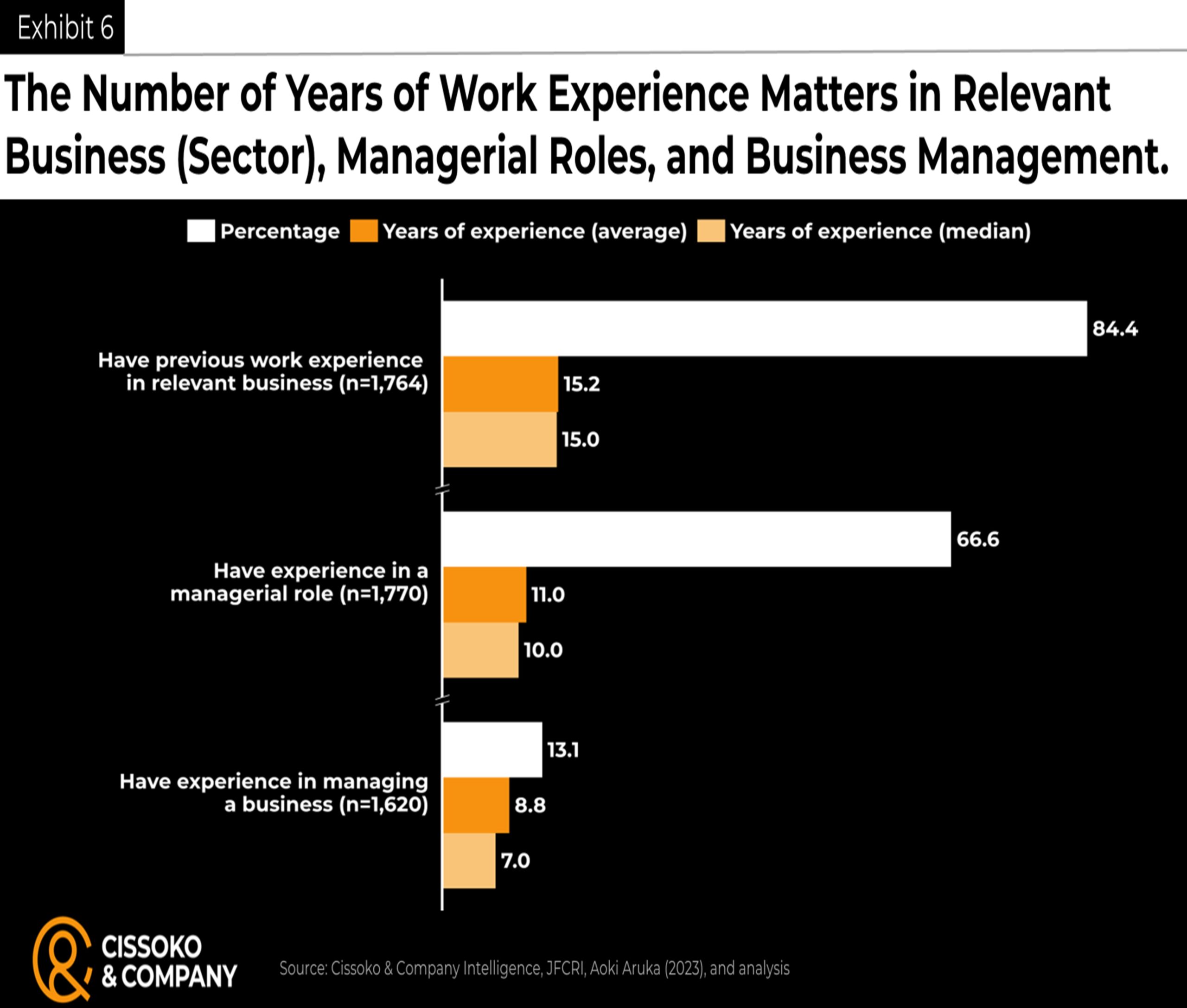
In startup entrepreneurship, it’s easy to claim work experience in a relevant business, but is all work experience equal? No. Similarly, claiming to have managerial experience doesn’t mean all managerial experience is the same in a competitive environment. Moreover, it’s simple to say you have experience managing a business, but is that experience deep enough to provide a competitive edge in the risky and demanding world of startup competition? To succeed, positive answers to these questions matter in the Land of the Rising Sun and beyond.
It’s time to rethink startup entrepreneurship in the age of artificial intelligence. The traditional approach of viewing startups solely through the narrow lens of value propositions, technical knowledge, and innovation is no longer sufficient. We need to change our perspective on business, including how we approach launching a startup, by considering it as a numbers game.
Get in Touch
We will respond to your message as soon as possible.
Insights to Win
Subscribe to our newsletter for in-depth analysis, reports, and our perspectives on business and economic issues related to the Japanese market and the global economy.