
Assessing the Impact of AI Potential Jobs Disruption in the Global Economy — Report CEO Brief
DOWNLOAD THE 14-PAGE CEO BRIEF HERE
 There is no doubt that artificial intelligence, including generative AI and the emerging agentic AI, will have significant implications for business within the global economy. While the potential productivity gains and the risks posed by this technology are heavily promoted and hotly debated, this article focuses on its disruptive impact on employment worldwide, specifically examining the number of jobs and their vulnerability to potential threats.
To understand the occupational exposure to the threat of artificial intelligence, it is necessary to analyze the share of major occupations within the global economy. This includes examining the automation exposure of key tasks within those occupations by breaking them down and closely observing workflows and processes, especially in terms of repetition and the degree to which technology is or will potentially be involved.
Unlike previous technological revolutions, which primarily impacted blue-collar workers, disruptions from artificial intelligence are more concentrated on knowledge-based tasks such as research, analysis, data collection and summarization, coding, translation, image creation, and other professional and white-collar activities. From this perspective, we can assume that, at least for now, workers in agriculture, fishing, and forestry are less exposed to AI threats than those in fields like accounting, programming, photography, and teaching at primary schools.
Similarly, the more developed a country is, the more involved it is in cutting-edge innovation and high-paying jobs that require advanced skills, often necessitating some form of tertiary education. These types of jobs are more vulnerable to productivity enhancements and the associated risks posed by artificial intelligence.
In this context, we argue that advanced economies, dominated by knowledge workers, are most vulnerable to the potential threats that AI poses to their workforces. However, they also stand to benefit the most from productivity gains. In other words, artificial intelligence is a double-edged sword. The key is to harness its economic benefits while mitigating its disruptive impact on the livelihoods of people worldwide. This includes addressing the widening gap of existing inequality, combating biases, and reducing economic opportunities based on ethnicity, race, and gender, especially as dangerous actors might exploit AI for cyberattacks, fraud, and warfare.
Furthermore, due to the gender gap across occupations, industries, and organizational levels, it is reasonable to expect that men and women will be affected differently within and across sectors and countries in the global economy. Broader implications for women will depend on where they work, whether in advanced or developing countries, and across different global regions.
Potential Occupational Exposure to Artificial Intelligence Disruption Worldwide
Given the multifaceted nature of impact and exposure, we have classified the exposure into three categories: highly exposed (highest exposure), significantly exposed (significant exposure), and low-to-medium exposure to disruptions caused by artificial intelligence. For instance, the total number of jobs worldwide that are currently highly exposed to these risks is approximately 117 million.

Furthermore, considering the variation in exposure between females and males across different occupations and regions, it has been observed that, among the 117 million exposed jobs, an average of 11.5% of male employment (including required tasks) and 17% of female jobs are highly exposed globally.
Potential Occupational Exposure to Artificial Intelligence Disruption Across High-Income Countries
In high-income countries, which are comparatively more susceptible to the threat than low-income countries, there are approximately 42 million jobs, constituting 18% of the total employment, that are considered highly at risk. Specifically, 12.5% of men’s employment and 23.5% of all women’s employment are at risk of being threatened by automation through artificial intelligence.

In upper-middle-income countries, the level of exposure is comparatively lower than in high-income nations; nevertheless, it remains substantial, with over 48 million jobs (14.5% of total employment) identified as highly exposed. Notably, women are the most vulnerable across gender groups in these contexts. Within these countries, 12% of men’s employment and 16.7% of women’s employment are susceptible to disruption.
Potential Job Exposure to Artificial Intelligence Automation Across Asia and the Pacific
Furthermore, relative to other prominent regions worldwide, Asia and the Pacific exhibit notable potential for occupational exposure to disruptions driven by artificial intelligence and automation, with approximately 64 million jobs at risk across diverse occupations and genders.

Once more, like global trends, the categories of employment in which women participate, compared to men, appear to encounter the highest levels of exposure.
Assessing the Potential Exposure to Artificial Intelligence in Europe and Central Asia
Relatively speaking, Europe and Central Asia account for nearly 14% of the total global employment considered highly vulnerable to the threat of artificial intelligence, which includes approximately 24.5 million jobs in these regions.
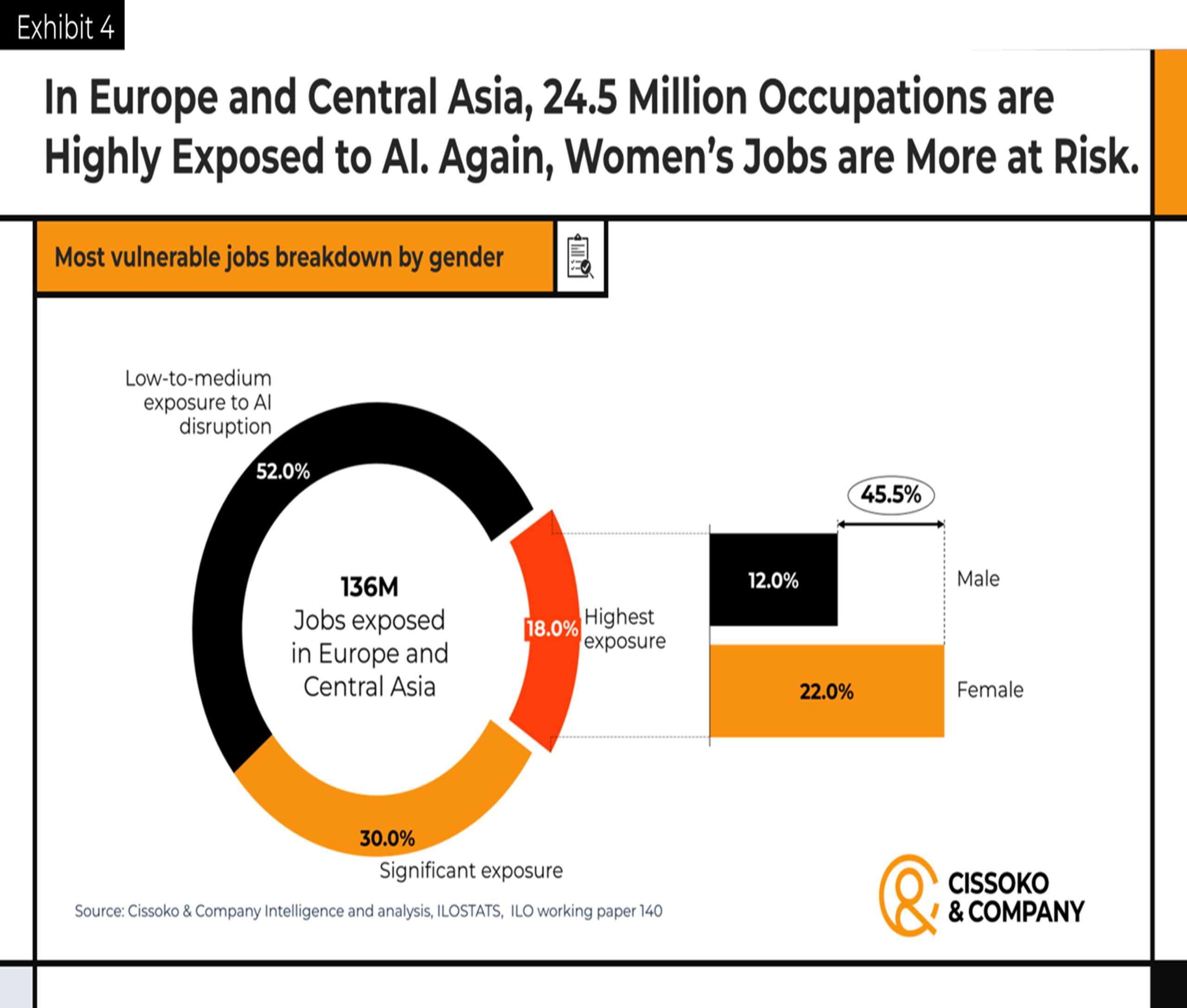
Jobs that traditionally tend to attract a higher proportion of women are 45% more exposed than those usually dominated by men, posing significant implications for social inequality. This demographic disparity will further complicate efforts to close the gender pay gap, which policymakers have tried to address over the past decade.
The Case of Lower-Middle-Income Countries: How Potentially Exposed are They?
Similarly, in lower-middle-income countries, the proportion of jobs that are highly exposed appears lower in percentage but is significant in absolute numbers. In other words, nearly 23 million jobs are highly vulnerable to the threat of generative AI.
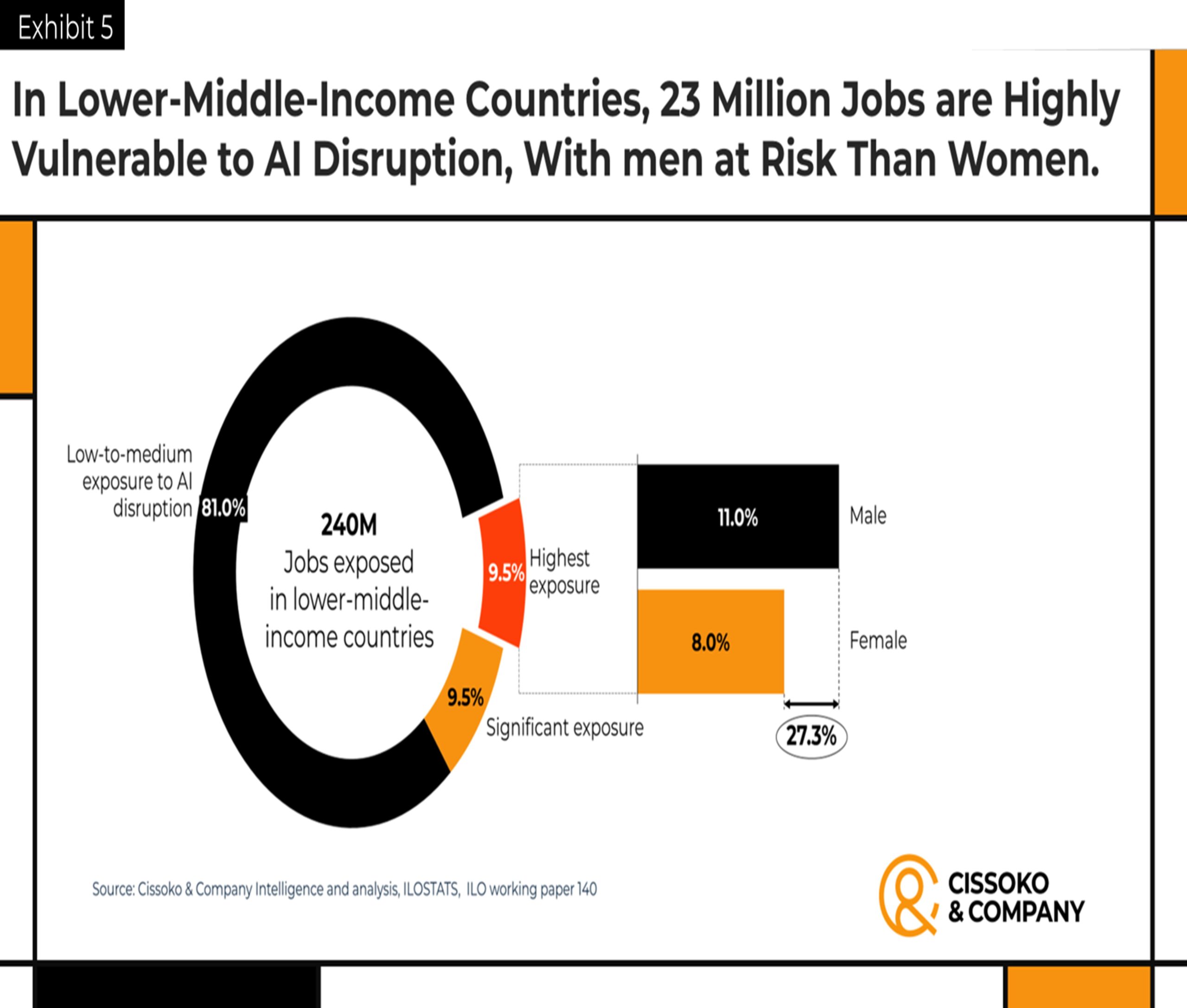
However, a major difference between these countries and high- and upper-middle-income countries is that males are more exposed to these risks than females. That is, 11% of males’ employment compared to 8% of females’ jobs.
Potential Occupational Threat Across Low-Income Countries
Finally, in low-income countries, where most employment is in the informal sector, exposure to agentic AI, generative AI, and other forms of artificial intelligence remains comparatively limited, affecting approximately two million jobs, in contrast to more developed regions. In essence, less than 1% of the total workforce can be classified as highly exposed. Similar to patterns observed in lower-income nations, males tend to face a greater risk than females within their respective occupational roles. Please download the CEO Brief above to discover more about other countries and regions around the world.
Get in Touch
We will respond to your message as soon as possible.
Insights to Win
Subscribe to our newsletter for in-depth analysis, reports, and our perspectives on business and economic issues related to the Japanese market and the global economy.