
Ukraine-Russia war: Winning in age of Inflation Within the Global Economy
The pillars of many strategies and business models are crumbling faster than anticipated. Given that the Russian invasion of Ukraine has laid bare fatal flaws of corporate strategies — by upending the assumptions that have underpinned the global economy for decades. The fast-evolving disruptions may morph into a financial demon that risks slipping out of control by pushing many companies into deep financial losses, while the beleaguered ones will be teetering on the brink of collapse at worst. To be sure, the invasion planning has been in the works for many months. US intelligence warned about the imminent invasion for weeks. Still, many CEOs ignored it at their peril by refusing to untangle pressing questions and the necessary bold actions before it was too late.
With over 3 million displaced across borders and thousands killed without mentioning the humanitarian crisis-running corporations like they used to be just a few weeks ago (like in 2021), it seems a dangerous gamble grounded in wishful thinking. For this reason, over 400 Western corporate giants, including McDonald’s, Sony, Google, Apple, and JP Morgan, have suspended their operations in Russia.
Against this backdrop, we will discuss many winning strategies for CEOs and business leaders like Apple and Samsung for responding—to the Ukraine war, rising inflation, and the persistence of COVID-19 while building corporate resilience against emerging threats across the global economy regarding geopolitical risks. For one thing, many CEOs and business leaders are caught flat-footed, unprepared to compete in this emerging economic environment. Since the old strategic management playbooks don’t apply, business leaders can consider this strategy to beat the competition post-COVID.
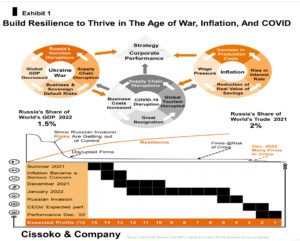
Unlike other periods of uncertainty since the Ukraine war began, risks within the global economy are getting out of control, given the rise of cyberattacks, supply chain woes, financial default risks, and commodity price volatility-induced inflation expectations. On top of that, COVID-19 disruptions sporadically persist across many regions worldwide, compounding the trouble caused by the Russian invasion, such as the creeping sanctions from the Western economic powers.
According to our regular CEOs’ performance expectations regarding profit margins (EBIT), since the fall of 2021, when inflation became a concern across corporate boardrooms, a downward trend accelerated after the Russian invasion of Ukraine on February 24, 2022. The average expected profit margin fell from 15% to 5%, a spectacular 66% downward revision in just a few months, given the worldwide volatility, uncertainty, complexity, and ambiguity (VUCA).
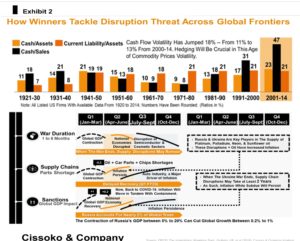
Scenario planning is crucial for building resilience in times of uncertainty, like the Ukraine crisis. Thus, to build resilience for the sake of thriving rather than surviving within the fast-evolving economic landscape, CEOs and business leaders need to reconsider their previous assumptions regarding globalization, the global value chain, the possibility of World War III, military confrontation, the Ukrainian conflict duration, the probability of a global recession, among others.
While Russia accounts for just 1.5% of the global GDP and 2% of the global trade, Russia and Ukraine are among the leading players in nickel, palladium, sunflower oil, and neon, crucial inputs for the semiconductors and cosmetics sectors. Given that oil prices swing and the disruption of car availability (used and old) are key drivers of current inflation trends, the duration of the war will dramatically exacerbate the shortage of these key materials and, in turn, will impact the inflation rate around the world.
Saving Millions Through Better Supply Chain Strategies
The major problem during inflation is that input (inventory) costs rise faster than product prices, given that inflation reduces the real purchasing power of consumers’ wallets. Worse still, it takes a very long time for consumers to adjust and perhaps get an inflation-adjusted pay raise for the luckier employees.
On top of that, inflation expectations negatively impact companies’ economic decisions. For one, inflation expectations lead to an increase in credit demand, a reduction of employment, an arbitrary rise in product prices, and a reduction of capital, which sometimes have nothing to do with either economic reality or common sense. In other words, inflation expectations lead to a chaotic business environment within and across industries. Furthermore, in many cases, it is unrealistic to think of passing along the extra input (inventory) cost to consumers without disrupting customer experience by unintentionally sending them to the competition. Our experience suggests that predicting input supply is a little bit easier than product demand during disruptive inflation.
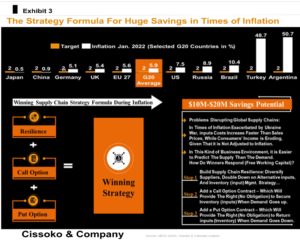
In this kind of economic environment driven by uncertainty and volatility, the winning companies use an inventory management strategy that provides an edge over the competition, given the huge savings potential (Exhibit 3). By deploying the hedging tools in supply chain risk management through call-and-put option contracts, they weather the disruptions storms better than the competition while building better-working capital across industries, such as fast fashion, drug stores, and electronics, to name a few.
Build Resilience Through Better Risk Management
Our decade of experience suggests that by stress-testing assumptions and business operations, preparation can provide insights into many flaws of a business model (including the operating model) before it’s too late. In times of uncertainty and major disruptions, stress increases, and executives consider many views on a particular topic, creating a fertile ground for polythink (the opposite of groupthink)—a dangerous strategic decision-making trap.
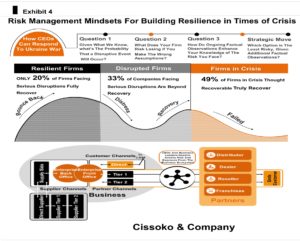
In other words, polythink refers to the situation in which diverse opinions become so polarized that no agenda can move forward while urgency requiring a quick decision is postponed. In this instance, the plurality of opinion is a great liability.
Companies need to double down on a sever-pronged strategy to respond to the threat of Ukraine war-induced disruptions. The first order of business calls for building resilience at all costs – this is non-negotiable, given that:
• Only 20% of companies facing severe disruptions fully recover.
• 33% of firms facing severe disruptions are beyond recovery.
• 49% of businesses in crisis that were thought to be recoverable truly recovered from the crisis.
Against this backdrop, building resilience is imperative because it is the new competitive advantage in this age of economic disruptions.
How can CEOs Respond to the Ukrainian Crisis?
Given the fluidity of the fast-evolving business ecosystem, the four other steps below can help organizations build strategic ambidexterity.
Strategic sensitivity (sensemaking): The high alertness regarding changes in the external environment and translating the signals into insights regarding the appropriate and timely response.
Resource adaptability: Rapid reconfiguration of internal and external resources to exploit and explore opportunities in times of disruptions.
The C-suite unity: No good strategic decision can be made when the top management (including the board) is in disarray. Thus, inclusiveness enables organizational dynamism and responsiveness during uncertainty.
The Value of Competing With Purpose in Times of Crisis
Beyond building organizational resilience, assisting Ukrainian refugees in this age of stakeholder capitalism means good business. Indeed, employees and consumers increasingly want to work for or buy products from companies associated with a good cause. Thus, in this age of stakeholder capitalism, our research demonstrated that those purpose-driven organizations are winning the business game. Highly. Moreover, highly purposeful firms gain 74% in mean operating profit versus low-purpose organizations. Regarding total shareholder return (TSR) before the COVID-19 crisis, highly purpose-driven organizations had 19.1% versus 5.8% for the other group.
When the Coronavirus crisis occurred, the gap between the two groups widened. Highly purpose-driven companies made 34.7% in total shareholder return (TSR) versus 13.3% for low-purpose businesses.
In short, the Russian invasion of Ukraine has dramatically disrupted the old economic and rule-based international orders familiar to most business leaders. Thus, to thrive, CEOs and business leaders need to readjust their mindsets regarding what is possible and plausible and their implications for their organizations in the coming decades.
Get in Touch
We will respond to your message as soon as possible.
Insights to Win
Subscribe to our newsletter for in-depth analysis, reports, and our perspectives on business and economic issues related to the Japanese market and the global economy.