
Lessons From Apple Japan: How to win in the Land of the Rising Sun? REPORT
 DOWNLOAD THE 28-PAGE REPORT HERE
Japan, the world’s third-largest economy with a gross domestic product (GDP) of nearly $4.4 trillion, is one of the most challenging markets for foreign companies. In 2016, Japan had over 3,200 foreign affiliates, with European firms leading the pack, accounting for 44.3%, American 23.9%, Asian at 25.7%, Chinese at 9.8%, and others at 6.1%. The foreign affiliates are more involved in the non-manufacturing sector at 82.5% compared to manufacturing at 17.5%.
However, challenges are associated with Japanese business culture, sophisticated consumers, regulatory barriers, safety and health standards ( for Indonesian manufacturers), and competition. As a result, many foreign organizations or affiliates have failed in the Land of Rising Sun. The list of failures is too long, from Vodafone to Wendy’s to eBay, among other prominent failures or exits from the Japanese market.
Indeed, CEOs and other business leaders, Japanese and foreigners, are seeking the answer to the key question: what does it take to win in Japan through a market entry strategy? To answer this question, first, we tracked Apple Japan’s market entry and how it succeeded against all odds. Second, we did the same for competitive subscription on-demand video streaming wars in Japan between Amazon Prime, Netflix, Hulu (the first entrant), and Disney+. We compared the performance against what we know as ” Japan’s market entry-tested playbook” for winning market share in Japan. Finally, we draw our conclusion.
First Case Study: Apple Japan’s Market Entry
In the case of Apple (see below), it struggled to win market share in Japan in the ’80s, given the poor performance of its product import strategy. It worked with (Toray) a textile manufacturer with a weak background and a lack experience in managing foreign technology businesses in Japan. After the launch of Apple Japan Inc. in 1983, Apple worked with Canon for quite some time, but the partnership results were not satisfactory.
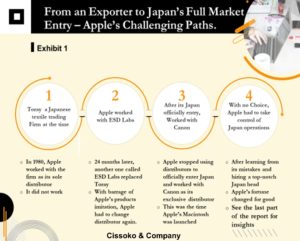
The Complexity of Japan’s Distribution Channels: Formidable Barriers to Entry
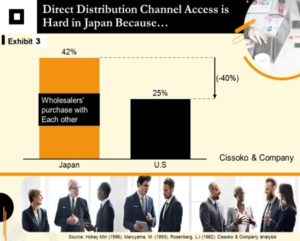
Japan’s distribution channels are notorious for their complexities. Thus, it presents a formidable barrier to entry for foreign firms wanting to expand their operations in the Land of the Rising Sun. Apple Japan had to learn how to navigate this minefield. For example, on average, goods pass through two layers in the United States, but this number suddenly doubled in Japan.
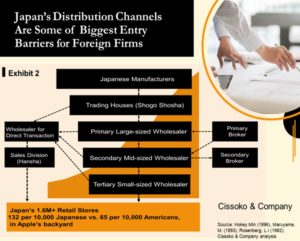
On top of this, unlike in the United States, in Japan, the wholesalers are very powerful, given that the wholesale sales volume is three times the retail sales volume. Moreover, in Apple’s backyard at the time, there were 65 retail stores per 10,000 Americans, while in Japan, that ratio almost doubled to 132 retail stores per 10,000 Japanese people. As such, distribution channel complexities and the power of wholesalers can increase the costs of foreign goods by a whopping 54%+. As a result, Apple Japan had just 1% of the market share five years after its market entry.
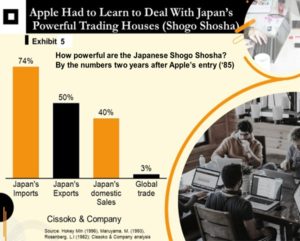
Apple could not figure out how to work with one of Japan’s nine influential trading houses, Sogo Shosha. Indeed, they were very powerful at the time. Consider this: in 1984, they handled three-quarters of Japan’s imports, 50% of its exports, and 40% of Japan’s domestic sales. In other words, they handled 3% of the entire world’s trade.

On top of this (gradually changing), the legal barriers to opening large stores resulted in many small and medium-sized retail stores of less than 3250 feet square, which accounted for more than 55% of the retail sales in Japan compared to less than 4% in America. In other words, in 1989, Japan had more than 1.6 million retail stores—a ratio of more than 130 retail stores per 10,000 Japanese people compared to nearly 65 per 10,000 American people.
Luckily, in 1989, Apple Japan hired Takeuchi, 44, a 20-year Toshiba veteran, to run its operations in the country. For one thing, foreign managers failed to deal with the damaging brand and poor service. To deal with lackluster performance and build resilience, Apple Japan changed its head several times within a short time.
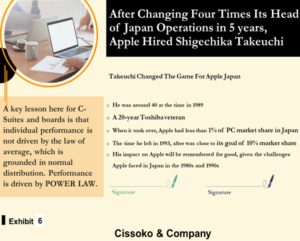
Thanks to the revamp proposed by Takeuchi in 1989, Apple adapted its games by localizing and customizing many of its products, including its Japanese operating systems, to win back business while improving customer experience. As a result of this strategic renewal and value creation through technical support to local Japanese developers, growth began to take off in earnest.
Takeuchi dealt with Apple’s distribution channel headaches while adapting Apple computer technologies to Japanese consumers’ habits. Indeed, unlike in other advanced countries, Japan’s distribution channels are notoriously impenetrable by foreign companies. For one thing, the vertical keiretsu distribution systems have dominated Japan for decades. As a result, they can increase the product price of foreign goods by more than 55% and over 170% to the landed cost of imported products, owing to the complexity of Byzantine.
On average, a product in Japan moves through five distribution layers compared to just two in the U.S. and fewer in other major economies. Moreover, they have a staunch loyalty to their members through strategic alliances while disregarding other outsiders – Japanese or foreign businesses. That’s why multinational foreign companies such as Coca-Cola built their distribution channels in Japan.
Among the pillars of adaptation used by Takeuchi was improving the business development function, including marketing. The efforts pay off. A few years later—in the early 90s, Apple Japan’s market share dramatically increased because PC shipments grew by 46% while its revenues rose by more than 30% to nearly 65 billion Yen.
Second Case Study: Hulu’s Japan Market Entry
Given the uncertain economic environment in this age of COVID-19, where digital transformation is all the rage while many business activities are moving online – what can foreign companies do to win in Japan? Above all, is a strategy based on Japan’s first-mover advantage realistic or an illusion?
Many organizations are joining the bandwagon with the boom in subscription video-on-demand (SVOD) (see above) and video game live streaming. Netflix, Amazon Prime, Hulu, and Disney are classic cases. Given the cutthroat competition in the U.S. market, most are expanding their global footprint.

Hulu was the first American SVOD platform to make inroads into the Japanese market in 2011—nearly four years before Netflix and Amazon. Conventional management wisdom will tell you that Hulu has the first-mover advantage. However, if gaining more market share in Japan than the competitors is the first-mover advantage, Hulu failed to capitalize on it because it was trailing its late competitors to the party.
As of this writing, Netflix was leading Japan’s subscription video-on-demand market with nearly 20% market share, followed by Amazon Prime Video. Hulu, who entered the Japanese market first, grabbed less than 9% of Japan’s video streaming pie in 2020.
In addition to Japan’s industry profit pool trends, which we have discussed over the years, other aspects of Japan’s market entry strategy need to be part of the executives’ strategic calculus. These considerations can improve the odds of product success when making a big strategic bet. At the same time, CEOs can avoid the pitfalls of Japanese market entry, such as the first-mover advantage illusion.
In short, the Japanese market is one of the most difficult for foreign companies to win a fair market share. Our experience suggests that businesses and their CEOs wanting to enhance their odds of success need to learn from the cases of Apple and Hulu. The key lesson is
do not craft a market entry strategy solely based on first-mover advantage because it may be an illusion in your specific circumstance. Other competitive dimensions need to be reviewed. Globally, the market entry challenges regarding distribution channels have been well documented. However, Japanese distribution channels are unique, considering the number of layers is two times higher than that found in major economies such as the United States. Thus, companies need to be aware of Japan’s market-entry minefield before it’s too late.
Moreover, organizations wanting to win big in Japan need to adapt their business models regarding language, business model, hardware and software, etc., to succeed in Japan. Further, relative advantage through a commitment to the market is crucial. For one, they made a big difference in corporate performance across dozens of foreign companies and their affiliates in Japan. Similarly, regarding the product lifecycle, timing is critical, given that each timing has strategic and financial consequences. Finally, be committed, as Apple’s case suggests. It went through different challenges between 1980 and 1989. Apple eventually changed its prospect in the Land of the Rising Sun through this commitment.
Get in Touch
We will respond to your message as soon as possible.
Insights to Win
Subscribe to our newsletter for in-depth analysis, reports, and our perspectives on business and economic issues related to the Japanese market and the global economy.