
Platform Dominance and Governance: Who are the Gatekeepers of the Global Economy?
The world’s economy has dramatically changed over the past decades. The firms that used to be the linchpin for economic growth have been replaced through digital transformation by a new breed of companies, such as digital platforms. The COVID-19 disruption has just accelerated and showcased the value of gatekeeping important economic activities: online shopping, mobile app distribution, video streaming, social media interactions, job search, and cashless payment processors.
The old stories of Google controlling over 80% of online searches outside China and Google and Facebook capturing all but 12% of online ad spending are familiar. Because digital platforms are not well understood, given their recency in the public discourse. Below the public radar, digital platforms have managed to become the gatekeepers of the global economy through their dominance and market power around the globe.
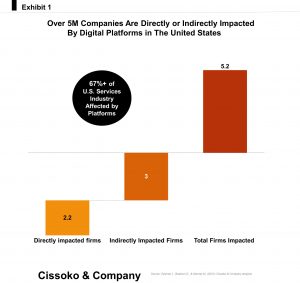
Consider this: in October 2019, Alibaba, Tencent (Chinese platforms), Google, Facebook, Apple, and Amazon (American platforms) constituted seven of the top 10 most valuable companies globally. Further, digital platforms grow faster than legacy businesses. For example, Google Drive was founded in 2012; just six years later (2018), it had reached one billion users. Again, in December 2020, Google, Apple, Amazon, Facebook, and Microsoft accounted for over 21% of the S&P 500 market cap. Indeed, platforms are becoming so dominant that recent research found that they directly impact over 2.2 million and indirectly impact over 3 million establishments in the United States alone.
Unfortunately, just a few business leaders are aware of the following facts:
Most, if not all, exchanges, such as the Nasdaq, New York Stock Exchange, and Japan Exchange Group, among others, are digital platforms that connect buyers and sellers of securities and commodities around the world.
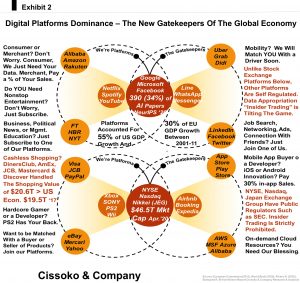
Similarly, most business leaders do not know that video game consoles such as Sony’s PlayStation, Microsoft Xbox, and Nintendo’s Switch are platforms involving separate game developers (on top of the firms’ internal developers) and hardcore gamers around the world. Given the launch cycles (every 2-5 years) and fluctuating demands, most video game console brands are not that profitable. Thus, royalties from licensing are the bread and butter of the video game business.
Further, modern newspapers such as the New York Times, The Wall Street Journal, and Nikkei-owned The Financial Times (FT) are hidden platforms. On the one hand, they inform their audience and charge subscription fees from one side of their platforms (the subscribers). On the other hand, they connect advertisers who want the eyeballs of their audience through advertising fees. Thus, the lower the circulation, the lower and less attractive the newspapers become. However, it is worth noting that some advertisers care more about the quality of the audience, such as CEOs or businesspeople than the newspaper circulation figures. The important thing here is to understand their business models.
Last but not least are business publication magazines or journals such as the Harvard Business Review, which is a classic digital platform. Given that external experts write most of the company’s content if not all of it, the Harvard Business Review sells these articles through a subscription model. At the same time, it makes money from advertising on the other side of its platform.
The key Difference Between Public and Private Platforms
The major differences between non-regulated platforms such as Amazon, Alibaba, and Google and the regulated platforms (Nasdaq, Japan Exchange Group, and New York Stock Exchange) are in their governance structure.
The non-regulated platforms are self-governed through rules, terms of use, content moderation (AI and human), reviews, ratings, and recommendation engines. Also, consumers’ and users’ data appropriation is a crucial element of their operating model, on top of privacy intrusion. However, this data appropriation seems like “insider trading,” particularly across the eCommerce platforms. Indeed, when the platform owner launches varied product lines that compete with other merchants while selling similar products, there is a potential risk of conflict of interest. As a result, the competitive landscape is increasingly tilted in favor of the dominant platforms, which has profound implications for the future of competition.
Securities and financial platforms such as stock exchanges are heavily scrutinized for ethics, transparency, fraud detection mechanisms, and insider trading. However, the boards and executives (owners) of product- and data-powered platforms are unaccountable to any public agency, such as the Security Exchange Commission (SEC), regarding data “insider trading.” Thus, sellers and smaller competitors are at a great disadvantage against their larger competitors, given the data appropriation advantage. This is because they know with minute details which products sell well, at what price point, and what kind of promotional campaign resonates with consumers across their eCommerce marketplace.
The eCommerce platforms can use this data appropriation advantage to copy best-selling products on their platforms and threaten the merchants or disrupt their businesses altogether. Indeed, there is no difference between a trader who appropriates a piece of insider information to buy or sell stock to make more money or reduce loss—and a platform that appropriates its competitors’ (listed sellers) data on its platform for commercial advantage.
The goal is still the same: making more money or reducing potential losses on a stock exchange or an eCommerce marketplace. The two are marketplaces, even if one concerns financial securities, and the other is a product marketplace. Both places exist to exchange value fairly, ethically, and legally. This is the key difference between competition law and anti-competitive practices. Failure to resolve this issue has tilted the playing field across platforms. Hence, the so-called winner-takes-all mantra, which seems true in some cases but in others, looks ridiculous, owing to the lack of real competition among law enforcement.
Get in Touch
We will respond to your message as soon as possible.
Insights to Win
Subscribe to our newsletter for in-depth analysis, reports, and our perspectives on business and economic issues related to the Japanese market and the global economy.