
Solving Japan’s Biotech Industry’s $1Billion Strategy Problem: The Winning Path
Solving Japanese biotech firms’ $1 billion strategy problem is imperative. For one thing, companies within Japan’s biotech industry are trapped between a rock and a hard place, given a handful of paths to win in this age of Omicron. They have no choice but to double down on strategic alliances with their downstream pharma partners and increase their revenues from licensing from multiple sources. Indeed, from 2010 to 2019, the number of biotech firms in Japan reached 2010, including drug discovery biotech and other biotech firms. In this article, we will focus on the former regarding how foreign CEOs can win in the Land of the Rising Sun.
Japan’s Biotech Innovation Funding Struggle
Most biotech firms are SMEs. As such, they must rely on venture capital (VC) funding, private placements, or licensing revenues and make an initial public offering (IPO) to finance the jaw-dropping R&D costs, which in the sector range from $800 million to $1.3 billion per drug from the discovery to the approval stage. However, the venture capital industry in Japan is underdeveloped and can provide just the bare minimum to the biotech industry. On top of that, as Japan’s generic drugs industry emerges as a challenger to the Japanese pharma industry, other funding risks may be on the horizon.
The Revenues From Licensing Deals are not Enough
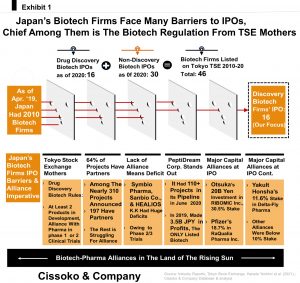
The average listed biotech firm in Japan as of 2019 had revenues at IPO of 1.3 billion Yen (nearly $125M), and the total revenues by the 16 listed biotech companies in Japan from 2010-19 stood at 20.9 billion Japanese yen (almost $200M). However, biotech firms are struggling to cross a sea of red ink, given that the average loss of the listed firms was 460 million yen. PeptiDream is the only listed company that made a profit of 3.5 billion Yen in 2019 among the 16 listed drug discovery biotech companies. To be sure, there is a correlation between the number of projects biotech has, the number of alliances, and that company’s profitability. Consider PeptiDream: it stands out. By far, it was the listed biotech firm with the highest number of projects underway, with 110+ projects.
Tokyo Stock Exchange’s Biotech IPO Rules are Tough – Yet the Money is not Enough
Unlike other major economies, the Tokyo Stock Exchange Mothers’ requirements for listing a biotech firm in Japan can be formidable barriers to IPOs. A drug discovery biotech needs to have at least two products in development or form an alliance with a pharma company in phase 1 or 2 in clinical trials. Failure to tick one or both boxes can be a serious blow to the IPO quest. Among the 300+ deals announced, over 195 have alliance partners, while others struggle to find an ally. Thus, rethinking strategy is imperative to thrive across the industry.
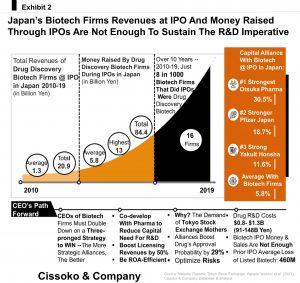
Moreover, the money raised through IPOs is not enough to sustain the money-angry R&D projects that biotech firms need in their quest to discover lifesaving compounds. The total amount the 16 listed biotech firms raised was just 84.4 billion yen. In contrast, the average money raised by each firm through 2019 was 5.38 billion yen—the highest being 13 billion raised by Sanbio Co., Ltd., the ally of Sumitomo Dainippon Pharma Co., Ltd. and Teijin Ltd. who own 6.6% and 6.5% stake in the firm, respectively. However, the capital alliance at IPO complicates the math because it provides pharma partners ownership rights on some percentages of the biotech value. For example, at IPO, Otsuka Pharma took a 30.5% stake in RIBOMIC Inc., Pfizer Japan took 18.7% in RaQualia Pharma Inc., and Yakult Honsha Co Ltd. grabbed 11.6% in Delta-Fly Pharma.
Japan’s tough requirements become crystal clear when comparing the number of biotech firms (16) that did IPOs in Japan over 10 years to China. In the two years through 2018, China had 145 listed biotech firms—nine times that of Japan in just 24 months—meaning Japan lags far behind in the pharmaceutical innovation race. Thus, to win, our experience and the data points to three areas. That is, CEOs of discovery biotech firms across Japan need to double down on a three-pronged strategy to thrive (the more strategic alliances, the better).
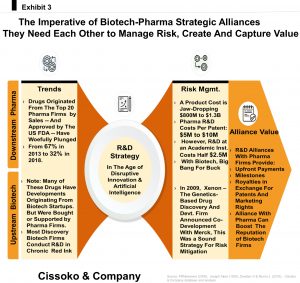
They need to codevelop with pharma firms to reduce the huge capital requirements for R&D projects, particularly in stages 2 and 3 of clinical trials. For example, among the Japanese biotech firms, Symbio Pharma (the ally of Eisai Co., 4.7% and DAIICHI SANKYO 1.2%), Sanbio Co. (ally of Dainippon Sumitomo Pharma, 6.6% stake and Teijin Co., 6.7%) and HEALIOS K.K(the ally of Dainippon Sumitomo 4% and Nikon Corp. 1.3%) made huge losses4.3B yen, 3.7B yen, and 4.2B yen respectively in 2019 because of the stage 2/3 trials in which they were involved.
Indeed, raising money through IPO is generally a good option for enhancing financial flexibility and independence. However, the money raised, and regulatory constraints from Tokyo Stock Exchange Mothers make the option an uphill battle for biotech firms in Japan seeking financing options for their money-hungry R&D projects.
New product development R&D projects are expensive and prohibitively in the biopharma and biotechnology industries. Many Japanese biotech firms may be teetering on the brink of collapse. CEOs across Japan’s biotechnology industry need to boost the licensing revenues by at least 50% while expanding the number of revenue sources, given that our analysis revealed that they have, on average, three sources of revenue from their intellectual property. Moreover, resource optimization through efficiency is becoming crucial for survival’s sake across the industry. As such, efficiency regarding return on assets (ROA) compared to other proxies can be useful in financial management.
Get in Touch
We will respond to your message as soon as possible.
Insights to Win
Subscribe to our newsletter for in-depth analysis, reports, and our perspectives on business and economic issues related to the Japanese market and the global economy.