
The Missing $200 Billion of Pharma Industry — How to Boost Sales by $40 Billion
Recent trends in the pharmaceutical industry suggest that big pharmaceuticals need to rethink their strategies — to thrive. As many blockbuster drugs became off-patent products in recent years, generic competitors have increased their market share(Exhibit 2). Thus, the innovators (biopharma industry) need a strategy to plug the sales holes in their financial statements. Indeed, between 2010 to 2015, pharmaceutical companies lost over $240 billion owing to their blockbuster drugs that lost competitive advantage from patent-enabled exclusivity. By 2030, the same cycle will repeat itself, meaning three major pharma firms — Pfizer, Amgen, and Bristol Myer Squibb — may lose on average 30% of their patent-protected revenues, given the threat of imminent patent cliffs. As a result, many pharmaceutical innovators have doubled down on defensive strategies against the onslaught of generic drug competitors.
However, overfocusing on generics alone is a misguided strategy (Exhibit3). Our analysis revealed that pharmaceutical innovators could generate over $40 billion each year if the industry responds to the other threat – the counterfeit drug problem – that stole an estimated $200 billion in 2018 from the global pharmaceutical industry, according to the World Customs Organization (WCO).

The huge profit opportunities provided by blockbuster drugs – such as Pfizer’s Lipitor, which generated $12 billion in 2005 alone — distracted the industry from seeing the emerging threats posed by counterfeit drugs. For example, the pharmaceutical industry was the most profitable in 2013 – making over 20% operating profit margin – with Pfizer at the top of the list with a nearly 25% operating margin. The pharmaceutical industry was even ahead of the mighty banking sector.
For these reasons, emerging threats posed by the fake drugs were neglected, given that recently as five years ago, there existed more than 35 million online pharmacies, of which fewer than 10% are estimated to be legitimate. Similarly, between 2000 and 2005, counterfeit pharmaceuticals grew by a jaw-dropping 690%. By 2016, the U.S. Department of Commerce estimated that the global sales of counterfeit pharmaceuticals ranged between $75 billion and $200 billion.
UNODC revealed that the U.K., China, India, Pakistan, and Paraguay are significant sources. But India and China are the sources of more than 49% of these illegal drugs – with India having more than 7.900 small units operating below the authorities’ radar. Given their influence in the global pharmaceutical value chain, it is not a coincidence – from finished goods (20% in 2010) to active pharmaceutical ingredients (40% in 2010). Their positions in the global pharma value chain provide economic arbitrage. For example, the cost of manufacturing American generics in India is nearly 30% lower in India than in the United States.
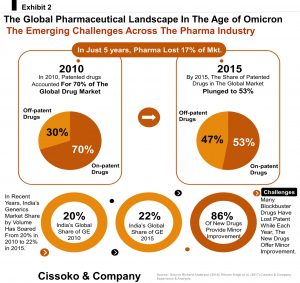
Thus, as the generics exports boomed over the recent decade in India, so did the counterfeit drugs. These disguised substandard (fake) drugs are exported to other developing countries such as Africa, Latin America, and Southeast Asia as anti-malaria or anti-tuberculosis drugs – which the poor and uneducated can’t ascertain the health risks associated with the consumption of these counterfeit pharmaceuticals. Consider this: online pharmacies are estimated to be more than 36,000, but fewer than 6% of drugs sold through these channels are believed to be legitimate.
As a result, in 2003 alone, one in five deaths from Malaria and Tuberculosis in Africa – 200,000 people – were related to the fake pharmaceuticals littered across India. Indeed, in 2002, the World Health Organization (WHO) reported that nearly 20% of drugs found in major Indian cities’ markets — such as wholesalers of Bhagirath Place in Delhi — were either illegal or substandard (fake medicines). In 2009 alone, over 675,000 died from fake Malaria and Tuberculosis drugs. In other words, as of 16 December 2021, the death toll from counterfeit medications is more than COVID-19-induced deaths from Germany, the U.K., Indonesia, France, and Italy combined. The problem of fake medicines in developing countries has become a public health crisis that the under-funded public health systems are ill-equipped to address – without external assistance.
An Indian government task force recommended 40 years ago a ratio of ten inspectors for every 250 manufacturing sites and 10 for every 1000 premises across the country. However, recent findings suggest that the government had nearly nine inspectors for each 30,000 sales premises – while in the capital Delhi had two drug inspectors for each 800 registered chemist workplaces – a ratio far below the recommended ratio by the government’s task force.
The counterfeit drug problem is a global issue calling for an agreed-upon definition of what needs to be considered as counterfeit medicines. Without a globally accepted definition, winning the war on counterfeit will be an uphill battle. Because varied types of counterfeit pharmaceuticals exist worldwide – from fake packaging to zero active ingredients to insufficient active ingredients and wrong active ingredients, to name a few. Beyond Africa – where the most counterfeited drugs are antimalarials and antibiotics — the counterfeit pharmaceuticals issue exists in South America. Brazil, the wealthiest country in Latin America, has a severe fake drugs problem of its own – with more than 18% of drugs being counterfeited by criminals.
Thus, to deal with the threat posed by counterfeit medicines, the pharmaceutical industry as a whole needs a concerted and sound supply chain strategy instead of a piecemeal approach. For example, to respond to the threat of fake drugs, AstraZeneca supplied more than 20,000 pharmacies directly in the Philippines. Also, the American pharma giant Merck launched a mobile minilab to detect and verify counterfeit pharmaceuticals in more than 65 emerging countries. Likewise, to prevent the substandard of its Viagra products in the U.S., Pfizer deployed tagging as a strategic defense against the threat.
To be sure, many of the disruptions that the biopharmaceutical industry is facing can be traced back to the industry’s flawed strategy — including pricing. Consider this: while it is imperative to innovate organically or through biotech alliances and recoup these R&D investments, over the past few years, between 1996 and 2005, ad spending increased from $11.4 billion to $29.9 billion in the United States alone.
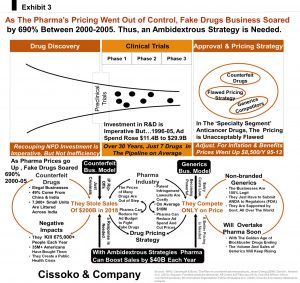
Similarly, in the so-called specialty drug segment of the pharmaceutical industry — the anticancer segment — the pricing strategy has been unacceptably flawed. Consider this: adjusted for inflation and benefits, prices increased by an eye-watering $8,500 each year between 1995 and 2013. The combination of these factors pressured payers to promote generics while providing a window of opportunity for criminals making counterfeit pharmaceuticals worldwide. Thus, the big pharma innovators need an ambidextrous strategy against both generics and counterfeit drugs — to be ahead of the curve while building COVID-19 resilience.
With the advances in Technology innovations, the pharmaceutical industry can double down on blockchain to enhance visibility and traceability across the complex pharma supply chain. For one thing, counterfeit and substandard drugs come from many shapes and sizes – from fraudulent packaging to alteration of the expiry date to zero or minimum active pharmaceutical ingredients, to name just a few challenges regarding the battle against counterfeit drugs. Thus, blockchain knowledge exchange can improve transparency and build trust across the pharmaceutical value chain, given the blockchain technology’s strength in preventing data forgery and alteration.
Get in Touch
We will respond to your message as soon as possible.
Insights to Win
Subscribe to our newsletter for in-depth analysis, reports, and our perspectives on business and economic issues related to the Japanese market and the global economy.