
Japan’s Biopharma Industry in the age of Generics: What are the Winning Strategies?
Japan’s pharmaceutical industry needs a better product lifecycle strategy to thrive in this age of generics. As medical care costs in Japan continue to rise, the Japanese government’s mood has changed in recent years. Consider this: in 2014, Japan’s medical care expenditure was 40.8 trillion yen, of which 18%7.3 trillion yen was attributed to biopharmaceuticals.
Since the Japanese government has set ambitious generic targets over the past decade, generic drugs have the same safety profile, quality, and efficacy as branded drugs (bioequivalence. In 2007, it targeted 30%; six years later, in 2013, it raised its generics target again to 60%. Its final prescription volume target for 2020 was 80% to align with other advanced economies such as the United States and the United Kingdom. Thus, on the strategy front, Japan’s big pharma leaders and foreign CEOs in Japan need to build COVID-19 resilience to avoid the fate of Japan’s biotechnology industry.

Similarly, worrisome signs are emerging across Japan, given that over 68% of Japanese are now aware of generics. In contrast, 86% think generics are a cheaper alternative to brand-name drugs, and 54% are willing to substitute branded drugs with generics. All these emerging trends reveal that Japan’s biopharmaceutical companies (the innovators) need a better product lifecycle strategy to thrive rather than survive in this age of COVID-19.
Japan’s Demographic Time Bomb and Economic Pressures Have Accelerated the Generic Drug Campaigns
Seniors accounted for 25% of Japan’s population in 2013. In 2002 (20 years ago), the proportion of Japan’s national medical care expenditure spent on the so-called seniors aged 65 or above was 49.3%. By 2011, the figure had jumped by nearly 13% to 55.6%. As a result, bold actions were needed to revamp the medical care expenditures and bring the situation under control. The low-hanging fruit was the vigorous promotion of generics in the Japanese market while closing the gap with other leading economies such as the United States and the United Kingdom.
Defensive Strategies in Japan’s Biopharma Industry in the age of Generics
Compete through a crystal form patent. The patent cliff is not the end of the game. Even when the basic compound patent expires, a biopharmaceutical firm (the innovator) can still extend the life of its invention through a crystal form patent.
A classic example from Japan: Astellas Pharma’s Cefdinir was launched under the brand name of Cefzon (an oral cephalosporin agent) in 1991. Cefzon was one of the bestsellers, given that it sold 205 billion yen ($1.74B) between 2000 and 2007. However, in 2005, Taiyo Yakuhin Co. Ltd, a leading Japanese generic manufacturer based in Nagoya, secured health insurance reimbursement from the Japanese government for an oral Cefdinir capsule. Astellas Pharma took legal action against Taiyo and won in 2007 due to its patented crystal form.
Understand the key Differences in the Pharma Patent Game. Unlike the United States and the European Union, in Japan, the patent term extension does not exist for just a single patent but multiple patents of a single pharmaceutical product. In other words, in Japan, pharmaceutical companies have many patent options on the table, such as usage patents, process patents, formulation patents, and product patents. On top of this, there is also the “regimen patent,” which, since 2010, began to provide dosage patents to Japanese biopharmaceutical firms wanting protection.
Strategize around key Therapeutic Areas. The most common diseases in Japan are high blood pressure, followed by neurological, psychiatric, and oncological disorders. A potential winning path for Japanese pharmaceutical firms is to focus their strategies on therapeutic areas such as L (antineoplastic and immunomodulating agents) and N (nervous system) according to the World Health Organization’s (WHO) anatomical therapeutic chemical (ATC) classification, which can boost growth and profitability in the global pharmaceutical race.
However, unlike the Japanese biopharma companies, the potential path for global pharmaceutical firms with the drive to win in Japan is to double down on the B (blood and blood-forming organs), H (systemic hormonal prep, excluding sex hormones), and S (sensory organs) as their therapeutic areas of focus regarding the World Health Organization’s (WHO) Anatomical Therapeutic Chemical (ATC) classification.
Pharma Product Lifecycle Strategies in the age of Generic Competition
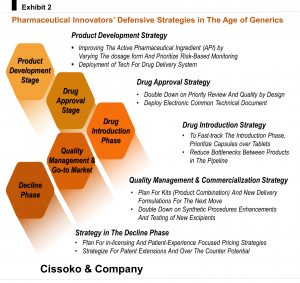
In the age of generic drugs, big pharma innovators need to double down on pharmaceutical product lifecycle strategies to thrive rather than survive in the age of Omicron. The key strategy options to protect market share and dwindling sales are:
Beyond Japan, Sound Regulatory Strategies to Know
Competition in the age of generic drugs requires a global view of the strategic landscape. Like diseases that pharma firms combat, the challenges generics pose to the biopharmaceutical firms’ revenues transcend national borders. Thus, pharmaceutical organizations must grasp the regulatory landscape regarding key therapeutic areas worldwide to win beyond Japan’s pharmaceutical industry.
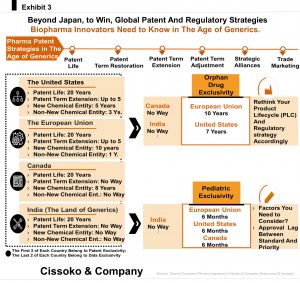
Thus, crafting a sound pharma strategy in the age of generics calls for both product lifecycle and regulatory strategies worldwide regarding exclusivity period – from the rules of the game regarding patent term restoration (PTR) to patent term adjustment (PTA) to new chemical entities (NCE) and non-new chemical entities, among others. For example, while the European Union provides 10 years and the United States seven years for orphan drug exclusivity, Canada and India do not offer such opportunities.
The trend in the pharmaceutical industry is worrisome, to say the least. In 2010, on-patent drugs made up 70% of the global drug market. However, five years later, in 2015, the global drug market share of on-patent drugs shrank to 57%. It may worsen in the future, thus making a sound pharmaceutical strategy imperative for survival in this age of Omicron.
Our experience on both sides of the Atlantic, particularly in Japan, suggests that deploying the above strategies can save the day regarding resilience, growth, and profitability across the Japanese pharmaceutical industry.
Get in Touch
We will respond to your message as soon as possible.
Insights to Win
Subscribe to our newsletter for in-depth analysis, reports, and our perspectives on business and economic issues related to the Japanese market and the global economy.