
Lessons From the Biotech Revolution: Pharma-BioTech Alliances and Strategies
Over the past decades, the value of biotech-pharma strategic alliances has become crucial. In the age of COVID-19, variant Omicron has become axiomatic. Pfizer-BioNTech COVID-19 vaccine is a testament to that value. However, below the public radar, one of the most critical competitive advantages in the game of strategic alliance is that the star scientists have gone unnoticed, which may prove myopic for pharmaceutical leaders.
This article will guide you in unlocking value in pharma-biotech strategic alliances while providing the key metrics biopharma firms need to hit to unleash the firepower of star scientists in the biopharma sector. For starters, what are the key trends and changes shaped alliances between downstream biopharma and upstream biotech startups?
Biotech Revolution: Pharma Innovation Great Leaps of the 20th Century
From the early 20th century, the biopharmaceutical industry’s quest for growth and innovations has been influenced by advances in many fields—sometimes simultaneously. The gem theory of disease came in the early 20th century and the chemo-therapy revolution followed this. Later, the industry was influenced by synthetic organic chemistry, soil microbiology, and virology. In the 1970s, the biotechnology revolution changed the game of pharmaceutical knowledge acquisition and network.

Until the biotechnology revolution of the 1970s, the biopharmaceutical innovation network was powered by alliances with public institutions, research universities, and scientists’ networks. However, the promise of biotechnology was so great that it forced big pharmaceutical companies to adapt their strategies to embrace and deploy the techniques of recombinant DNA and molecular genetics techniques to bolster their drug discovery and development capabilities. That emerging field of recombinant DNA (rDNA) enabled molecular biologists to develop huge volumes of bacteria and cellular protein.
The hype surrounding biotechnology promises did not stifle the quest for innovation in other areas, given that many pharmaceutical giants stood by their guns through their existing research in microbial biochemistry and enzymology for treating diseases — such as ulcers, arthritis, and hypertension. As a result, in 1980 – the year that Genentech, the first biotech firm, went public — enzymology and microbial chemistry became the innovation sources of the majority of pharmaceutical product sales of big pharma companies.
The IPO of Genentech created a domino effect of euphoria among investors and entrepreneurs, thanks to the capability enhancement of monoclonal antibodies. As a result, during the two years through 1983, more than 20 biotech IPOs listing happened. The same innovation quest to bolster pharmaceutical capabilities gave birth to bioinformatics – which combines the power of computing technologies and genomic information – to boost productivity in the sector.
Biotech Capabilities Development at Pharma Firms Between 1990-2000
By the end of the 20th century, pharmaceutical giants had made substantial progress in developing molecular genetics and biotech capabilities. However, each big pharma firm developed these capabilities through various strategic alliances—memorandums of understanding, contractual agreements, and equity stakes (Eli Lilly)—and internally through the networks of star scientists, the path used by Merck.
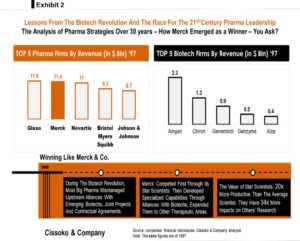
Also, globally, players developed strategies aligned with specific therapeutic areas or existing capabilities through strategic alliances—including the leading Japanese pharmaceutical companies—given that biotech capabilities were rare in the early days.
The Threat Posed by Biotech (Early Days) to Biopharma and the Rise of Upstream Alliances
Given the immediate threat posed by the newly emerging field of biotech recombinant DNA (rDNA)to Eli Lilly’s leading position within the insulin market in the United States, the pharma giant had to respond by forming strategic alliances with Genentech. A move that was unthinkable just a few years ago. Some pharma giants, such as Johnson & Johnson, doubled down on partnerships such as contractual agreements and joint projects with biotech startups with several biotech firms to plug the innovation capability holes.
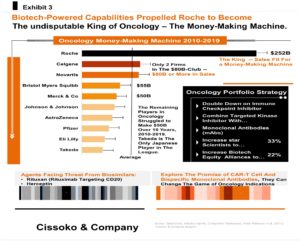
Others, such as Roche (previously known as Hoffmann La Roche), competed through collaborative research and M&As. Roche raised eyebrows by making the boldest move in its industry by acquiring 60% of the leading biotech firm at the time—Genentech. Finally, in 2009, Roche moved from an equity stake to a fulsome acquisition. As a result, Roche’s biotech-powered capabilities increased dramatically. From 2010 to 2019, Roche became the undisputable king of oncology, with sales of $252 billion over the 10 years.
Unlocking Value of Biotech-Pharma Strategic Alliances Through Star Scientists
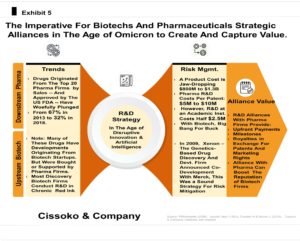
Emerging trends: Drugs originated from the top 20 biopharma companies by sales—and approved by the United States FDA plunged from 67% in 2013 to 32% in 2018. Worse still, many of these drugs have their development originating from biotechnology startups. Then, these startups were bought or supported by big pharmaceutical companies. Unfortunately, most biotech companies operate in the sea of red ink, and allying with biopharma is even more crucial to funding their ongoing research.
Managing risk: A pharma product cost from discovery to approval is jaw-dropping, ranging from $800 million to $1.3 billion. Indeed, it is expensive and prohibitively so. On top of this, historically, pharma R&D cost per patent stood between $5 million to $10 million. However, R&D at an academic institution costs half$2.5 million. At biotechnology startups, big pharma firms get bang for their buck, given their low-cost structure, according to our experience. In 2009, Xenon, the genetics-based drug discovery and development firm, announced co-development with Merck. This move, we believe, was a sound strategy for managing risk across its product lifecycle.
Alliance value: R&D alliances with biopharma companies provide upfront milestone payments and royalties in exchange for patents and marketing rights. Indeed, over the past five years, the mean licensing upfront costs have risen by 40% to nearly $71.5 million—a tailwind for biotech startups. On top of that, a partnership with more prominent pharmaceutical firms can enhance the reputation of biotechnology companies while boosting the probability of product approval by 29%, according to our experience. Beyond that, partnerships boost sales and strengthen R&D productivity in commercializing blockbuster drugs. For example, TAP Pharma (a JV between Takeda and Abbott Laboratories), through its Prevacid (lansoprazole), sold more than $2 billion worldwide. Similarly, Bristol Myers Squibb’s partnership with Sanofi was fruitful, given that their alliance-powered product—Plavix (clopidogrel) —sold over $3 billion worldwide.
The Value of Pharma Star Scientist – To Unlock Value Across Alliances’ R&D Productivity
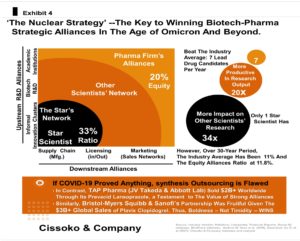
Over the past 30 years, our research revealed that the ratio of star scientists to pharma staff stood at 11%, while the equity alliance ratio has been 11.8% on average. In addition, the number of lead drug candidates stood at seven on average.
To win the R&D productivity race through strategic alliances, biopharma firms need to deploy the “nuclear strategy,” which is to double or triple the number of star scientists across the board, given their value to the pharmaceutical industry.
A star scientist is 20 times more productive than a staff scientist. Moreover, he has had a 34 times greater impact on other scientists’ research. Given these cold facts, the pharmaceutical nuclear strategy calls for tripling the number of scientists while doubling the number of equity alliances across the pharmaceutical industry (Exhibit 2). This strategy will boost productivity across the biopharma industry while beating the industry’s annual average lead drug candidates7 drugs each year through the informal and formal knowledge cluster from which innovation and productivity depend.
More than anything, the COVID-19 pandemic and the ensuing quest for cure proved the value and imperative of strategic alliances across the pharmaceutical industry. However, knowing something works and understanding how it works are two different things. Given that the biotech revolution set in motion pharma-biotech strategic alliances, we believe that winning today calls for gleaning insights from the innovation leaps of the 20th century, including the strategic missteps that have shaped the pharma industry’s leadership in the 21st century.
Get in Touch
We will respond to your message as soon as possible.
Insights to Win
Subscribe to our newsletter for in-depth analysis, reports, and our perspectives on business and economic issues related to the Japanese market and the global economy.