
Strategic Alliance in the age of AI: What are the Rules for Growth and Profitability?
Strategy is not something set in stone. As the environment changes, so must the strategy. CEOs and business leaders need to think of strategy as a symphony, not a solo, to be a gold medalist for growth. Thus, as the competition heats up, compounded by COVID-19 disruptions and the fast-evolving needs and wants of consumers, a strategic alliance is an answer to many of the questions that CEOs and business leaders constantly ask themselves, such as how can we grow our business or boost our profitability? Indeed, businesses engage in over 10,000 strategic alliances around the world each year, while alliances account for over 30% of the top 1,000 corporations’ revenues.
In today’s rapidly evolving competitive business environment and shorter innovation cycle times, meeting the consumer’s expectations regarding quality, speed, prices, and experiences is becoming hard. This evolving business landscape compounded by COVID-19 disruptions has forced the console kings Nintendo, Sony, and Microsoft to partner with influential Twitch live streamers for growth. Similarly, in China, a leading manufacturer of residential air conditioners sold over $9 billion through 13 live stream broadcasts during the crisis in 2020 on TikTok’s sister China-centered platform Douyin. Furthermore, in Japan, 7-Eleven, the convenience store giant, is partnering with Daiso to sell its 100-yen products in its convenience stores across the Land of the Rising Sun. In fact, the Japanese company’s. Also, Uber cut a deal with WhatsApp by allowing WhatsApp’s 500 million-plus users in India to book a ride from the app. Indeed, alliances have become the glue of the digital economy.

As winning is becoming exceedingly difficult and the vulnerability of many companies is on full display, the new rules of strategy for growth and profitability call for both competition and cooperation – co-opetition. Given that, on the one hand, a firm needs to compete to grab its share of the fixed economic profit pie through static efficiency. On the other, to grow the actual and future economic pie through dynamic efficiency, it needs to cooperate to boost its innovation productivity by forming alliances. For example, Apple and Nike formed an alliance to deal with rising demand from sophisticated consumers who love music and running. As such, given their long-standing mutual trust and partnership, they launched the Apple Watch Nike+ series in 2016 to enhance their customer experiences. Because neither, on its own, could deliver on this lofty value proposition in a short period.
Indeed, alliances have emerged in many shapes and sizes, such as international alliances in the airline industry, domestic alliances (Nissan and Mitsubishi), and R&D alliances regarding technology and innovation (self-driving car alliances.
Over the years, two dominant categories of alliance emerged. The most touted models are the equity-based alliances, accounting for 59%, while the non-equity alliances, such as R&D and innovation, account for most of the rest.
However, alliances are no different from other relationships, requiring trust and managing ambiguity. The higher the trust, the lower the costs of monitoring and resolving disputes. In other words, trust is the sine qua non of alliances. Given that When trust exists between partners, companies can hit the ground running with just a memorandum of understanding or just a contractual agreement.
In a situation where trust is lacking, the transaction costs of the exchange go higher. For one thing, companies fearing opportunism from a partner will most likely engage in a joint venture or equity stake arrangement to alleviate many concerns from the other party.
Strategic Alliances for Growth, Innovation Capabilities and Productivity
In our world of disruptive innovation compounded by the rise of artificial intelligence, companies wanting to maximize the success of their innovation alliances can follow our time-tested guide (Exhibit 2) as a reference. In the world of technology innovation, an organization’s quantity and quality of patents are arguably its competitive firepower. For this reason, the number of registered patents has dramatically increased over the past decades. In the United States and Japan, registered patents topped 250,000 in 2012; in China, Korea, and the European Union, over 200,000, 100,000, and 50,000 patents were registered, respectively. As such, a firm seeking an alliance partner is confronted with a dilemma regarding enhancing its innovation productivity while capturing value from an alliance.
Thus, organizations need to make hard choices regarding the type of alliance they need – exploitation, exploration, or both. However, winning requires innovation and strategic calculus regarding how close or far an organization’s alliance partner tech needs to be to win the game. Technology proximity—the degree to which a company’s patent portfolios overlap (similarity)—needs to be one of the major criteria for partner selection in an innovation alliance. The technological proximity of the two firms is between 0 and 1, where the closer the number is to 1, the higher the degree of technological similarity, and vice versa. For example, empirical studies revealed that the average technological proximity in the U.S. manufacturing sector is 0.75, which means it is competitive regarding the similarity of patents.
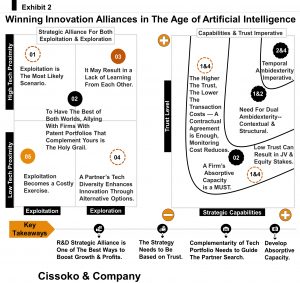
Indeed, the more two alliance partners’ patent portfolios overlap, the more knowledge acquisitions and learning can be curtailed, given that they have so much in common but few things to learn from each other. Companies in this situation form an alliance for exploitation regarding cost-savings synergy.
When forming a technological alliance, we believe it can be challenging to learn and capture value in an alliance composed of partners with technology portfolios completely different. But the silver lining is that efforts, patience, and the necessary investment of resources in this type of alliance can result in a breakthrough where the innovation productivity can be a game-changer or disruptive regarding novelty instead of incremental innovations becoming the outcome of the alliance’s performance.
Experience suggests that in today’s highly volatile economic environment, where competitive assaults are emerging nearly across all adjacent industries, competing on both exploitation and exploration can be the best path forward. However, trust and strategic capabilities regarding alliance management are imperative. For example, over the past decades, U.S. automakers had notable success in China compared to Japan because of historical mistrust between the two Asian economic powerhouses, China and Japan, at the national level. This mistrust, in turn, became the identity-induced trustworthiness of the Japanese carmakers and their parts suppliers in China. In other words, an alliance partner’s country of origin can impact trustworthiness worldwide, whether you are a CEO or a multinational organization.
Therefore, winning the game of strategic alliance calls for managing ambiguity regarding alliance partners, ongoing relationships, coordination activities, governance, evaluation, performance, and changes in the business environment, among others. As such, we believe that companies will need to be highly ambidextrous to succeed. The three types of ambidexterity that organizations will need depending on the type and stage of the alliance include:
Structural and contextual ambidexterity: Simply put, the creation of separate organizations or different structures for different activities within the company.
Temporal ambidexterity: managing actions, activities, and decisions with short- and long-term implications for the company.
Contextual ambidexterity: the daily choices made by individuals within an organization exploration or exploitation activities within their organization.
The unfolding business threat facing companies of all industries is worrisome, so unprecedented that it is almost unfathomable. From grim revenues, we see a flawed strategy. Thus, strategic alliances through co-opetition are the following options for companies to boost growth, profitability, and innovation productivity. The sad truth is that strategic alliances are not a new game. However, timidity across many boardrooms and C-Suites has made the topic a taboo, which needs to change for companies wanting to unlock growth.
Get in Touch
We will respond to your message as soon as possible.
Insights to Win
Subscribe to our newsletter for in-depth analysis, reports, and our perspectives on business and economic issues related to the Japanese market and the global economy.