
Winning Digital Platform Wars: How Apple Grows Sales More Than Rivals Combined?
To win the digital platform wars, we believe that focusing on the five golden rules of speed can help businesses boost their revenues by more than 30%. Through the case study of a familiar platform, Apple’s App Store, we will show you the 5 Golden Rules in action, which helped the App Store gross nearly $50 billion in revenues in 2019—greater than the sales of Netflix, Rakuten, and Uber combined.
As COVID-19 keeps wreaking havoc on the global economy, many business activities have moved online—such as telework, conferences, and dramatic shifts in consumer shopping. This has resulted in a boon for digital platforms, such as Amazon, which saw its stock rise by more than 60% in 2020 while adding over $560 billion to its market capitalization. Amazon is not alone; by May 2020, Netflix saw its stock rising by 30% compared to the beginning of the year. However, the pandemic became a bane for traditional firms and industries behind the digital transformation curve, such as the tourism industry, which generates 10.1% of the global GDP while employing 330 million people around the world. Beyond the tourism industry, COVID-19 hit the oil industry very hard; in April 2020, oil prices turned negative. We anticipate these trends to remain constant for several years.
Thus, as most activities suddenly moved digital, so did the cutthroat competition for consumer data and capturing value through monetization. As such, understanding the monetization funnel across digital platforms is imperative. Given that not all business models are created equal in the platform economy.
Our experience suggests that many business leaders do not have a firm grasp of the business model of digital platforms. For this reason, before our deep dive below, we will first explore the monetization strategy of Booking Holdings through a case study.
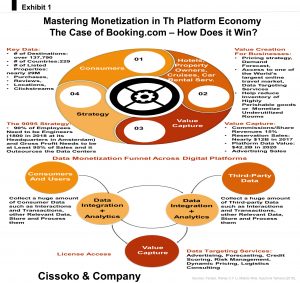
Second, to avoid the pitfalls of conflating digital platforms and traditional businesses, we explore in another case study the eBay platform compared to traditional manufacturing mindsets, which can be the kiss of death when running a digital platform ecosystem. Then, in the second part, we explore the article’s main theme— the five golden rules of speed through another case study, Apple’s App Store.

The 5 Golden Rules of Speed for Growth Acceleration
Adaptability Speed
Steve Jobs keenly understood that no one could go it alone any longer, given the required level of speed to compete effectively in our fast-changing world of technology. Similarly, he knew that open platforms would beat closed ones in the long run. As such, the visionary leader opened Apple’s ecosystem to third-party developers during the launch of the iPhone with just 500+ apps available for download in October 2007; five years later, by March 2012, the App Store had 550,000 apps, which downloaded 25 billion times across 315 million devices around the world. Unlike agility, which is largely internally focused, adaptability is more concerned with changes in the external environment. Thus, companies that can quickly adapt to a changing business environment strengthen their resilience and, ultimately, their competitive edge.
Decision-Making Speed
Over 4,000+ mobile apps are launched daily; 59% fail to break even, and just 10% manage to become the so-called killer apps. App developers struggle for traction within the crowded Apple App Store with a slim marketing budget. As such, the strategy adopted by most, if not all, app developers is a strategy to provide the free version of their apps with the hope of attracting paying users. In other words, they have a freemium business model, where free versions have limited features and paid versions with the full features of the apps. Managing this kind of ecosystem calls for speedy decisions, which Apple has learned over the years.
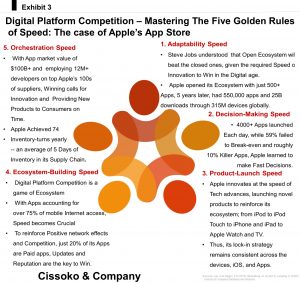
Product-Launch Speed
Apple’s customers need the latest gadgets or devices to keep downloading apps on the App Store. For this reason, Apple innovates at the speed of Tech advances, launching novel products to reinforce its ecosystem through a lock-in strategy. This is done through always-on product launches from iPod to iPod Touch to iPhone to iPad, and lately, Apple Watch and Apple TV. The go-to-market strategy is imperative for strengthening Apple’s digital goods ecosystem and traditional devices. Simply put, the strategy needs to sync.
Ecosystem-Building Speed
Make no mistake: digital platform competition is a game of the ecosystem. That is, not products versus products, but ecosystem versus ecosystem. With apps accounting for more than 75% of mobile internet access, ecosystem-building speed regarding third-party content producers and developers becomes crucial for growth. It is salient for platform owners such as Apple to understand what it takes to succeed on their platform to build a strong platform ecosystem at speed. For example, in the App Store, our experience suggests that winning calls for app developers to be at least three categories and deliver at least seven apps to enhance their likelihood of success.
Platform Orchestration Speed
The app’s market value has recently surpassed $100 billion and has employed over 12 million people worldwide. On top of this, Apple has hundreds of suppliers. As such, winning calls for innovating new products faster than ever in meeting the rising demand for Apple’s products. Consider this: with all the talks of COVID-19 disruption, the Tech giant ended the quarter of 2020 with sales north of $110 billion, its best quarter ever!
One key to its success is its speed in orchestrating its supply chain to deliver new products for consumers to download apps. For this reason, the $2 trillion behemoth achieved a record 74 inventory turns yearly. That is an average of five days of inventory in its supply chain, which is the envy of its industry.
As shown above, winning in today’s complex and ever-changing economic landscape requires deploying the five golden rules of success. In our experience, companies like Apple can enhance their revenues dramatically in the years to come.
Get in Touch
We will respond to your message as soon as possible.
Insights to Win
Subscribe to our newsletter for in-depth analysis, reports, and our perspectives on business and economic issues related to the Japanese market and the global economy.