
Winning Platform Competition: The Ultimate Guide to Disrupting a Digital Platform Leader
Ten years ago, there were more than 5 billion Internet-connected gadgets worldwide. As of 2018, there were almost 18 billion. By 2025, we expect that figure to rise to more than 40 billion. To cope with this meteoric growth, everything, including digital platform leaders, will be disrupted in the name of efficiency and digital experience.
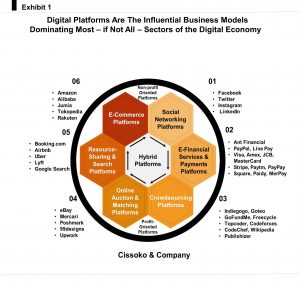
An unchallenged industry leadership position has become wishful thinking in this winner-takes-all environment. Moreover, an ambidextrous strategy for disrupting digital platform leaders is anything but mysterious, and we’ll go into this in five detailed steps in this section. First, to disrupt a platform leader, it is important to know the inner workings of the platform ecosystem. Let’s look at this now.
Step1. The Visible and Invisible Elements of Platforms
A platform’s key backbones are its architecture (the invisible elements) and governance (the visible elements). Many people are familiar with governance, such as how much the platform charges when you join (often free), the digital or transactional experience, etc. These are the visible elements. This core cornerstone deals with the question of power and influence between the platform proprietor and third-party software programmers and content creators.
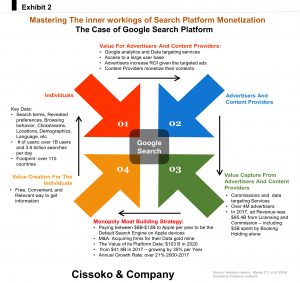
Similarly, the service-price decision tries to address the value capture issue regarding what fraction of the value each ecosystem partner deserves. Indeed, questions regarding the arrangement of value creation and capture belong to this cornerstone. For instance, do we need to charge all users equally? Which side should be subsidized, and by how much?
On the other hand, architecture seems like an invisible element to many. It deals with the decisions regarding the macro and microstructure of the whole value creation and capture system. Above all, the questions of architectural agility concerning modularity, API, innovation, and emerging technologies need great consideration from the outset. As such, an agile architecture will be crucial to enhancing capabilities regarding adaptive reinvention, which is necessary to sustain the competitive edge regarding the feedback loop from users or customers.
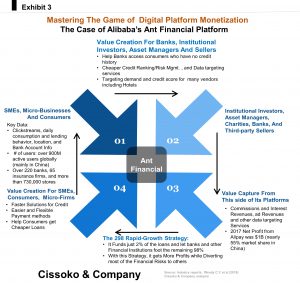
Again, platform success hinges on ambidextrous management of the governance mechanism and architectural design and resources. In our experience, failure concerning strategic management and execution of these two key backbones will spell disaster down the road. In other words, getting just the governance or the architecture right will not take a disruptor very far. It needs to be both.
Step 2. Re-Segment the Market or Activities While Preparing Your Disruption LaunchPad
The first order of business in disrupting a platform leader is to analyze the long-term trends of each customer (user) segment by breaking down the whole market. Gather the necessary data to analyze them to glean insights for uncovering the potential disruption launch pad. The crux of that opportunity lies in understanding how to win the digital platforms race. That is, first, by being in the game through elements of parity (ticking the key success factor boxes) and winning through elements of difference (strategic innovation differentiators). Indeed, game-changing innovation happens through this latter differentiation dimension, and the upstart eventually dethrones industry leaders. To be sure, the disruptor needs a bold vision grounded in exponential thinking. So, incremental and linear thinking must be rejected at all costs, given that they are based on false assumptions and a blinkered vision. Below, we have listed some options to disrupt a digital platform leader that several firms have used across industries to change the game.
The First Approach: Re-Segment the Market and Focus on a Forward-looking Niche
In this approach, the upstart needs to focus its energy on the segment with the highest future potential, for the trends and future demand potential as its domain of choice. As such, this is the area we called “the disruption launch pad.” In this niche, the upstart’s innovation will flourish regarding emerging technologies, such as blockchain, artificial intelligence, mobile banking, payments, augmented reality, etc. The key to getting it right is to avoid design blunders, given that it must be planned with key stakeholders in mind, such as users (customers), external programmers, and content providers concerning mobile-first and AI-first experience interoperability and the like.
The Second Approach: Unbundling
The disruptor needs to unbundle the key activities regarding the value creation process and use a particular activity as its disruption launch pad. For instance, while traditional banks in retail banking provide services from checking and savings accounts to credit cards, remittance, and loans, Fintech, such as social finance (SoFi), has unbundled the services by focusing on student loans first—a distinct segment within the tradition retail bank loan services. Similarly, the European unicorn (i.e., a startup with a valuation of $1 billion or more) TransferWise started eating the lunch of retail banking services by laser-focusing its efforts on remittance services. Moreover, it is now expanding its footprint by providing credit card services.
The Third Approach: Competing Through the Network Game
In this approach, the disruptor, often an established firm, leverages the power of its network to provide services that it could not otherwise deliver alone. For example, the number of people employed by a firm alone or in combination with its partners can be used for this type of disruption. Examples are the newly founded healthcare alliance between Amazon, Berkshire Hathaway, and JPMorgan, which was established to provide enhanced healthcare services to their combined employees through disintermediation.
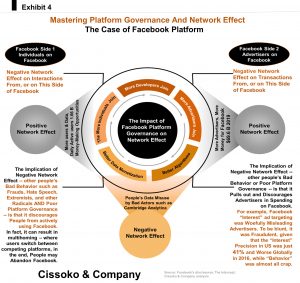
Similarly, a firm can leverage its customer base in collaboration with its digital platform ecosystem stakeholders to provide services in adjacent industries. The classic examples are Amazon and Alibaba, which leverage their power across their ecosystems to provide services such as credit cards, loans, health care, etc. Likewise, a large car manufacturer such as Toyota can easily enter the auto insurance industry through data gleaned from its customers’ driving habits based on sensors and AI-powered algorithms.
The Fourth Approach: Disrupt a Digital Platform with a Platform Ecosystem
The classic case is Apple’s recent foray into streaming and issuing its signature credit card bearing the firm’s name. Unlike other credit cards, which force applicants to hold up their shopping for weeks before the new card arrives, Apple’s Goldman-Sachs-issued, zero-fees, and security-powered cards allow an in-app application through its Apple wallet by streamlining the whole process in record time—not requiring an hour—to allow the consumer to quickly go ahead with its shopping. As a result, the applicants get their application results faster.
Moreover, the new card provides huge incentives, including several percentage points for shopping in the firm’s stores and buying its services and other financial rewards daily. So, these huge incentives will enhance the demand for the smartphone giant’s upcoming streaming services through Apple TV Plus.
Apple is competing through an ecosystem of products (iPhone and watches), payments (Apple wallet and card), and services (streaming). Through these disruptive ecosystems, the demand for one of its products or services will be dependent or highly correlated with the demand for others across the ecosystems. This strategy seems like a lock-in strategy common across the technology industry. The disruption is akin to the iPhone ecosystem a decade ago. The good news is that we believe that over time, these new interrelated products and services will revive the falling sales of its crown jewel, the iPhone, in the coming years.
Step 3. How to Compete?
This question is just the first in a catalog of lingering concerns we have repeatedly asked about. The answer is not clear-cut. An ambidextrous strategy is crucial to disrupting a leading platform. This means that you must build into your platform the attributes, functionalities, or interactions that might be shared by most of your competitors, that is, the elements of parity (EOP), as well as the new features and distinctive value that will change the game, the elements of difference (EOD). These latter features do not just differentiate you from the pack. They should also allow you to retain the users who join your platform, given that they make you unique. And these two strategies of parity and difference must be used simultaneously, hence, ambidexterity.
Relying on an envelopment strategy of copying the competitor’s platform features will lead to the obvious: the failure to reach a critical mass, given that users will be switching back and forth between the upstart and the established competitor or leader. Unfortunately, this may lead to copycat rip-offs that may keep an upstart in the game but will not push it very far. In our experience, this common situation can result in a scalability trap, where a platform user’s growth flattens for a long.
Similarly, the copycat can result in producing a local or regional champion, which will compel the upstart to seek new and urgent EOD. Consider the Japanese platform Line. In its early days, it grew at breakneck speed concerning monthly users. However, in recent years, it has faced the challenge of a scalability trap regarding its core chatting services. As a result, the platform was forced to find new growth opportunities through a multiplatform strategy.
Winning your disruption game requires that you become a farsighted strategic leader. You need detailed insights into what creates an advantage over the game today while having a telescopic view of innovative elements of the platform’s architecture that will sustain your edge over the competition.
Step 4. Use Both Enhanced Digital Experience and Architectural Capabilities Equally
The upstart must be ambidextrous in using its architectural capabilities (hardware, software, apps, data, and machine learning) and governance tools (coordination, policies, culture, privacy, digital experience, etc.) in its disruptive strategy. For this reason, it needs to create value by reducing friction and negative network effects while enhancing the parallel communication through mobile-first and digital experience on the platform by harmonizing the value creation and value capture strategy across the ecosystems. This means an optimal pricing strategy that obeys the golden rules on digital platforms, or in other words, accepts the brutal reality of losing money on one or many sides (i.e., incentives) to make money from others.
Unlike in legacy business models, you need to manage the whole ecosystem comprising the upstart (the platform proprietors), the internal and external software coders, and content suppliers, including those who contribute to the value creation process. So, direction concerning the platform culture should also be established for what is accepted, tolerated, rewarded, and punished.
Moreover, privacy and fraud control schemes must be taken seriously. Similarly, the platform needs to incentivize external programmers to encourage others to join the ecosystems whenever necessary. A classic example of this coordination is seen in Amazon. By relieving developers of some of the financial burden, the platform provided several incentives to encourage them to innovate by building apps on its fledgling Alexa ecosystem. Why, you ask? Most developers working on fledgling platforms, such as Siri and Alexa, have an uphill battle to make ends meet from their tireless efforts to finding an application developer to talk to while researching the answer to the question. One went far as to suggest that if the e-commerce giant reduces its incentives in the near future, it will abandon the platform for more lucrative projects elsewhere.
Again, to make this two-way interdependence tick, upstarts must work as catalysts in industry innovation. They must provide an innovation-stimulating platform by attracting and retaining users and developers while defining compatibility parameters with third-party coders when building apps and creating content for synergetic interoperability.
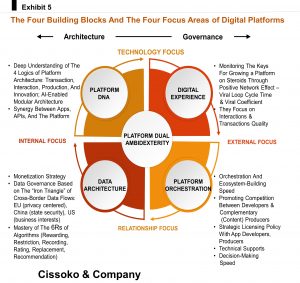
A platform ecosystem is a classic co-opetition in which a firm competes with its direct competitors while cooperating with its complementors. These application programmers build apps on its platform. For example, according to Gawer and Cusumano, in 2002, the three rules of the game regarding Intel’s platform dominance in the past decades were PC-based architectural innovation sponsorship (fueling outside) and open innovation.
Winning in the competitive world of digital platforms requires an ambidextrous strategy. First, a digital platform must simultaneously use its architectural capabilities regarding synergistic interoperability concerning future game-changing innovations and governance know-how. Second, the platform needs a strategy to attract customers while having a strategy in place for retaining them. Hence, ambidexterity is the key.
However, the elements that attract may often differ from those that retain the customers’ users on the digital platform. So, winning requires the platform proprietors to think strategically at the outset about the strategic architectural elements of the platform that will be necessary to change the game regarding innovation, among others, including other tactical and strategic design elements. Failure to plan strategically in advance may hinder the platform’s growth in reaching its critical mass; at this point, the positive network effects begin to show their power.
Step 5. Sustaining Growth and Network Effects Through Critical Coefficients
Advertising your way to a critical mass is a dangerous distraction. Our experience suggests that many of these marketing initiatives fail miserably. Pretending otherwise is being woefully profligate — particularly for startups — for whom wasting resources may be akin to mortal sin, given that lowering costs should be part of a startup’s DNA. For these reasons, the best option is to fast-track your disruptive strategy through the viral approach. In truth, going viral has been around for quite some time. However, knowing that something works and having deep insights regarding what it takes to win are very different things; indeed, this is where the winners separate themselves from the pack.
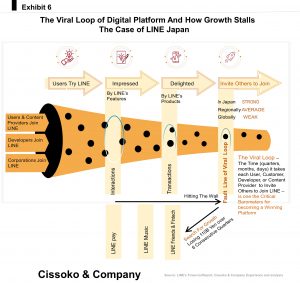
Our research points to two critical elements or parameters that separate the winners. The first is the coefficient of virality—the percentage of new platform users times the average amount of outbound invites from the actual (enthusiastic) users. We believe this conversion rate should be greater or equal to 30%. Below this threshold, the probability of viral growth failure increases dramatically over time.
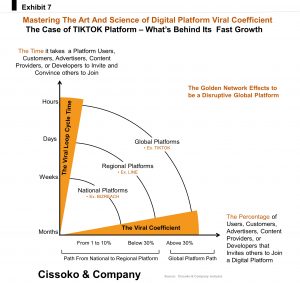
The second parameter is the cycle time—the average time, the number of hours or days a delighted platform user takes to trumpet calls for all contacts and friends to join. So, the fewer days, the quicker the platform can reach the critical mass needed to sustain a positive network effect. Ideally, our experience suggests that a three-day cycle time is the optimum in our winner-takes-all environment.
Essentially, when people join your platform, you satisfy them, and you must make sure to convert at least 30% of them to stay or turn them into buying customers. Then, give them some incentive (e.g., 500 GB of free Dropbox space) for anyone who invites a friend or colleague within a few days or hours. The faster, the better. Do the same again with your new customers, and the cycle of going viral continues.
Get in Touch
We will respond to your message as soon as possible.
Insights to Win
Subscribe to our newsletter for in-depth analysis, reports, and our perspectives on business and economic issues related to the Japanese market and the global economy.