
Leading With Meaning: A CEO’s Guide to Improving Performance With Purpose
In a world where trust in corporations is evaporating and inequality is rising rapidly, customers demand where brands stand on social justice issues and the common good. Moreover, climate change is threatening businesses, small and large—compounded by COVID-19 disruptions. In this challenging economic environment, which kinds of firms are thriving? The clear answer is purpose-driven organizations. They are winning and will keep on succeeding in the decades to come.
Unleashing corporate purpose, the reason a firm exists beyond profit-maximization goals while acting responsibly for the common good, sends strong signals to customers. A company’s purpose suggests that the organization considers the best interests of stakeholders other than shareholders’ short-term oriented profit-seeking exercise regarding market share. Thus, as a driving force, purposeful firms act, behave, and innovate by causing no harm with their products or services while making a difference in improving lives.

Indeed, these purpose-driven actions spill over as halo effects on the products and services that a firm makes or delivers. For one thing, the actions of a purposeful firm positively influence the consumer’s perception of the entire organization. This is known as inference making – the process by which consumers use information about a company’s attribute, such as purpose, to infer information about other unknown characteristics of the firm’s products and services that are not readily apparent.
A company’s purpose can be a powerful shield against product or service scrutiny from customers, regulators, and society, given that people will infer that products or services from a purposeful organization are better than the competition regarding quality standards, fair wages, production process, product content regarding fat and calorie, for example. As a result, they increase their value substantially over time. The data reveals that over 18 years, purpose-driven companies – referring here to those with strategies based upon the triple bottom line increased their value by more than 45%.
Leading With Meaning: How to Unleash Corporate Purpose
We believe the six steps below can help businesses start with their purpose. COVID-19 has been a perfect human tragedy where in America alone, COVID-19 casualties equal to over 41 Iraq and Afghanistan wars, 97 9/11 attacks, and closing in six Vietnam wars. Indeed, we have proven below the significant impact of prioritizing employee well-being and workplace safety on corporate performance through data in developed and developing countries.
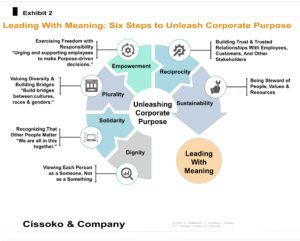
Before COVID-19, the expected economic loss related to death expectancy between 2010 and 2030 was more than the jaw-dropping $60 trillion. Moreover, according to the International Labor Organization, more than 6,250 people die every day due to job-related diseases and occupational accidents, which is more than 2.2 million per year. In contrast, diseases cause over 85% of deaths.
Thus, firms need to double down on employee well-being and workplace safety through the COVID-19 crisis and beyond. According to our research, the good news is that organizations that prioritize workplace safety and employee well-being have performed better than the S&P 500 over 13 years by 78.72% or 5.27% per year. Again, in South Africa, employee and workplace safety-conscious businesses outperformed the Johannesburg stock exchange by over 24% per year over 10 years. In other words, doubling down on workplace safety and employee well-being is an excellent strategy.

The problem with unleashing corporate purpose at many organizations is that most believe practicing ethical, social responsibility grounded on moral values will reduce profitability. That may be true in the short run. However, our experience and the data suggest otherwise.
Make no mistake; a company’s purpose is not the same as the “shared values” by Michael Porter of Harvard and Kramer (2006 and 2011). For one thing, “shared values” can turn an organization’s purpose into a greenwashing exercise. Moreover, the big hole of “share values” arguments regarding an organization’s purpose is that it lacks real commitment to society, sustainability, and social justice.
Consider this: BP used to be hailed as the pinnacle of a responsible organization. However, cost-saving imperatives blindsided the firm in reducing costs by skimming the badly needed maintenance, which resulted in reputational, environmental, and financial crises. Since over 178 were missing, 18 people died due to cutting corners in the maintenance standard in 2005.
To be sure, unleashing corporate purpose in many instances across different parts of the world calls for external stakeholder dialogue to create win-win cooperative working relationships between a business and its stakeholders. Indeed, we believe that sound strategic management takes the network of the whole stakeholder gamut into account. In other words, stakeholder engagements need to be a lynchpin of corporate purpose. For one thing, meeting the expectations of various stakeholders as a modern corporation—a social institution—hinges on the firm’s legitimacy within these stakeholder constituencies. Today, many organizations are becoming benefit corporations or getting certified as B Corp. This can help companies navigate their sustainable objectives by targeting and benchmarking the areas that need an organization’s attention and ongoing commitment.
Unleashing Corporate Purpose Through Diversity and Inclusion
As we all know, 2020 has spotlighted workplace diversity, inclusion, equity, and dignity. However, well-intentioned organizations have been struggling for decades to navigate the challenges associated with this element of an organizational purpose. According to our experience, when companies deploy the tools of organizational justice, they dramatically improve dignity and equity in their quest for becoming truly diverse, inclusive, and fair companies. Organizational justice (fairness) provides insights into the degree to which other stakeholders perceive a company as fair within and outside the company.
Thus, asking tough questions about the four legs of organizational justice—distributive justice, procedural justice, interpersonal justice, and informational justice—can be eye-opening.
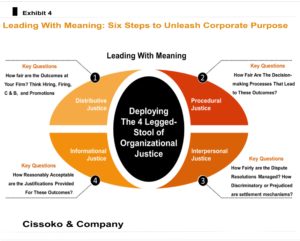
Companies need to stop sending confusing messages across their supply chains. They insist on safety and fair wages while purchasing executives pressure the same supply chain partners for low-cost production and inputs with an increasingly challenging production schedule. However, they are aggressive in their quest for efficiency, exacerbated by the lack of visibility across their supply chains. They fail to restore diversity within their value chain partners regarding minority and other ethnicity partners.
The Imperatives of Sustainability and Climate Change
Stockholm revealed that nearly 30% of aviation emissions from the city’s residents could be traced back to business travel. Thus, we believe that policies such as urging employees to use other alternatives to flying if the same journey can be made by train.
Moreover, to make the corporate carbon emissions goals relatable, it is a good idea to translate (compare) the daily, weekly, or monthly carbon emissions within the organization to the deforestation factor or into car equivalent emissions for employees to truly internalize the dangerous impacts of the firm’s carbon footprint. Furthermore, businesses can set a target against a base year this year or last year’s emissions and provide a roadmap for cutting their climate footprint a la Microsoft to be carbon negative by 2030.
Barriers to Corporate Purpose — Sustainability and Other Business Risks Ahead
As of December 2013, over 60% of American oil refineries were in highly vulnerable areas to rising sea levels. Indeed, climate change poses uncertainty regarding many firms’ valuations while making their prospects riskier.
Again, the SEC released its Climate Change Disclosure Guidance to let companies know its position on climate-related risks and the importance of this disclosure for companies’ valuation regarding information accuracy and investor protection because climate risks are by their nature forward-looking and considered reasonable. Thus, like other important future issues, they need to be communicated to investors to avoid potential litigations. A study by Andrea Vittorio in 2017 revealed that over 70% of firms worldwide did not disclose climate-related risks in their financial statements.
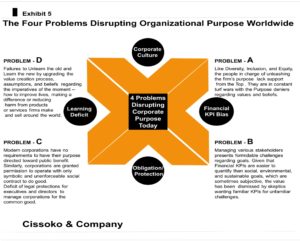
Indeed, the lawsuits filed against Peabody and ExxonMobil by the New York Attorney General are a subtle reminder of what the future holds regarding climate-related litigations from investors in the coming years. Above all, we are aware that many firms are racing to unleash their purpose. However, our experience suggests four barriers disrupt organizations wanting to unleash their purpose.
Culturelike diversity, inclusion, and equity, the people in charge of unleashing the firm’s purpose lack support from the top management. They are in constant turf wars with the Purpose deniers regarding values and beliefs.
Financial KPI bias dominates the business world, and managing various stakeholders presents formidable challenges regarding goals. Because financial KPIs are easier to quantify than social, environmental, and sustainable goals, which are sometimes subjective, skeptics who want familiar KPIs for unfamiliar challenges have dismissed their value.
The deficit of legal obligation and executive protection—modern corporations have no requirement that their purpose be directed toward public benefit. Similarly, corporations are granted permission to operate with a symbolic and unenforceable social contract to do good. There is a deficit of legal protections for executives and directors who manage corporations for the common good.
Knowledge deficit: Failures to unlearn the old and learn the new by upgrading the value creation process, assumptions, and beliefs regarding the imperatives of the moment to improve lives, make a difference, or reduce harm from products or services firms make and sell worldwide.
This guide bears the value and business case for doubling down on purpose. CEOs can now begin the hard work of leading with meaning by unleashing their organizations’ purpose and ultimately improving their corporate performance. Beyond an agile team, building a resilient team and developing a CEO’s strategy IQ can make a huge difference. Understanding why leadership matters for building a winning culture is imperative as well.
Get in Touch
We will respond to your message as soon as possible.
Insights to Win
Subscribe to our newsletter for in-depth analysis, reports, and our perspectives on business and economic issues related to the Japanese market and the global economy.