
A Strategy for the Strategist: How to win Again—and Beat Competitors Post-COVID
Crises and disruptions such as COVID-19 are frustratingly challenging moments that no CEO wants to witness in his entire career. However, the silver lining part of disruptions is that they test CEOs’ and business leaders’ strategy IQ. In other words, crises and disruptions reveal whether a CEO has a profound grasp of the strategy game regarding decisions, strategic moves, and priorities, to name just a few.
The first section provides insights into the two common types of disruptions organizations face while clarifying the differences between the kinds of interventions that CEOs can provide to their organizations. In the second part, we dive deeper by providing the strategy for the strategist to win again and beat the competitors post-COVID.
Crucial CEOs’ Questions During Times of Disruptions: Are we in
Distress or in a Crisis?
Our experience suggests that many CEOs make wrong decisions regarding downsizing and turnaround strategies. In fact, during the 2008 economic crisis, among the 4,700+ listed firms on the S&P 500, many doubled down on the wrong strategy regarding retrenchment (cost and asset reduction). As a result, many failed just a few years after deploying a short-term fix that proved to be anything but a strategy. In fact, over 8 million Americans were laid off in 2008 alone.
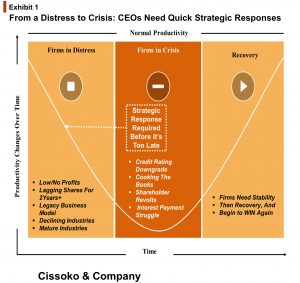
What are the lessons of the 2008 financial crisis? Companies trying to be more efficient through retrenchment without a strategy behind the decisions were two times more likely to go under than those with a well-developed strategy. That is, how and where to downsize without weakening their future strategic capabilities.
To avoid the fate of other disrupted firms, this article provides CEOs and business leaders the insights to weather any actual or future downturn while emerging stronger and better than the competition post-COVID-19. While firms can be disrupted even during a good economy, there are differences between companies in distress and crisis. While the latter is more serious and requires more urgency, business leaders should not take the former trouble lightly.
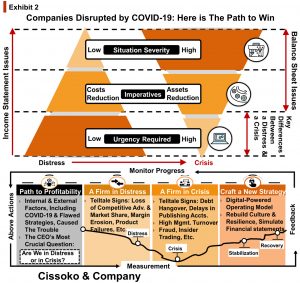
While at first, a business leader may not know with certainty the cause of the ailment plaguing his firm, an obvious but crucial question a CEO needs to ask is: are we in distress or a crisis? This question is simple yet powerful because the two situations require different types of strategic interventions. Similarly, business leaders need to be on alert regarding signs of distress and crisis to respond as quickly as possible. This early sensemaking can allow companies to act swiftly before a distress situation becomes a full-blown crisis, requiring Herculean efforts and strategy IQ.
This second part will discuss the main game, “A Strategy for the Strategist,” And show business leaders how to be strategic in dealing with the challenges of the disruption tsunami. The disruptive situation across industries calls for controlling emotions and avoiding costly band-aid solutions worse than the disease. Simply put, we will guide CEOs in deploying business economics tools to win today and in the post-COVID era.
The View From the Golden Triangle for Strategic Insights
The product or industry life cycle will provide insights regarding the company’s product or industry at a given time and the trends. It will also enhance the strategic decision-making regarding cost-cutting. Indeed, some costs, such as R&D and innovation, may be considered investments, given their future potential. Similarly, the firm’s or product’s positions on the lifecycle curve can provide insights regarding the type of talent required for growth, branding, and innovation. A flawed cost-cutting decision at this level will hamper the company’s future strategic capabilities for exploration, for example.
The industry where a firm operates needs its tailored strategy—given that not all industries are created equal, the imperatives are also dissimilar. For example, oil & gas or shipbuilding firms are in asset-intensive industries. However, companies in pharma, chemical, and high-tech industries, for example, are in innovation-intensive industries calling for more R&D and innovation. Discerning these two parameters of the strategic decisions is crucial in weathering COVID-19 or other disruptions while considering the future capabilities of an organization to win the game.
Strategic Capabilities Game—Linking the Product Lifecycle to the Financial Statements
Strategic capabilities, in short, are a company’s ability to dynamically deploy its resources effectively and efficiently than the company for producing a given result. As such, an economic downturn or disruption is unforgiving. Strategic mistakes reduce the likelihood of successfully weathering the storm, which is more difficult, let alone beating the competition in the future because CEOs who make costly mistakes in depleting their capabilities will not have a future, given that they will be either out of business, bankrupt or swallowed by the competition.
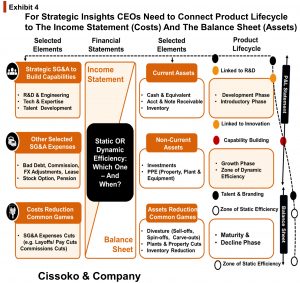
The first order of business calls for linking each product lifecycle to the financial statements, particularly the income and balance sheets. In other words, product development in the mid-growth stage is akin to the economics of innovation-intensive industries such as pharma and high-tech. For example, product versioning is one way for companies to get ahead of the curve in the software industry.
Static and Dynamic Efficiency: Which one—and When?
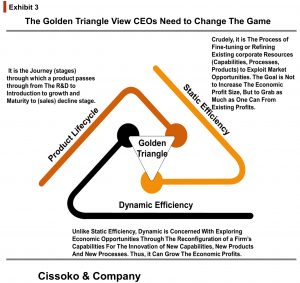
Firms operating in asset-intensive industries have almost the same economic logic as mature and declining products on the product lifecycle curve. In that sense, the strategic game here is static efficiency—fine-tuning or refining products or optimizing assets efficiently. The Strategic game of economies of scale, curve out, spin-off, and industry exit are some options organizations consider in their strategic calculus.
In many cases, the game is no longer about increasing the economic profit size of a given market or industry, which may be stagnant or declining, but about maintaining market share and profit margins through cost leadership. Arguably, this is the territory of the old-school strategy well documented in Porter’s Competitive Strategy, which is grounded in static efficiency by shifting corporate resources as efficiently as possible. Tactics such as closing factories and reducing the number of employees or their salaries with short notice are key elements of static efficiency. Thus, according to our experience, static efficiency often results in short-term performance improvement. However, it enhances operational efficiency.
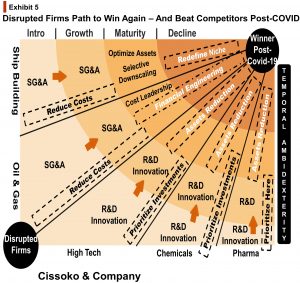
On the other hand, the strategy logic is dynamic efficiency companies try to increase the size of the economic pie through the process, business model, or product innovation while doubling down on R&D investments and risk-taking. It calls for more exploration of different economic possibilities. Said differently, dynamic efficiency refers to the efficient use and improvement of organizational resources, such as talent and other assets, to innovate and reconfigure existing capabilities.
To win the strategic capability game, an organization needs to reconfigure new assets into its existing capabilities faster than the competition. It must also be careful not to degrade or deplete its existing strategic firepower.
In the platform economy characterized by a fast-changing business landscape, rapid technological advances, and sophisticated consumers, capability-building needs to move in tandem to remain relevant and competitive. As such, organizations disrupted by COVID-19 or not need both combinative capability (the ability to synthesize and deploy existing and acquired knowledge) and architectural competence (the ability to develop outside knowledge beyond the organizational frontier and integrate it through agility with the accumulated know-how). Indeed, architectural competence is a significant differentiator between top performers and the average companies across industries such as pharma and biotech.
For ambidexterity to be temporal, firms must balance static efficiency, which optimizes operational excellence and dynamic efficiency grounded in exploration and risk-taking for breakthrough or disruptive innovation. However, CEOs lack patience for the long-term imperatives of the competition-beating dynamic efficiency through exploration because they can take three to five years to bear fruit.
For this reason, many business leaders are inclined to exploit to satisfy shareholders and analysts. We believe this is a mistake and urge business leaders to rethink their approach. Absorptive capacity—the ability to recognize the value of novel outside information, integrate it, and deploy it to commercial ends—is required for exploration. Without this capability, disruptive or breakthrough innovation is increasingly becoming a pipe dream across many sectors of the economy.
It must be clear that an organizational capability to innovate depends significantly on its current accumulated knowledge over the years and its technological assets. This creates a double-edged destiny for businesses, given that the more accumulated tacit knowledge a firm has, the better its chances of becoming more innovative. At the same time, the poorer an organization is regarding knowledge stock, the weaker its innovative muscle becomes.
As the exhibit above suggests, companies in asset-intensive industries, such as oil and gas, need to focus on the cost aspects of their downsizing—not the assets—to win by preserving their capabilities. For example, selling, general, and administrative (SG&A) needs to be linked to its cost center and downsized accordingly.
However, firms in innovation-intensive industries—such as high tech—need to do the opposite when weathering the storm while protecting their core strategic capabilities for tomorrow. Thus, in our experience, they need to focus on the assets on their balance sheets while avoiding the income statement.
The economic wound from COVID-19 will take many years to heal across several industries. The question is not how disrupted a company is but how it can strategically play the game as a Pro to emerge more robust than the competitors post-COVID-19. As we all know, resources become scarce during economic disruptions. Thus, a strategic mistake by business leaders or CEOs can be very costly and compromise the viability of an organization. Given our experience dealing with downturns, we hope CEOs can hit the ground running after reading this article.
Get in Touch
We will respond to your message as soon as possible.
Insights to Win
Subscribe to our newsletter for in-depth analysis, reports, and our perspectives on business and economic issues related to the Japanese market and the global economy.