
Lessons From Apple and Samsung: How Disrupted Firms can Still Beat Competitors Like a Joke
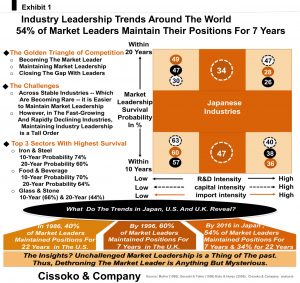
Unchallenged industry leadership is a thing of the past. Thus, dethroning the market leader is anything but mysterious. This article will show you exactly how Samsung and Apple did it. For starters, understanding the trends regarding the competitive landscape, market share, and industry leadership is imperative. For one thing, the golden triangle of strategy is firmly grounded in three key games. To be the market leader, maintain industry leadership, and catch up with the industry leader by closing the gap.
For how Long can a Firm Maintain its Market Leadership?
The trends since 1975 are as follows. In 1986, 40% of market leaders in the United States maintained their industry leadership positions for 22 years. By 1996, 60% of market leaders in the United Kingdom held their positions for just seven years. Again, by 2004, in Japan, the downward trends were worsening.
Indeed, the number of businesses maintaining market share leadership for seven years nosedived by 6% to 54%. Similar trends emerged for the number of Japanese firms that could survive the market share leadership battle. As such, market leaders maintaining their crowns for 22 years decreased by 6% to 34%. Insights into the underlying industry trends prove that dethroning or closing the gap with a market leader does not require rocket science.
The game has many streams in strategy practices, from growth to profitability. However, in our experience, the most crucial technique many lagging firms (including startups) lack is catch-up and leapfrogging strategies. These strategies can be disruptive or otherwise. The ultimate goal is to close the gap between a firm and its competitors and hopefully dethrone the industry leader in the process.
Our studies of Apple and Samsung suggest that disrupted companies can pursue many options to reach the top. Paradoxically, touted tools such as artificial intelligence, machine learning, and the like are part of the story; however, they are not what these two leading organizations used to become their sectors’ bellwethers.

Before going any further, it will be imperative to discuss two famous curves—the bell curve (normal distribution) and the power-law curve (Paretian distribution)—because of their profound implications for organizational productivity, given their underlying assumptions.
Grounded in industrial organization economics of the old order, the assumptions underlying the normal distribution are well-established, which means that most of the company’s productivity is centered in the middle. Yet implicitly admitting that the productivity between employees does not vary that much. These mindsets and assumptions provide a flawed like-for-like comparison regarding employees’ salaries, promotions, and raises, among others.
In other words, this paradigm allowed organizations to deal with compensation and benefits quickly while ensuring that firms were efficient with payroll issues. Some organizations are run by efficiency warriors, consistently asking the minimum number of employees we need this week, this month, or next year. Some even have preemptive layoff strategies for the sake of misguided savings. As such, they become their own enemies after weakening their organizations by firing the most productive employees. Consider this: over the six years through 2000, American firms fired over 12 million people, with over 73% being office workers, which means talented people.
Thus, the problem with these assumptions is that they don’t allow firms to catch up with the competition. Given that, for many firms, leapfrogging may require a divine intervention, consider this analogy. If two cars, A and B, are moving at the same speed while car A moves five hours before car B. Everything else being equal, car B will never catch up, right? What does car B need to do to close the gap? It needs to speed up faster than A. In other words, when a firm is in catch-up mode, it needs to be more productive than the leaders to close the gap; otherwise, only a miracle can save the day. That’s what Samsung did to dethrone others.
Samsung’s Catch-up Strategy: Dethroning Market leaders
As one of the world’s leading firms engaged in the manufacturing of electronic gadgets and their components, Samsung knew earlier that the way to boost the productivity of its workforce was to add a percentage of people more than required. That is, the company used the assumptions of the normal distribution of productivity to its advantage. If 68% of employees’ performance is close to the average, you need more people to boost productivity. For this reason, Samsung’s 20% HR rules were established. These HR rules are deployed on top of the internal competition among executives. This means that for an executive to move higher through the ranks, his division needs to perform well, even above expectations. Otherwise, you may be politely asked to step aside while letting executives from top-performing divisions run the show.
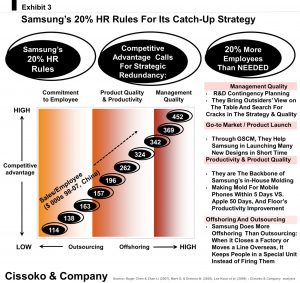
To fully deploy this strategy of the 20% HR rules, the Korean giant – unlike its competitors – uses more offshoring and less outsourcing. Samsung owns 90% of its assembly plants compared to Apple’s almost zero (owned by EMS). It has internalized most of its hardware and supply chain-related complementors. Again, compared to Apple, Samsung has a higher internalization ratio of 36% versus 7% for Apple, referring to the percentage of production made by affiliates, which Samsung had 73+ in Dec. 2013.
Similarly, regarding localization and production within Korea, Samsung has the edge at 42% versus Apple at 17%. For this reason, thanks to Samsung’s 20% HR rules, from 1998 to 2007, the sales per employee in China grew by 296% to $452,000 per employee.
It is important to note that up until the early 2000s, Samsung was still the laggard, and the strategy’s success was far from assured. Given that during this period, Samsung’s market value was around 10% of Sony’s in 1999. However, with the dramatic boost in productivity and the cracks that appeared in Sony’s strategy, Samsung overtook Sony by the fourth quarter of 2002. That was just the beginning!
Height years later, by the fourth quarter of 2010, a spectacular event happened before the eyes of Japan Inc. What was that? Samsung overtook the market capitalization of Japan’s four largest electronics companies in Japan at the time. We don’t mean one by one. The South Korean titan surpassed the market capitalization of NEC, Toshiba, Sony, and Panasonic combined. However, that’s not all!
Again, four years later, by the end of the first quarter of 2012, Samsung dethroned the almighty Nokia and became the world’s top mobile phone maker by unit sold in 2013 by grabbing the crown from Apple. This leapfrogging aligned with our expectations regarding maintaining the industry’s leadership crown. Dethroning a market leader is more straightforward than business leaders can imagine.
Apple Japan’s Catch-up Strategy Through the Power-law Game
In the case of Apple Japan, it used the power curve game, which is the most appropriate strategy for many organizations in the platform economy. T the past decades, the game of organizational and economic productivity has changed, meaning that few people, the outliers, drive firms’ growth strategy and financial performance across most industries. The power law is visible everywhere. Consider this: the top 10% (decile) own 48% of patents and 93% of national foundation grants. Similarly, the top 10% have 70% of United States wealth, and the wealthiest 10% control 89% of U.S. stocks.
The process works through the Paretian distribution, where the top 10% of employees produce 25% or more of the firm’s productivity. In other words, catch-up strategies call for the top quartile (25%) to deliver 50% of organizations’ productivity. To be clear, these people can be anyone from programmers to salespeople to CEOs, among others. You can’t measure them by one-off events. An appropriate timeframe is required, said one or two quarters. In other words, there is a reasonable timeframe to uncover these people regarding their disproportionate productivity.
After six years in Japan and nearly 16 years after founding the parent company, Apple Japan began to see true momentum in its business in the Land of the Rising Sun. It changed its trajectory to catch up with its competitors in Japan when it hired the 20-year veteran of Toshiba, Shigechika Takeuchi, after changing its Japan head many times without hope. The outlier Takeuchi changed the game for Apple Japan and brought hope where there was none. Productivity increased dramatically, shipment jumped by more than 40%, and sales hit $650M within a short period. Fast forward to 2020, Apple Japan’s revenues hit $20.4 billion. Thus, from a laggard, the firm became a leader.
In short, disrupted firms by the COVID-19 shouldn’t lose hope. The more complex the battle, the more glorious the victory. What opposes a company needs to strengthen it. Therefore, with the right catch-up strategies, today’s upended organizations can be their industries’ vanguards, as Apple and Samsung did.
Get in Touch
We will respond to your message as soon as possible.
Insights to Win
Subscribe to our newsletter for in-depth analysis, reports, and our perspectives on business and economic issues related to the Japanese market and the global economy.