
Winning With Meaning Through Purpose: What’s the Best Shield Against the Competition?
A company’s purpose is the reason it exists. Thus, it drives the type of strategy the firm chooses and refuses. Unlike the strategy, which changes regularly, an organization’s purpose is more enduring. In other words, the purpose needs to go beyond short-term financial performance goals and include all stakeholders. Similarly, it needs to put people first and add value to customers. Moreover, a firm’s purpose needs to have the best interest of society at its core through strong ethical standards. Furthermore, the psychological contract derived from the purpose needs to prioritize employee well-being and engagement.
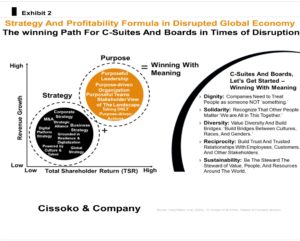
Given that many strategies are crafted and revised through short-termism lenses, given the increasing pressures from shareholders and analysts, a firm’s purpose is more than the strategy a firm chooses for a given time frame. Thus, Unleashing corporate purpose calls for organizational integrity. Because each dishonest act reduces subordinates’ and other stakeholders’ trust in the entire company, in the worst case, their respect for their superiors evaporates overnight. Said differently, when the corporate purpose espoused by an organization’s leaders is in direct contraction with what it does daily, it can damage a psychological contract within the four walls of an organization that unites crucial stakeholders.
Purposeful organizations have made—and continue to make—the world better and change the world. Make no mistake: a company’s purpose is greater than the money in its bank account and nobler than C-suited titles that need to unleash it because it is more than just making money. The history of business and management is littered with stories of purpose-driven organizations going into hell for a heavenly cause.
However, with all that beauty and competitive advantage deriving from purpose, many organizations and their CEOs have been on the fence for quite some time, given that they did not know the Return on Purpose. Many have been victims of the shining object syndrome from the hype of digital transformation, the potential of artificial intelligence, and big data analytics. Technology discussions seem to dominate the boardroom discussions, including the threats from cyberattacks – the hardware parts of the equation. As such, many business leaders have been blindsided and distracted by Tech noise.
However, missing from the discussions is the most powerful shield against the competition – purpose. That’s why the enlightened CEO of Black Rock, Larry Fink, titled his letter to shareholders in 2019 “Purpose and Profit.” This title is the natural order of business. Because purpose comes before profit, with profit or not, purposeful organizations have existed and will continue to exist.
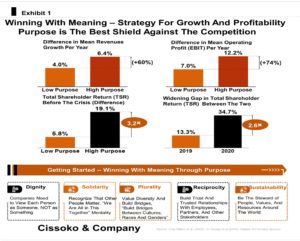
Larry Fink’s action resulted from converging trends that stakeholder capitalism – not shareholder capitalism – is the way forward. Our analysis suggests that highly purposeful firms beat firms with low purpose in revenue growth by 60%. In operating profit margin (EBIT) — purpose-driven companies outperform low-purpose firms by 74%. Again, when it comes to total shareholder return (TSR) before and after the crisis, purposeful organizations beat the low purpose by 13.3% in 2019. Furthermore, when the COVID-19 crisis hit, the gap between the two groups kept widening — from a 13.3% difference by the end of 2019 to 34.7% by 2020. We believe that companies need to get serious and double down on their purpose to fend off competitive threats while thriving during the crisis and beyond.
According to our experience, many firms can claim to be purposeful with scant evidence during good economic times. However, as Warren Buffett put it, when the tide goes out, you learn who has been swimming naked.’ Thus, the litmus test of an organization’s purpose is how it treats people when the ship begins to sink. This test is crucial during times of crisis, such as COVID-19, where many companies downsize indiscriminately.
How do Purpose-Driven Companies Manage to Downsize (Rightsize) During a Crisis?
Purposeful organizations manage the downsizing process with responsibility. They believe any action they intend to take must be congruent with their purpose and values. As such, layoffs are used as the last resort – if at all. Even when the going gets tough, such as during an economic downturn, they do their very best for the laid-off employees when seeking new jobs, providing training, helping them prepare for interviews, and writing great letters of recommendation (Exhibit 2). Similarly, they keep in touch with them to bring them back when the economic conditions improve. CEOs and business leaders can learn a great deal from leading firms such as Philips and Cisco Systems because of their purpose-driven approach to handling the process.
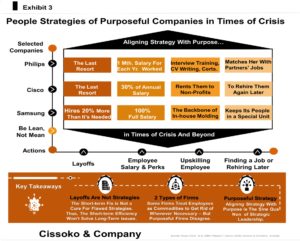
The strategy behind these actions is that the company’s doors are still open when there is a light at the end of the tunnel. The company will not need to waste resources on recruiting unfamiliar (new) employees who do not understand their cultures, given that they have strategically built a bridge between themselves and their departing employees. Similarly, through their excellent experiences and company experiences, these employees can become indirect ambassadors who promote them because of what they have experienced with them during challenging times. Thus, beyond purpose, this word of mouth from former employees is a great PR and enhances their employer’s brand worldwide.
Companies need to double down their corporate purpose to win the corporate performance battle (profitability and growth) during COVID-19 and beyond. Purpose-driven organizations care deeply about the well-being of their employees, which is associated with high performance. On top of that, when an organization becomes highly purposeful, consumers will love you, employees will fight for you, and shareholders will smile with you. Above all, the society at large will recommend you. Thus, we highly recommend your company to be a purpose-driven organization in this age of stakeholder capitalism and climate change.
Get in Touch
We will respond to your message as soon as possible.
Insights to Win
Subscribe to our newsletter for in-depth analysis, reports, and our perspectives on business and economic issues related to the Japanese market and the global economy.