
Building a High-performance Culture in Times of COVID-19: Why Leadership Matters?
Building a high-performance culture in this chaotic economic environment requires the best leadership skills for the challenges of the moment. In other words, leadership matters, given its influence on organizational performance and perception regarding ethics, purpose, empathy, fairness, inclusiveness, and followers‘ motivation across the whole stakeholder gamut.
As the COVID-19 pandemic continues its Black Swan disruption of the global economy, the vulnerability of large and small organizations is on full display across industries. The crisis is pressuring firms to race against the clock to stay afloat. As of this writing, there were 500 corporate bankruptcies in Japan, 39,000,000 cases of COVID-19, and more than one million deaths around the world. As such, these unprecedented challenges call for relevant leadership skills across organizations to tackle these disruptions. Given that not all leadership skills are created equal when it comes to building a high-performance organizational culture.

Indeed, with all the technological advances, most companies, given their toxic cultures, were ill-prepared for the emerging remote work of the future. Since we all talked about digital transformation and becoming an agile organization, many firms have been dragging their feet across industries. As a result, when the COVID-19 outbreak began in China, their business leaders were taken off guard.
Thus, panic ensued within boardrooms, resulting in remote work transition chaos exacerbated by a trust crisis in many workplaces. For years, many organizations feared adopting remote work would negatively impact their productivity. That’s why the leadership of firms has been reluctant to change the culture by adopting and embracing novel communication technologies to get the jobs done.
Unfortunately, remote work has become mainstream today. This can be seen through Zoom’s valuation, which has swollen by nearly 690% this year. Managing virtual teams is part of the challenges, such as supply chain disruptions, building organizational resilience and agility, diversity and inclusion, etc.
The hard-nosed practical question that firms need to answer is: among the dominant leadership styles – autocratic, transactional, “status quo” transformational, and servant leadership, which one is the most relevant for the challenges of COVID-19? Our experience suggests that in our world economy, which is increasingly troubled by climate change, environmental assaults, sustainability issues, and currently with the tragedy of COVID-19, servant leadership skills are what businesses and their CEOs need to navigate the storms. Indeed, the concept has been around since the seminal work of former AT&T executive Robert Greenleaf in 1970. However, as the business world becomes more volatile, uncertain, complex, and ambiguous, servant leadership skills are increasingly becoming crucial today.
Why It’s Time for CEOs to be Servant Leaders for a High-Performance Culture
Tackling the challenges of the digital age calls for up-skilling and re-skilling the workforce to be more productive and competitive. Thus, the servant leadership style is very relevant in our coronavirus age. For one thing, the style emphasizes developing employees, providing emotional healing and support for communities, and developing tomorrow’s strong leaders, who in turn become servant leaders through contagion.
Similarly, during the past few months, the issues of diversity and inclusion and social and racial justice have become prominent in workplaces worldwide. We believe the failure on many of these fronts can be traced back to the critical lack of servant leaders across industries today. Consider this: last year, 181 leaders of some of the largest organizations in the United States belonging to Business Roundtable pledged to dump shareholder primacy in favor of stakeholder capitalism.
However, hypocrisy became evident when COVID-19 hit the United States. In the first month of the coronavirus crisis, the companies that made the solemn pledge were, on average, paying over 18% more dividends than those that did not sign the pledge. Also, the ones that made the solemn pledge were, on average, more than 18% more likely to fire their employees than the firms that did not sign the pledge, according to Tyler Wry of the Wharton School. This experiment was a classic case of organizational hypocrisy across companies lacking servant leaders. However, this was not surprising to the legion of critics of the Business Roundtable’s solemn pledge in August 2019. As a result, when organizations made pledges during the summer regarding Black Lives Matter, their statements and commitments were ignored as publicity stunts.
Thus, developing relevant servant leadership skills cannot be overstated. We believe business leaders can avoid this kind of embarrassment, where words and actions go in opposite directions. Stakeholders will always be watching and cannot be fooled by PR stunts to make headlines worldwide.
Again, as remote work becomes mainstream, the old-school command and control leadership skills can spell trouble at many firms. For one thing, they are inappropriate for the emerging workplaces of the future, exacerbated by the COVID-19 crisis. Moreover, trust in organizations has been decreasing for years. In fact, a Gallup poll found that over 60% of US citizens are dissatisfied with American ethical standards, given the raft of corporate scandals over the years. As such, servant leadership skills are what the next generation of CEOs needs to restore dignity and high performance through purposeful, employee-centered, and ethical leadership.
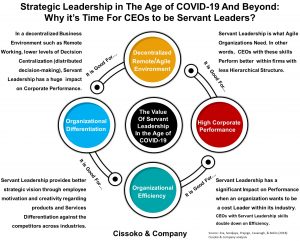
Furthermore, building organizational resilience through a pivot is the clarion call for strategic leadership during this crisis. As such, firms need to navigate the crisis based on the three-legged stool—strategic differentiation, productivity in the virtual environment, and organizational efficiency. Servant leadership style ticks these boxes, and it is badly needed for competitive advantage today while improving corporate performance.
Responding to COVID-19 Disruptions With the Right C-Suite Skills
Why was Paul Polman, the former CEO of Unilever, awarded the UN Foundation’s Champion for Global Change Award in 2014—while others did not? Because of his exemplary strategic leadership regarding stakeholder capitalism.
To be sure, the market logic on which free-market capitalism is grounded brought prosperity. However, it needs to be tamed given its obvious ramifications, such as corporate short-termism, the emphasis on a ruthless quest for value capture over value creation, which has pitted all stakeholders against each other (employees vs. business leaders vs. shareholders vs. competitors vs. the society)—rising inequality, a deficit of sustainability (social) view, and abnormal CEO compensation, just to name a few.
Above all, the ridiculous assumptions that we, human beings, are just selfishly seeking to optimize our utility (interest)—have glaring flaws. This myth has been debunked by behavioral economists —the newly emerging field of economics—in recent years.
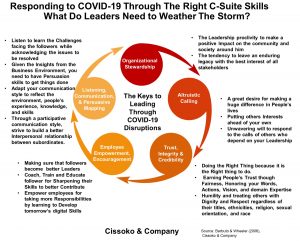
Our experience suggests that business leaders with servant leadership skills are the right types of leaders for navigating these market failures and flawed economic assumptions prevalent across many industries today. This is because servant leadership is the kind of leadership style that urges followers to voice their concerns by bringing to the management’s attention the real issues confronting the company. Above all, servant leaders believe they are accountable to the stakeholders they serve rather than the opposite, as many business leaders wrongly believe, or at least accountable to just shareholders.
In short, in this emerging age of stakeholder capitalism, where shareholder primacy has become a relic, CEOs need to develop more servant leadership skills within their walls than ever. For one thing, the leadership philosophy called organizational stewardship entails making positive contributions to society through a genuine commitment to sustainability practices and environmental and climate initiatives, which are increasingly becoming the hottest topics within C-suites of the largest organizations.
Why Servant Leadership Matters in this Age of Disruptions
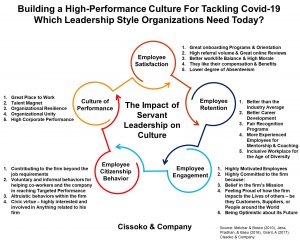
By developing servant leadership skills, corporate performance can improve dramatically, given that employees will be more satisfied, which, in turn, will enhance retention. The more experienced employees at a company, the better they can mentor and coach the juniors, which can improve employee engagement through commitment that can make people proud of the mission of the firm and its future prospects. Above employee engagement, employees begin to exhibit corporate citizenship behaviors, which go beyond the job description. In the end, all these cultural elements reinforce each other in building strong teams to improve corporate performance.
In our experience, each CEO’s servant leadership style will be a function of his beliefs, integrity, values, and moral character, among others. As such, each leader’s self-reflection regarding what he believes is crucial in aligning his actions with his espoused values in building a high-performance culture for the challenge of COVID-19 will be crucial. Therefore, the leader’s regular introspection is salient. Given that leaders’ moral character, ethical standards, and the situational challenges of the firm they manage need to guide a CEO’s actions regarding conflict resolution, decision-making, revamping toxic corporate culture, and unhealthy politics for delivering superior performance. The quest for organizational performance needs to be grounded in organizational justice, which refers to informational, interpersonal, distributive, and procedural justice among stakeholders.
In fact, Parolini, Patterson, and Winston revealed in 2009 that the vast differences between a transformational and servant leader in the dimensions mentioned above are the means of influence, development, ethics, focus, and motive in delivering high corporate performance. Again, one of the biggest differences between servant leadership and other leadership styles is that servant leadership is firmly grounded in unwavering ethical standards no matter what disruptive challenges arise. That’s why a business leader who has mastered these important leadership skills doesn’t manipulate followers through misrepresentation of facts through self-serving means.
We believe rethinking the digital age crisis is imperative for improving corporate performance. In our experience, servant leadership is the best for delivering superior performance when it comes to high-performance culture in this age of disruptions. Therefore, firms need to avoid being held captive by flawed leadership styles that are superficially relevant by adding a new pair of lenses to emerging challenges they are trying to solve.
Get in Touch
We will respond to your message as soon as possible.
Insights to Win
Subscribe to our newsletter for in-depth analysis, reports, and our perspectives on business and economic issues related to the Japanese market and the global economy.