
Changing ‘the Smell’ of Corporate Culture: How to win Like Satya Nadella
Winning in the platform economy is not all about artificial intelligence or technology in general. It calls for a human-centered transformation, changing the smell of the place (the context). The great success of Satya Nadella in turning around Microsoft, which was becoming increasingly irrelevant — after taking the leadership manteau from Steve Ballmer in 2014 is illustrative. Nadella’s success is a perfect trifecta of revenues hitting $250B, the firm taking the third spot of the most valuable companies, and the net profit topped $39B in 2020.
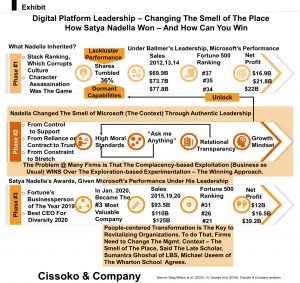
What did Satya Nadella Inherit From Steve Ballmer?
- A dysfunctional culture
- Stack ranking employees, which corrupts an organizational culture.
- Character assassination was the name of the game.
- Only those who are corporate politics savvy can thrive.
- Microsoft’s value had plunged by 36% from its 2000 peak.
- Lackluster corporate performance regarding sales, Fortune 500 ranking, and net profit
- Other direct or indirect competitors, such as Google and Apple, grew faster than ever imagined.
Satya Nadella Changing the Smell of Microsoft – The Context
With so many troubles inherited, Satya Nadella, an engineer who joined Microsoft in 1992, set out to change the smell of the place through a human-centered revitalization strategy. For this reason, in 2015, at a sales conference in Florida, Microsoft revealed its new strategic mission as a Tech company: “To empower every person and every organization on the planet to achieve more.”
As a Microsoft veteran, Nadella knows that his beloved company has enormous dormant power. The key to Microsoft’s success will require unlocking these static capabilities by changing the context at the firm—the smell of the place—as advised by his fellow Indian, the late distinguished professor at the London Business School, Sumantra Ghoshal.
From managerialism (just controlling employees) to support by demonstrating empathy through listening and learning for nearly 12 months while reducing the power distance between him and Microsoft employees through an open-door policy. He even told people at Microsoft to “ask him anything.”
From relying on contract to trust—Many things across modern organizations are implicitly based on a contractual agreement, from hiring to budgeting to other stakeholders’ relationships. As a result, trust between parties (stakeholders) has vanished over the years in the business world. Thus, changing the context of the smell of the place entails trusting people and other stakeholders without an over-reliance on explicit and implicit contractual agreements.
From constraint to stretch: high bureaucracy is one of the worst diseases afflicting large organizations. The related competing demand creates more constraints than needed, distracting employees from using their full creative potential within the corporate walls. Reducing these obstacles and replacing them with stretch goals has unleashed the full intellectual horsepower of the entire Microsoft like a dynamo converting mechanical energy into electrical energy.
Relationship transparency: This is one of the hallmarks of a truly authentic leader. Satya Nadella secured the commitment of his followers at Microsoft through this transparency in decision-making, where he encourages people to share their ideas and gives them a chance to express their opinions by ensuring that people follow through at the execution level. As a result, Nadella built a culture of openness and psychological safety, a prerequisite for building a culture of innovation and learning. In other words, Microsoft went from an “expert culture” where the company pretended to know it all and blamed whoever made a mistake to a culture of learning where mistakes are welcomed.
From a self-limiting and self-defeating mindset to a growth mindset—Nadella refocused Microsoft on customer centricity, doubled down on diversity and inclusion, and finally on unity. That is one Microsoft. Indeed, under his predecessor, Microsoft became a kind of federation of companies, which created a silo mentality across the board. The obvious consequence of such an organizational structure was unhealthy internal competition, gradually damaging the once-formidable culture at Microsoft under Bill Gates.
At the same time, to succeed, Satya Nadella needed to become the trend’s best friend. He doubled down on cloud computing, mobile-first strategy, and cementing Microsoft’s relevance; he strategically acquired LinkedIn, which refreshed the corporate brand.
Satya Nadella’s Transformation of Microsoft Paid a Huge Dividend
- He became Fortune Person of the Year in 2019.
- He became the best CEO for diversity in 2020.
- In January 2020, Satya Nadella’s leadership propelled Microsoft to the third most valuable company in the world while making his company number 21 on the Fortune 500—with sales of $125B and net profit soaring to another height—$39.2B.
Technology firepower is not enough in the platform economy, which is increasingly dominated by big data analytics and artificial intelligence. To succeed, organizations big and small and their leaders need to double down on human-centered revitalization during turnaround and develop a new mission or vision for their organizations. Simply put, it calls for changing the smell of the place in the corporate management context, as the late Sumantra Ghoshal correctly understood nearly two decades ago. Indeed, CEOs can learn a great deal about digital platform leadership from Satya Nadella’s human-centered authentic leadership style.
Get in Touch
We will respond to your message as soon as possible.
Insights to Win
Subscribe to our newsletter for in-depth analysis, reports, and our perspectives on business and economic issues related to the Japanese market and the global economy.