
Debunking the Myth of Digital Transformation: Which Transformation — and When?
Over the past seven years, several thousands of articles have discussed digital transformation. This year alone, over 29,000 papers were published about it through June. In our increasingly digital age, we believe organizations that have digitally transformed themselves perform better than their peers across the same industry by nearly 15%.
Indeed, Building COVID-19 resilience is the new competitive advantage. Because digitally-ready firms are doing better than others, given the lockdowns, stay-at-home orders, the new reality of social distancing, and the acceleration of remote working. Consider Amazon, Netflix, Zoom, and Apple; they are doing tremendously well in this chaotic business environment compared to others. That’s why Apple this week—through its share price appreciation of more than 70% since January—became the first U.S. firm to hit the $2 trillion valuation milestone. At the same time, Zoom saw its monthly users skyrocketing since the onset of the pandemic, like many digital platforms.
However, given the lack of clarity regarding digital transformation, confusion has engulfed C-suites worldwide for quite some time. As a result, some organizations are confusing digitization with digitalization. While others think digital transformation is about rushing to buy technologies without a clear strategy and value proposition, they intend to offer their customers—online and offline—anytime and anywhere. As a result, most digital transformation is a gambling exercise with disastrous consequences. However, many companies’ troubles have roots in flawed digital maturity assessment models.
The Hard Truth About the Digital Maturity Models—Most are Unreliable and Invalid
To be sure, companies large and small need to understand the level of digital maturity. Here are some of the most trusted digital maturity layers at the enterprise architecture level:
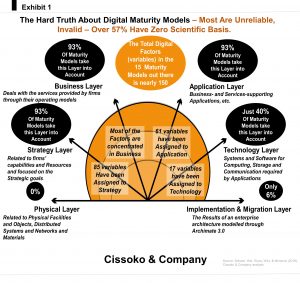
Strategy layer—deals with the resource capabilities, including people’s digital skill levels.
Business layer deals with the business development aspect, including marketing, sales, customer relationship management, customer experience, and social media.
Application layer—tries to ascertain the types of applications holding up the company as its backbone.
Technology layer—establishes the systems, technology, and software deployed for computation, manipulation of data, and communication purposes within and outside the firm.
Physical layer—deals with the hardware aspect regarding their locations, the distributed networks, and systems used within a company.
Implementation and migration layer—deals with processes such as steps taken to deliver the necessary results.
Over the past decade, we witnessed the proliferation of the so-called digital maturity models—around 15—to help businesses assess how mature and in which areas they need to focus their attention to start their digital transformation journey.
• Digital Maturity Matrix MIT & Capgemini (Westermann et al., 2014)
• Digital Maturity Model Universitat St. Gallen (Back & Berghaus, 2016)
• Digital Transformation Assessment (Fenwick & Gill, 2014)
• Gartner Taxonomies (Gartner, 2016)
• Digital Maturity Model IBM (Berman & Bell, 2016)
• Digital Capability Framework (O’Hea, 2011)
• The Digital Maturity Map (Mueller et al., 2006)
• Aligning Organization to its Digital Future (Kiron et al., 2016)
• Digital Maturity Model (TM Forum, 2017)
• Digital Maturity Model Hochschule Reutlingen & Neuland (Land, 2015)
• Maturity Model PWC (Greif et al., 2016)
• Survival of the Smartest 2.0 (KPMG, 2014)
• Digital Maturity Model for Telecommunications Service Providers (Valdez-de-Leon, 2016)
• DREAMY Maturity Model (De Caloris et al., 2017)
• Maturity Scape Model
Unfortunately, many of them are invalid and unreliable. For one thing, just 40% of those digital maturity models out there have incorporated the technology layer—while none of them has physical, implementation, and migration layers discussed elsewhere. In short, in our experience, just a handful of them can be considered insightful. In other words, recent findings revealed that over 57% have no validity or reliability in a comprehensive digital maturity assessment.
The invalid and unreliable models list includes the MIT and Capgemini Digital Maturity Matrix 2014, PWC’s Digital Maturity Model 2016, and KPMG’s Survival of the Smartest Model 2014. The digital maturity models trumpeted by most of these organizations above have no scientific basis — noted Schwer, Hitz, Wyss, Wirz, & Minonne in 2019 in the journal—Problem and Perspective in Management 16(4), 141-154. Just six among them—Digital Maturity Model Universitat St. Gallen (Back & Berghaus, 2016), Digital Transformation Assessment (Fenwick & Gill, 2014), Digital Maturity Model Hochschule Reutlingen & Neuland (Land, 2015), Gartner Taxonomies (Gartner, 2016), Digital Maturity Model IBM (Berman & Bell, 2016), Digital Maturity Model (TM Forum, 2017)—have assessment models that focus on four of the six enterprise architecture. Out of the 15 above, these six models have better chances of doing what they intend for firms.
Digital or IT-Led Transformation: Which Transformation—and When?
With the confusion mentioned elsewhere, we believe it is time to clarify what digital transformation is because we believe the time has come to explain the key differences between digital and IT-led transformations.
In the 90s, we all talked about an IT-led transformation and the strategic value of IT in delivering a firm’s value proposition to customers. However, since the mid-2000s, the narrative has dramatically changed. One thing is the rise of new technologies—including AI, cloud computing, and the profusion of data in our economy, among others. These emerging technologies have exacerbated misinformation and misunderstanding through the hype on social media. Moreover, like other buzzwords, the Internet and the traditional media amplified the dangerous half-truth about digital transformation. As such, here are the differences and similarities between an IT-led transformation and a digital transformation, given that confusing the two can spell disaster for firms during these times of the COVID-19 pandemic.
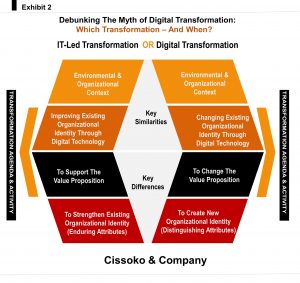
Most companies start their digital journey with environmental and organizational contexts that pressure them to embark on their transformations—by thinking about the best approach to take them from where they are to where they intend to be. Then, firms will have their transformation agendas. However, differences gradually emerge given the type of activities each business engages in and its ultimate goals for transformation. During an IT-led transformation, organizations will engage in transformational activities to improve their existing corporate identity by deploying digital technologies to support their current value propositions, strengthening their enduring identities.
In other words, in an IT-led transformation, firms do not want to change what makes them tick or the strategy and value propositions they have been implementing that work very well for the sake of a fashionable buzzword—digital transformation. These companies do not want to change their cultures by becoming Silicon Valley startups overnight with ping-pong tables while abandoning their formal business suits for woodies as the new norm.
They may at least cherry-pick what works well within the startup ecosystems worldwide. However, they don’t want to abandon their winning cultures and identities. Above all, the type of transformation they engage in is centered on ICT without dipping their toes in other advanced technologies, which they consider unnecessary. For example, consider a medical institution transforming itself to meet the imperatives of patient experiences by enhancing its value proposition through the electronic medical record (EMR) from paper-based record keeping.
In the case of a digital transformation, unlike the IT-led transformation, experience suggests that the ultimate goal of the transformation is to redefine an organizational identity through digital technology by changing the value propositions to create distinguishing organizational attributes. For example, when a legacy firm becomes a digital platform, it requires a different value proposition, given the nature of the digital platform ecosystem. Legacy organizations play by the rules of the old economy—the pipe model. However, the digital platforms work differently by orchestrating the entire platform ecosystem while delivering value. However, it does not end here. The platform needs to be ambidextrous in attracting customers while retaining them.
Agile During Digital Transformation: Where Do the Challenges Lie?
The COVID-19 pandemic has—and will accelerate digital transformation across sectors, particularly those firms and industries that have hesitated to embark on their digital transformation journey. With the ensuing Black Swan disruption, they must take bold actions and make the right moves to thrive rather than survive the watershed moment. For one thing, shambolic responses can spell disaster, given that the unfolding threats from COVID-19 are worrisome.
In other words, beyond resilience, organizations need to understand disruptions in the 21st century for better responses to COVID-19. Similarly, firms need to rethink their strategy around the world. By doing so, through a pivot, they can capitalize on the $700 billion opportunities by using the odds-defying strategies that CEOs can use to perform like a gold medalist.
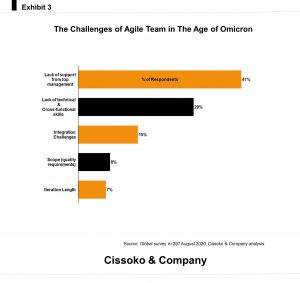
However, as the pandemic disrupted a considerable part of the world economy and pressured reluctant organizations to join the remote work bandwagon, firms’ data for machine learning models and agile processes have also been upended. Our survey of 397 firms worldwide suggests that businesses must fix many challenges within the agile teams to enhance their productivity.
Our findings revealed that the most significant challenges are the lack of support from the management (41%), followed by the lack of technical and cross-functional skills (29%). Similarly, 15% of the respondents said they had a tough time during the integration phase for estimation and coordination with multiple teams. Furthermore, the project scope presents formidable challenges regarding the poor quality of the requirements (8%). Finally, the iteration length has been frustrating across many agile teams worldwide.
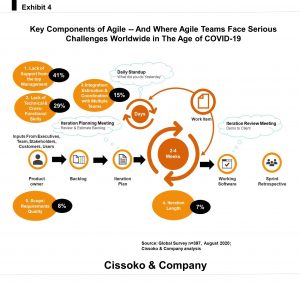
To deal with these challenges, the management’s participation needs to be active during agile coaching while closely managing stakeholders’ engagement processes. Moreover, the top management needs to assist in resources and communication management. Similarly, agile teams need to follow guidelines for optimal iteration length in these trying times. For the scope challenges, it will be necessary in many cases to fit the role to the specific demands arising from each project. As the survey revealed, integration presents serious challenges; experience suggests that agile tailoring and tailoring guidelines under PRINCE2 can serve stranded teams very well. As agile principles entail a considerable dose of adaptability, organizations need to provide the environment for schedule modification through modified multi-mode resource-constrained project scheduling models.
This kind of adaptability can be a true game-changer during complex projects—such as the complexity arising from size, scale, number difference and variety of elements, interdependence complexity, dynamic complexity regarding the variations in both the rate of delivery, and the change with which the projects keep moving and the complexity arising from uncertainty regarding both the levels of uncertainty or risk any and every element that a modern project carries. Indeed, having a dedicated framework for maturing agile team development can effectively solve problems disrupting many agile teams worldwide.
Get in Touch
We will respond to your message as soon as possible.
Insights to Win
Subscribe to our newsletter for in-depth analysis, reports, and our perspectives on business and economic issues related to the Japanese market and the global economy.