
The C-Suite and Board Diversity Strategy: How to Improve Performance
56 years after the Civil Rights Act was enacted, the corporate world’s diversity, inclusion, and equity track records have been disturbingly poor. That’s why we wrote a CEO’s guide to winning diversity and inclusion in the age of racial justice. However, since the horrible death of George Floyd, pressures are mounting on business leaders to do more by changing course. Indeed, our latest report based on the largest 3,800 firms across the OECD revealed a huge gap regarding women on board, in C-Suite and top management.
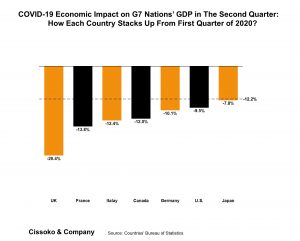
In other words, companies are urged to move from cosmetic diversity to an inclusive workforce where everyone, regardless of race, gender, ethnicity, age, or sexual orientation, among others, can join a modern organization — while adding value to the firm. For these reasons, we wrote a white paper titled “The D in Diversity Stands for Dignity in the Work: Building Corporate Cultures Worthy of Human Dignity.” The COVID-19 pandemic has been traumatic, to say the least – particularly during the second quarter of 2020 when the UK saw its GDP plunging by more than 20%—the worst among the G7 nations. However, that should not be an excuse for not doing the right thing because fighting for human dignity means good business regardless of the size of an organization, particularly in times of racial reckoning around the world.
To be on the right track, companies need to learn how to build a culture of human dignity in the age of Black Lives Matter, where everyone is valued through the recruitment process, advancement, and better equity as an outcome of joining the firm. Our experience suggests that while many firms are trying their very best to get the underrepresented people on board, they fail miserably in another aspect—employee retention. In other words, from an equilibrium perspective, some organizations may need to first break the dangerous cycle of underrepresented employee turnover—recruiting, for example, 20 people while 30 are leaving the firm, which is a net loss of 10 employees.
For one thing, the prejudice, bias, discrimination, and racism against minorities and other underrepresented ethnicities are so pronounced at some companies that the workplace becomes a fertile ground for the so-called set-up-to-fail syndrome. That is the opposite of the Pygmalion effect, where employees live up to the high expectations that the managers and those around them have. The set-up-to-fail syndrome, in our experience, starts with a low-level incident, such as missing a target or deadline or losing a client. There may be a personality conflict with the underrepresented minority or ethnicity and their managers in some cases.
From there, confirmation bias from the manager becomes entrenched, with the supervisor increasingly finding faults and problems from subordinates where there are none. As a result, the workplace becomes increasingly unwelcoming for the underrepresented minority or ethnicity. In the end, they quit believing that they are ‘persona non grata at the company’—referring to people not welcome—given their superiors’ heightened level of micromanagement. Thus, failure to have the necessary retention processes to embed the recruits for a more extended period to reach a positive net gain of underrepresented people per year, frustrations, and wasting corporate resources will be the obvious result of the efforts.
Beyond micromanagement, trust is paramount, particularly in this age of COVID-19, where most organizations work remotely. However, with all the positive talks about working at home or virtually, a trust deficit in the human capital across many industries worldwide has brought its own challenges – draconian employee monitoring through software. Employees in many parts of the globe have been urged to install employee-monitoring software on their computers to track their actions while sending the information back to the leaders.
When employees clock in and out, the software records which websites they visit, taking screenshots of what employees are viewing at the company’s preferred intervals and tracking their location through other apps on their smartphones, among others. In some cases, given the outstanding violations of employees’ privacy, the monitoring is akin to a police state, given that even an employee’s job search can be revealed. Indeed, the COVID-19 pandemic-induced lockdowns and remote working have been a boon for the monitoring software industry, which saw its customers jump by more than 275% in just a few months in Australia alone.
On top of these challenges, businesses need to increase their diversity budget while giving more authority to diversity and inclusion leaders. By doing so, business leaders will send strong signals across the entire organization regarding their seriousness about diversity, inclusion, and equity. As a result, the company moves from wishing to be an inclusive firm to committing to a diversity strategy by making it a top priority. Indeed, in our prior article on building a culture of human dignity in the age of Black Lives Matter and the CEO’s guide to winning diversity and inclusion, we discussed further the best options for business leaders.
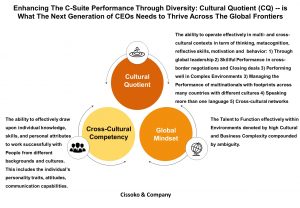
Our experience suggests that beyond the overrated IQ and EQ, Cultural Quotient is what the next generation of CEOs needs to navigate the challenges across the global frontiers. If IQ and EQ were enough, the corporate world has plenty of high-caliber talents with these skills, but why, 56 years after the Civil Rights Act, the corporate world is still failing to get its house in order around the world? We believe that unlike intellectual quotient (IQ) and emotional quotient (EQ), there is a woeful shortage of business leaders or professionals with badly needed cultural quotient (CQ), which is crucial for cross-cultural management.
In short, cultural intelligence or quotient (CQ) is the ability to operate effectively in multi- and cross-cultural contexts in terms of thinking, motivation, and behavior:
- Through global leadership
- Skillful performance in cross-border negotiations and closing deals
- To work effectively in a global setting
- Managing the business performance of multinationals with footprints across global frontiers with different cultures from the headquarters
- It calls for speaking more than just one language
- It requires a cross-cultural network and interests
Closely related to cultural quotient is the development of a global mindset, which is the ability to work effectively within environments denoted by high cultural and business complexity and ambiguity. Another in-demand skill today is cross-cultural competency—effectively drawing upon individual knowledge, skills, and personal attributes to work successfully with people from different backgrounds and cultures. This requires doubling down on personality traits, attitudes, and communication skills in managing across borders.
Again, we believe that some of the problems that we found to have hindered diversity and inclusion worldwide can be traced back to the lack of a global standard of diversity that can be used as a benchmark for the rest of the industry or sector. Also, contradicting studies regarding diversity and inclusion on the bottom line or innovation productivity have emerged. For one thing, different studies use varied methodologies in different organizational contexts or environments. In contrast, some studies suffer from inappropriate methodologies that impact the results. Others have suffered from statistical bias. Fortunately, we have uncovered the time-tested diversity aspects that the C-suite and the board need to deliver a high performance. Below are the four diversity attributes that will make a huge difference within the corporate boardrooms.
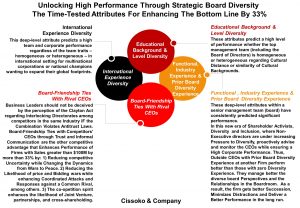
The board-friendship ties to competitors’ CEOs may help manage competitive uncertainty by facilitating inter-company cooperation, which reduces the likelihood of cutthroat competition – while providing a source of competitive advantage relative to other organizations lacking such ties. In the corporate world today, 31% of CEOs are outside CEOs—recruited from an external firm. Also, the trend in corporate governance suggests that independent board members are becoming mandatory. Thus, having independent board members with friendship ties with rival CEOs or friends of competitors’ CEOs can be a boon for an organization.
Make no mistake; this strategy complies with the Clayton Act. Thus, nothing is illegal here, in our view. Indeed, our experience suggests that non-executive directors are consistently involved in top strategic decisions. Therefore, they are aware of both companies—the firm where they are outside directors and a rival firm run by their friends—strategic plans. As such, an external director who is the friend of a rival’s CEO can tip off the board where he is a member of the competitor’s strategic plans, given his privilege of access to knowledge as a supervisor of the strategic decisions and plans because of his insider status.
Experience suggests that many independent directors’ appointments to boards are made to glean crucial information, i.e., strategic insights from competitors. Moreover, given the private nature of this information, it goes unnoticed. Thus, this is one way, among others, that boards use to deal with the uncertainty in the business environment. Because uncertainty regarding competitive moves is high, the C-suite has difficulty reliably predicting or anticipating competitors’ moves (actions), particularly in sectors with an intermediate level of market concentration.
In truth, we believe that the board’s friendship ties with competitors are highly correlated with joint venture deals and inter-company shareholding while reducing the war-like competition between firms. Moreover, board-friendship ties reduce the probability of price and bidding wars. Also, the ties can enhance the coordinated attacks or responses against a common rival. That’s why companies with board-friendship ties with competitors have improved their performance by more than 33% over the years, given that the relationship, informal as it seems, is based on trust between the non-executive director of a company and his rival firm’s CEO.
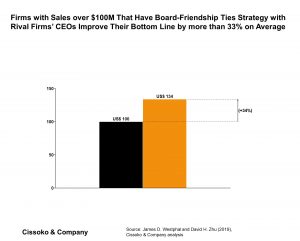
In fact, David H. Zhu of Carey School of Business noted that, unlike the public information and data regarding industry concentration and board interlocks, the communications between a non-executive director and a rival company’s CEO are usually informal. Therefore, they are happening below the anti-trust authority’s radar of scrutiny. As such, spotting these kinds of ties presents formidable challenges for outsiders. In short, our experience suggests that board-friendship ties with competitors’ CEOs change the competitive dynamics—from the competition as a war to peace—meaning cooperation.
The outside CEO’s prior board experience with diversity in the boardroom enhances the relationship with the new board. Recent findings suggest that the demographic diversity among the board of directors highly influences the new external CEO’s relationship with the boardroom. Because the modern board of directors’ primary function is to advise and monitor the CEO in charge. However, with the rise of shareholder activists, the board of directors is increasingly pressured to advise the CEO proactively. They believe that diversity can provide different perspectives and insights to the chief executive officer. When the C-suite doesn’t listen, many boards threaten to leave in many cases. For example, recently, many non-executive directors at Facebook – including the former CEO of Amex, Kenneth Chenault – have left Facebook. To be sure, the era of passive boards is gone for good. On top of this attribute, having people in the boardroom with functional and industry experience is correlated with high boardroom performance.
Educational background and educational level diversity in the boardroom—these attributes predict high corporate performance whether the board is homogeneous or heterogeneous. Functional experience and industry experience among board members—these deep-level attributes of diversity are great predictors of business performance within the boardroom regarding Return on Equity (ROE), Return on Asset (ROA), Return on Invested Capital (ROIC), and others.
International experience diversity within the boardroom—this deep-level attribute predicts top corporate performance within boardrooms around the world regardless of the board members’ traits—homogeneous or heterogeneous. The high performance remains consistent with these diverse traits in an international setting for multinational corporations or national champions wanting to expand their global footprints. For more on how to win in the age of the COVID-19 pandemic, please read our coronavirus collection for building resilience and culture and managing virtual and agile teams, among others.
Get in Touch
We will respond to your message as soon as possible.
Insights to Win
Subscribe to our newsletter for in-depth analysis, reports, and our perspectives on business and economic issues related to the Japanese market and the global economy.