
Developing CEOs’ Strategy IQ: Strategic Firepower for a Gold Medalist’s Performance
The business world is threatened by the triple whammy of the economic slump, COVID-19 second wave, and activists’ disruptions worldwide, which have cost Facebook over $55 billion. At the same time, given the relentlessly negative media campaigns, its share price went into a tailspin. For one thing, as of this writing, nearly 160 companies have joined the Facebook ad boycott movement. However, the campaigners told Reuters that they would take them from the national to the global level—by urging other firms on both sides of the Atlantic to join the Civil Rights campaigners. The impetus for this calculus is to pressure the social media giant to change its intransigence.
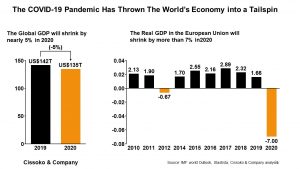
On top of this, COVID-19 cases are increasing at an alarming rate—particularly in the United States—where the death toll from the pandemic is nearly three times that of the Vietnam War. Also, many countries that did well during the first wave, such as Australia, Japan, and Hong Kong, are grappling with the second wave of COVID-19 across the board. As a result, the global economy is projected to shrink by nearly 5% in 2020. About the European Union, the size of its gross domestic product will plunge by a jaw-dropping 7% this year. The same distressing figures in the Asia Pacific region are the new realities that businesses and governments need to cope with. Indeed, the coronavirus crisis presents a mind-boggling array of challenges that business leaders need to navigate carefully. The big question now is how an organization can weather the storm. Challenging as the situation may seem, our experience suggests that CEOs can thrive by responding to disruptions through pre-emptive and defensive strategies, and developing the CEOs’ Strategy IQ can enhance companies’ strategic firepower for the COVID-19 era. These strategic moves can be a game-changer in weathering the storm.
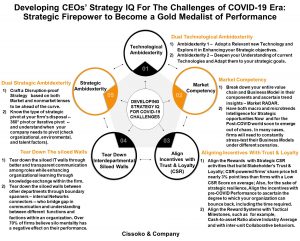
Strategic Firepower Firms Need to be Performance
Gold Medalists in Times of Disruptions
First, we want to clarify that the traditional strategic planning process is woefully inadequate for the new reality. Because it addresses just one aspect of a disruption-proof strategy—the market-based strategy. Worse still, most of the strategies that organizations are accustomed to are based on outdated theories, which are disturbingly inappropriate for the current challenges that are hurting businesses, large and small, worldwide badly. Above all, market-based strategies have no solutions for the emerging challenges from nonmarket actors—activists, campaigners, NGOs, big government—that Facebook and many other companies are facing right now since the great reckoning after the death of George Floyd at the hands of police in Minneapolis two months ago. That is racial justice, equality, environmental activists, and the like, given that these pressures are from the nonmarket actors—unfamiliar territory to many business leaders.
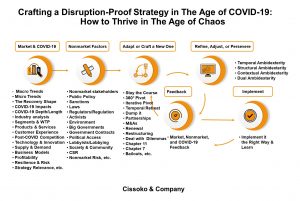
Thus, crafting a disruption-proof strategy calls for both market and nonmarket lenses. While most people are familiar with market-based components of a strategy, such as the competition, the supply chain, the customer experience, and the like—only a handful of firms are aware of the nonmarket aspects of a strategy, which include activists – be they social, civil rights, LGBTQ, environmental, or privacy—also the government, including regulators, public policy, government contracts, gaining political access, lobbying, to name a few.
These nonmarket stakeholders have increasingly become very disruptive in recent years. Simply put a disruption-proof strategy—the winning strategy for the age of COVID-19—needs to solve the Strategy Equation—that is, combining both market and nonmarket aspects (actors and factors) of strategy. Failure to have a nonmarket perspective included in your strategy planning—is a dangerous gamble fit for a bygone era—given that you will have solved just one aspect of strategy—an incomplete one—that will expose your organization to forces of disruption, ultimately that poor judgment may jeopardize an entire organization for many years to come.
Knowing the Type of Strategic Pivot at a Firm’s Disposal
To be sure, we have discussed at length in this article how to build strategic resilience through a pivot and the seven types of pivots that firms can use to thrive rather than survive. Thus, this article will focus on when a strategic pivot becomes necessary for an organization’s survival. Indeed, our experience suggests that there are two types – a 360-degree pivot or an iterative pivot (see the seven types of pivot and how your organization can benefit from the $700 billion opportunities from the COVID-19 crisis). Many organizations struggle with the judgment calls of knowing the answer: When should we pivot? Simply put, the question boils down to these four questions: When should we create and test a new direction different from the one, we were following before the coronavirus crisis? When should we reposition our direction regarding the current business environment and competitive landscape? When should we strategically realign our firm with current market forces? When should we reorganize our organization’s structure, processes, technologies, and systems?
When Do Organizations Usually Pivot (or May Need to Pivot)?
The doing-performing gap—that is, the gap between an organization’s product or service and the performance desired and hoped by the firm. When this gap is too huge, most businesses begin to reconsider their products or services in the market, resulting in a systematic review that will ultimately pressure the company to pivot.
Benchmarking existing and new products or services—when businesses launch a new product or service, they intuitively gauge it against the actual or similar one that it offers – sometimes even what the competition is offering—the wider the gap between the actual and expected performance of the product, pivoting becomes one of the best options on the table for most organizations.
The search for growth regarding potential customers—how to best serve the customer, when, and with what type of process or pricing? Questions like these in a fast-changing or ‘cutthroat’ competitive environment may lead to an iterative pivot.
Serious threats such as the COVID-19 disruptions and social-distancing orders—that is, threats such as the magnitude of the actual and potential loss of staying the course, how imminent they can materialize, and how uncertain and complex are the threats that an organization foresees regarding its business, products or services, will ultimately pressure many organizations to change the course to avoid going under for survival’s sake. For example, many firms today produce facemasks not because they like them or plan to be making them. Still, given that the demand for their core business has evaporated overnight because of the coronavirus crisis, the logical move was for them to pivot by becoming manufacturers of facemasks, given the rise in demand for personal protective equipment (PPE) from COVID-19. In light of our experience, one or the combination of factors above, including leadership risk tolerance, is behind most organizations’ pivot decisions.
Dual technological ambidexterity
Our experience suggests that winning in this fast-changing, disruptive environment requires two types of technological ambidexterity. Businesses wanting to enhance their strategic firepower need to adopt new technology and explore it to improve their strategic goals. Similarly, given the abundance of technologies, success today entails that firms deepen their understanding of current technologies to adapt them through ambidexterity to their strategic goals. Given that they need these two types of ambidexterity to thrive rather than survive the COVID-19 disruption at the same time, that’s why we said dual ambidexterity is increasingly becoming a necessity for developing strategy IQ today.
To be clear, in this ambidexterity game, the three types of organizational ambidexterity apply. First, temporal ambidexterity—when a firm moves from exploitation through product and service improvement (static efficiency) to exploring other frontiers of possibilities (dynamic efficiency) through innovation. Second, structural ambidexterity—when the company manages both exploitation and exploration in parallel function or structure simultaneously within a firm. Third, contextual ambidexterity—the strategic capability of an organization to align the ambidextrous pillars of exploitation and exploration processes with its strategy while dynamically adapting the processes to meet the realities of the external environment to meet its goals.
Market Competency
Businesses need to build a market radar by breaking down their entire value chain and business models. Then, firms need to ascertain the relevant macro and microtrends within each component (segment or product line) to further their understanding of their corporate environment. This analysis may include the industry profit and demand pools within and beyond their industry boundaries. However, the horizon should go beyond the current crisis and consider the post-COVID era. Companies can consider fundamental questions such as: Given what we know, what capabilities will be necessary for our industry after the COVID-19 crisis?
Also, given that key variables are changing faster, winning organizations are constantly stress-testing their business regarding the supply chain, customers, product and service demand, and profitability under different scenarios. In other words, given the speed of change, our experience suggests that assumptions are becoming useless daily, even hourly. This has serious business implications that CEOs and other business leaders need to quickly grasp before it is too late to take the necessary actions.
Align Incentives (Rewards) With Nonmarket Factors
As discussed above, market-based strategies are just the tip of the iceberg. To win, companies need to rebuild the stakeholder’s loyalty and trust by engaging in strategic corporate social responsibility (CSR) activities. Recent findings by Edelman suggest that nearly 65% of consumers worldwide would like to buy products and services from organizations with a strong stance associated with social issues—such as the environment, racial justice, diversity, LGBTQ, and inequality, to name a few. For more on how to succeed in this quest, we have a free downloadable guide that businesses can use to navigate the complex field while aligning their CSR with their market-based strategies for better results. Indeed, during this coronavirus crisis, CSR-powered organizations’ share prices fell 3% less than those with poor to zero strategic CSR initiatives worldwide. Similarly, to enhance their strategic resilience, firms need to align their incentives with tactical milestones such as the firms’ pre-COVID-19 performance. By doing so, companies can gain insights into how long and hard it will be for them to bounce back. As a result, they can consider potential pivots, if necessary, given the insights gleaned from the data.
Tearing Down the Siloed Walls–the Disrupter of Performance
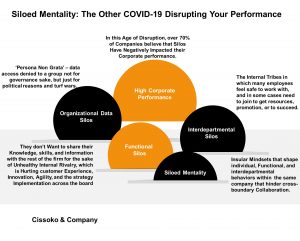
In times of disruption and a fast-changing business landscape, more collaboration—not less—is what large organizations badly need. Unfortunately, our experience suggests that while firms are turning their attention externally to understand the disruption magnitude of COVID-19, they forget that they need to deal with another type of COVID-19 within their corporate walls—a siloed mentality—hindering their performance for decades.
Indeed, our recent survey revealed that over 70% of CEOs believe that silos—be they data, insular mindsets, interdepartmental turf wars, or unhealthy politics across functions, are badly hurting their organizations. Unchecked, organizational silos can result in a dangerous game where people—from departments or functions, even teams—put their interests above that of the organization that employs them. Thus, CEOs or other business leaders wanting to enhance their corporate performance during this pandemic need to bust the silos.
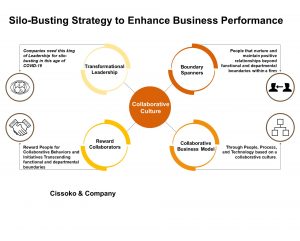
Busting Organizational Silos for Better Corporate Performance
Transformational leadership is what firms need to shake up the siloed mentality hurting their business performance regarding customer experience, innovation, go-to-market, and, above all, cross-functional team projects. Given that building a collaborative, healthy working environment is one of the hallmarks of great leadership. When people can’t work together collaboratively, the big question becomes: What are you managing, let alone who you are leading? In other words, CEOs and other business leaders should not be sleeping at the corporate wheel. They need to be vigilant in this age of the second wave of COVID-19.
Double down collaborative corporate values through boundary spanners who can nurture and maintain relationships and positive interactions beyond functional and interdepartmental boundaries. These people are usually experienced and have an in-depth understanding of the firm’s inner workings. As a result, they have maintained good relationships given their political skills, influence, and discretion, but they don’t rely on their authority within the company. In our experience, boundary spanners do not have formal authority within many companies. They are trusted because they have their ears on the ground, given their sensitivity regarding the best interest of all employees – not just the interests of the strong and experienced but also those of others with less influence or authority at the firm. Thus, organizations need to leverage the skills of these boundary spanners to break the siloed mentality hurting their performance given the turf wars within—like COVID-19—that are disrupting their performance.
Build a collaborative business model through people, processes, and technology. In other words, this collaborative business model needs to encompass the whole gamut—from the way an organization recruits, onboards new employees, promotes them, assesses their work, rewards them, and allocates resources to the way the firm makes decisions and gives authority. Moreover, the way the firm makes decisions and gives authority needs to be revamped by empowering others in our increasingly agile landscape.
Unfortunately, according to our findings, even the widely-touted agile teams are increasingly self-organized but not self-managed. (see Beyond Agile Teams: Thriving Through Team Resilience in The Age of Disruptions) This aspect of agile teams needs to be reconsidered. Furthermore, modern organizations’ technology and tech aspects need to become more collaborative for better product development and intra-team performance between software engineers, project managers, and other tech team members, as well as between tech people and other non-tech business leaders.
Reward collaborative behaviors within the company—incentives are powerful tools that firms need to deploy to build a collaborative organization fully. Putting incentive systems in place that value people for their collaborative behaviors and initiatives transcending functional and departmental boundaries sends a strong signal across the company by telling people directly that this organization values collaboration. That’s why it is putting its money where its mouth is. The clock is ticking for many organizations. Today is the day to dismantle the siloed mentality, which has been hurting their performance for decades, given that even before the coronavirus crisis, many firms’ performance was disturbingly inadequate. Otherwise, some may become the latest tombstones in the COVID-19 graveyard.
Get in Touch
We will respond to your message as soon as possible.
Insights to Win
Subscribe to our newsletter for in-depth analysis, reports, and our perspectives on business and economic issues related to the Japanese market and the global economy.