
Nonmarket Strategy Imperatives in the age of Activists’ Business Threats
Global protests pressured Samsung to commit to renewable energy across several countries, such as the United States, China, and Europe, by 2020. The campaigners forced the electronic giant to disclose its environmental impact regarding the Carbon Disclosure Project. In addition, every year, several hundred million tons of plastic and related products are produced. Yet our beautiful sea is the final destination of a considerable proportion of these environmentally dangerous products comprising one out of every 10.
It is estimated that by 2050, plastic will dominate our ocean more than fish, which will be unfortunate if nothing is done about the brewing troubles on the horizon.
Against this backdrop, pressures mount on many firms from the EU and environmental activists to take urgent actions to address the issue before it is too late. For this reason, McDonald’s has pledged to break its traditional use of plastic-based straws in hundreds of its restaurants across the United Kingdom and Ireland before 2020.
Starbucks has followed suit with almost the same pledge as McDonald’s by the aforementioned deadline. In truth, as the distinguished Stanford Professor David P. Baron noted, companies operate in a triune market: The market-based financial instruments intended for the investment community, the product-based market for customers, and the pressure-based market derived from campaigners and non-governmental organizations. However, many firms today seem not to take the latter seriously, which can dramatically affect their business strategies and corporate performance over time.
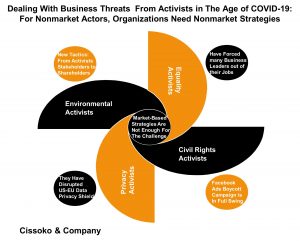
Indeed, activists’ ultimate goal is to influence firm and industry practices regarding ethical, social, and sustainability concerns that these participants ignore or neglect. The activists are not deeply pocketed like the corporate giants spending millions of dollars on lobbying, as explained elsewhere. They pressure companies to change their behaviors through boycotts offline and online through social media hashtags (e.g., boycott Starbucks).
Broadly speaking, we have social (including human rights) and environmental activists. On the one hand, social activists have centered their attacks on industries making products that can negatively affect our lives (health) through overconsumption, such as fast food, soda, tobacco, alcohol, and the like. Also on their list of suspects are companies engaged in cross-border business through complex supply chains across countries with poor records regarding labor conditions and human rights. On the other hand, we have environmental activists targeting the companies within and across industries engaged in highly correlated activities with environmental damages, such as companies involved with plastics, chemicals, mining, oil and gas, car production, etc. These kinds of firms and industries have been historically their usual suspects.
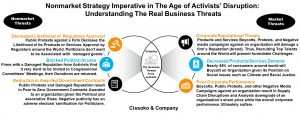
In our experience, activists can affect the demand and perception of companies’ products or services by making a target firm and its industry look very reckless by damaging their decades-old built brand, which, like a vicious circle, will ultimately hinder their performance over time. The more they persist, the higher the damage concerning negative publicity through public awareness given the media attention, according to Khan-Ibarra findings in 2015, which potentially increases the number of sympathizers to their demand. As a result, the campaign can turn into a movement akin to the Me Too movement, which has jeopardized more than 190 executives and business leaders, according to Carlsen and his colleagues in 2018.
Again, since the horrible death of George Floyd two months ago, racial justice and equity activists have been challenging businesses on both sides of the Atlantic to become an ally in the battle for fairness and dignity in the workplace and across the global economy. These newly empowered activists target firms with poor records on diversity within and at the top of companies. They are labeling insensitive and parts of Black and minorities’ plight in the labor market. They believe those kinds of companies are part of inequality today through their contributions to slavery or their anti-black cultures. For this reason, Civil Rights activists are campaigning vigorously in demanding that firms suspend their advertising on Facebook, given the platform’s giant disturbing history of tolerating hate speech on its social platform. They have been joined by many sympathizers such as Adidas, Chobani, and CVS, among other big spenders.
Today, businesses need to know without a doubt that public protests and negative publicity affect an organization’s performance. For example, corporate reputational threats will result in a damaged brand, making it harder for the organization to recruit top talent. In addition, the damaged reputation will reduce the demand for the firm’s products and services. A recent survey by Edelman suggests that nearly 65% of consumers worldwide will boycott a company’s products given its stance on social issues such as the environment and racial justice, like the Black Lives Matter movement. Moreover, the boycotts, public protests, and negative campaigns result in supply chain disruption and analysts’ downgrade of an organization’s share price while the overall corporate performance suffers.
Indeed, negative publicity is a real threat to a firm’s reputation and affects its ability to access political stakeholders. Yet a firm disrupted by public protests or that becomes the target of activists will find it very hard to be invited to Congressional Committees’ meetings, an opportunity for companies to shape the discussions to their advantage through their inputs and perspectives. Moreover, when the associative risks are so high in some circumstances, the political stakeholders will choose to return donations from a political action committee (PAC) of reputationally damaged organizations.
Similarly, recent research by McDonell & Werner in 2016 found that ‘damaged goods’—companies with a damaged reputation by public protest from activists and negative media campaigns have dramatically reduced the likelihood of products or services being approved by regulators. Furthermore, public protests from activists with serious media attention resulted in a reduction of Government contracts to the organization—given that the negative publicity has adverse electoral ramifications for politicians, particularly in an election year.
Businesses need to learn the lesson of reputational risk from what happened to several U.S. firms a few years ago. For decades, they had nurtured strong relationships with the controversial NRA. However, after the Florida incident regarding the high school killings in February 2018, the fallout created a storm across the political spectrum at both state and federal levels. To amplify their campaigns on social media, hashtags, such as “boycott NRA” and “boycott Delta,” were tweeted and retweeted like wildfire. As a result, a dozen or more NRA business partners severed their decade-old relationships with the influential lobby, including Symantec Corp, MetLife, and Delta.
Get in Touch
We will respond to your message as soon as possible.
Insights to Win
Subscribe to our newsletter for in-depth analysis, reports, and our perspectives on business and economic issues related to the Japanese market and the global economy.