
Nonmarket Strategy: How Your Competitors Gain Unfair Competitive Advantage
Almost five decades ago (1971), the Nobel Prize-winning economist George Stigler argued that sectors’ regulations are crafted and work to their advantage. In fact, Eric Schmidt of Google agrees with this statement by saying that, in 2010, most Americans were not aware of the extent to which special interests write the laws. And he was alarmed when he understood the system’s inner workings after spending much time across it. He continues by saying that it is self-evident that the laws shaped by well-established firms will ultimately benefit them, as Thompson noted in 2010.
Recently, many scholars have echoed these arguments, particularly Joseph Bower of Harvard Business School. He argues that the neoclassical framework misunderstands modern businesses, given that the neoclassical business theories disregard nonmarket activities, such as lobbying.
With this understanding of the implications and importance of public policies, the modern firms that want to win in the digital age need to strive to forge positive relationships with the government, monitor the developments of public policies, and try to influence outcomes through means explained elsewhere.
Questionable and uncomfortable as this may seem, winning firms have been doing this for decades. Anecdotal evidence is illustrative of the magnitude of this influence. In 2012, the spending declared by registered special interests was slightly $3.5 billion (under the Lobbyist Disclosure Act). Still, other scholars found almost twice as much as this figure. Indeed, their research revealed that more than half of special interest activities remain below the radar, according to LaPira and Thomas in 2013. In other words, the figure above is almost 50% of the true amount.
Walt Disney managed to sustain strong profitability by buying influence. That is high-profit margins of more than 50% over a long period through large-scale lobbying since the ’90s for extending the copyrights of its crown jewel—Disney. The firm spent almost $1 million through its election—and legislation-influencing committee during the last campaign season of the ’90s, according to Ota in a 1998 report. In other words, the $165 billion entertainment giant was lobbying vigorously to lengthen the life of its most valuable intangible asset—its copyright protection—derived from its flagship brand, Mickey Mouse, which was on the verge of ending soon. As a result, these nonmarket efforts bear fruit for decades through profitability and shield the entertainment powerhouse from the competition.
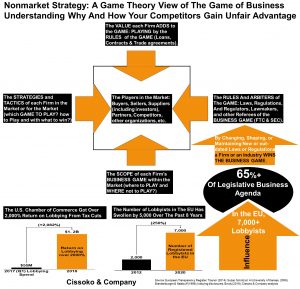
But why are they spending this huge amount on buying influence? Susan Scholz (University of Kansas) and colleagues interestingly decided to find out the answers to this question through their research on George W. Bush’s 2004 fiscal stimulus, similar to the Trump administration’s recent stimulus of $1 trillion. What did they find, you ask? Every $10 spent on a provision, particularly taxes, provided a return on investment (ROI) of over $2000 (more than 20,000% ROI). As an example, according to the U.S. government disclosures, three of the most powerful associations, including the U.S. Chamber of Commerce, spent more than $55 million on tax-related issues in the last quarter of 2017, per Brody’s account in 2018.
With the aforementioned scholars’ ROI yardstick, all other things being equal, we can argue that these three big business lobbies could receive over $1.2 billion in ROI from their influence-buying expenditure. By any measure, it is an excellent return.
To be clear, the United States is not the only country where the voice of special interests is loud. In the European Union, almost 7,000 special interests were registered at the European Commission and Parliament, according to the Europe Transparency Register in 2018. That is an increase of 250% from 2012 (2,000 lobbyists). In addition, more than 25,000 special interests are littered across Brussels, influencing more than 65% of the law-making agenda, according to Traynor in 2014. The influence of special interests is so pervasive that it became the subject of a popular documentary bearing the same name, which exposed the special interests’ influence on the old continent’s affairs.
In short, market-based strategies are good but not enough to gain and sustain a competitive advantage for a very long time in this age of big government, trade wars, geopolitical uncertainties, and the pressures of activists—be they social, rights, environmental, or Black Lives Matter. Market-based strategies have a serious weakness in dealing with those issues. Given that they are not just shareholder issues but stakeholder issues. Most of these issues are not just profitability issues but moral and reputational ones that call for a different lens in this age of shareholder capitalism.
Get in Touch
We will respond to your message as soon as possible.
Insights to Win
Subscribe to our newsletter for in-depth analysis, reports, and our perspectives on business and economic issues related to the Japanese market and the global economy.