
Solving the Strategy Equation: Winning Through Nonmarket Strategy
As far as public policy is concerned, no firm or sector is exempted from the influence of the policy decisions in capitals worldwide, particularly from the most powerful countries. For example, consider an industry such as payment. Public policy in India, announced in November 2016, gave a competitive edge to several mobile money upstarts across the country, including the well-known Paytm. As of This writing, the company was India’s largest mobile payments company and arguably the biggest beneficiary of the public policy move, which compounded the waves of digitization already in the making across the nation.
To be clear, it seems that the intent of the public policy, as reported, was to create efficiency in tax collection by reducing leakages through digitization. However, it also tilted the field to Paytm’s advantage by giving FinTech firms a competitive edge over traditional banks. The public policy move became a boon for Paytm, which suddenly saw its users grow by 200% within 12 months, thanks to demonetization.
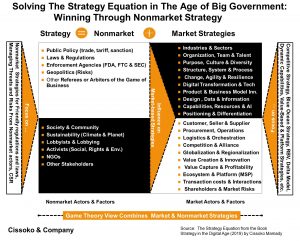
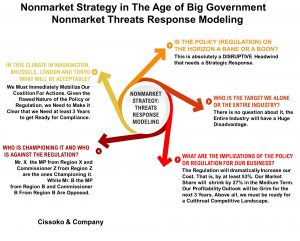
Unfortunately, many business leaders still behave like public policy is a distraction that does not deserve enough precious time until public policies disrupt their business or industry. Clearly, disregarding the government or public policy up to the last minute may have been wise decades ago. Still, this strategy is a recipe for disaster. Given that today, companies need to be more proactive in dealing with the issues that can have devastating consequences on their strategy or their entire industry like never before. As such, firms need to consider the implications of public policy earlier to analyze and formulate a winning strategy. Executives can do this by answering such questions as:
• In the current climate, what is politically acceptable?
• Is the policy under consideration a headwind or tailwind?
• How can we proactively deal with the policy initiatives on the horizon?
• What are the options on the table?
• Who is championing the policy, and who is against it?
The key is to deter or lessen imminent threats while creating, maintaining, and sustaining a competitive edge. Or to develop a valuable connection that makes policymakers a partner—but not a threat—in the national or international race for competitive advantage. As such, political engagement needs to be one of the top strategic considerations, given the impact of public policies on almost any sector’s level of productivity.
Businesses have several tools at their disposal, some more effective and efficient than others depending on the context and issues, such as lobbying and grassroots organization through identifying members of Congress and executive branch agencies with high stakes in their agenda. It is also imperative to monitor political developments that will affect their industries. These efforts enable the firm to be ahead of the curve in taking the necessary actions to deter future potential policy threats. Simply put, this step is a basic policy threat barometer and preemption analysis.
From this first step above, the company can take its analysis to another level by ascertaining whether the potential or actual policy threatens the firm alone or its entire industry. So, it can go it alone when it is the sole target, join the industry association (lobby) to enhance its relative competitive edge, or lessen the negative impacts of the policy when it is a collective threat. The advantage of a collective agenda is that by deploying shared resources together, a sector can enhance the likelihood of their concerted voice being heard loudly on the issue by hiring the right people with the experience or influence to get the job done.
Japan is a classic example, given that lobbying is alive and well in the Land of the Rising Sun. Still, the approach is changing to fit the new political landscape of the past decade, given the successive changes of political parties running the show across the country, which resulted in many firms losing access to the right policymakers. For this reason, going it alone has increasingly been replaced by collective lobbying from businesses and industries with similar concerns facilitated by outside consultants and reinforced by the subject matter expertise of relevant authorities in that field.
Above all, the Overton method can guide what is socially and politically acceptable, given the goal in the actual political environment. Likewise, in some instances, the “Be-in-the-game” approach can be used to get alternative views accepted when other options are ill-advised. In this approach, firms start the discussions from the areas where all the parties agree and enhance their negotiation muscle regarding the thorny issues over time.
Therefore, solid strategic planning should always include a nonmarket strategy concerning public policy awareness and implications to the corporate strategy. Whether a headwind or a tailwind needs to be deeply understood among the top management, including the board of directors. For example, it must be clear that environmental and social policy concerns regarding sustainability may lead to sudden or even drastic changes in the rules of the business game, which can hamper an organization’s winning formula that made it successful for decades. As a result, a firm’s performance can quickly deteriorate. It may take years to fully recover from the impact of public policy.
In this disruptive environment, where public policies and geopolitics seem to be some of the biggest disruptors that paralyze the global supply chain, businesses need to be quick to recognize policy-influencing opportunities earlier and use preemptive means to defeat political issues earlier when the first signs of dangerous threats become apparent.
Indeed, in an increasingly digital world dominated by intangible assets, profitability and winning entail pressuring the government to enforce the laws related to these assets yet punish the violators at the national and international levels. This is epitomized by the intellectual property theft and forced technology transfer battle between Trump’s administration and the Chinese government, which has turned into a trade war. In addition, with all the hype regarding the free market, many industries, such as defense, pharmaceutical, and banking (now changing), still present formidable market entry barriers. So, complying with all these government regulations and policy changes can hinder companies’ market entry, go-to-market strategy, R&D productivity, and, ultimately, their innovation capabilities.
Furthermore, international trade policy may strengthen or lessen the competition and, ultimately, profitability among multinational firms regarding tariffs, quotas, preferential treatments regarding non-tariff barriers, or even sanctions. For example, several firms doing business in China today became victims of the U.S.-China trade war, given that the costs of the supply chain adjustments have taken a toll on their already tiny margins (AP News, 2018). Moreover, Mexico became one of the undisputed winners, given that several firms shifted their production there to lessen the impact of the trade war disruptions. As a result, the U.S. trade deficit with the country snowballed by over $75 billion.
Finally, the speed at which antitrust laws are updated and enforced and the punishment of anti-competitive behaviors matter a great deal in the digital era regarding innovation and entrepreneurship. This is the reason, among others, that 19 months before the 21st century, several U.S. states lodged formal complaints against the software titan and later, together with the Department of Justice, took Microsoft to the courtroom for federal competition law violation. Similarly, the European Union slapped Google with a nearly $3 billion fine in June 2017 for its alleged purposeful biased shopping search results, which were reportedly found to be favoring Google-related businesses.
All these government actions were taken to enhance competition and fairness while punishing monopolistic behaviors. However, these investigations take time. In other words, it takes antitrust regulators several years to conclude. Before the final decision, serious damages to other (potential) competitors had already occurred. So, the key to making them effective is to use a great deal of technology to speed up the investigation process to fit the speed of our fast-moving business world. Or to increase the budget dedicated to these tasks.
For more on disruption and COVID-19 insights, check our coronavirus collection.
Get in Touch
We will respond to your message as soon as possible.
Insights to Win
Subscribe to our newsletter for in-depth analysis, reports, and our perspectives on business and economic issues related to the Japanese market and the global economy.