
Japan Supply Chains Resilience Trends: From Just in Time to Just in Case
When effectively managed, just-in-time supply chains provide efficiencies by freeing up working capital while boosting corporate financial performance. However, as the frequency of supply chain disruptions in recent years has become common since COVID-19, most Japanese companies are moving to just-in-case supply chains for resilience’s sake, according to our analysis.
Indeed, most CEOs have learned the hard way that building strategic resilience is increasingly becoming a competitive advantage, given the mounting threats from disruptions worldwide. That is, non-market (e.g., Ukraine war), market-based (e.g., artificial intelligence and supply chains), and Black Swan (e.g., COVID-19 and the Great East earthquake). Many Japanese companies still remember the twin devastations—the earthquake and tsunami of 3/11, 2011, which caused over 55,000 internally displaced Japanese while unleashing Japan’s Great Resignation.
Worse still, the Japanese government’s 2012 report suggests that the country will face similar natural disasters with a 70% probability over the next 30 years. One prediction includes the greater Tokyo area, while the other excludes the capital, but each one is predicted to cause more than 20,000 deaths. When bitter memories of 3/11, 2011 faded away, COVID-19 reminded CEOs that disruption is the new business reality. Indeed, supply chain risks have risen exponentially across industries, given that most firms lack supply chain visibility beyond tier 2 suppliers.
Supply Chains Resilience Imperative: COVID-19, Chip Shortages, and Ukraine war
Since the COVID-19 pandemic, supply chain disruptions have worsened due to the Russian invasion of Ukraine and chip shortages worldwide. As a result, firms across industries, from automotive to food to video games, have been forced to curtail production—even shut down production lines for weeks. Consider this: Toyota, the global leader in the industry, had no choice but to shut down production for weeks in June 2022 in Japan and around the world.
Toyota was not alone in this firefighting mode. Many Japanese automakers reported that by mid-2022, their productions were nearly 15% below the same period in 2021. Beyond the supply chain disruptions from COVID-19 and the second-order effects of the Ukraine war heightened risks, the Biden administration doubled down on its punitive Tech restriction in October 2022. On top of this, China’s invasion of Taiwan is increasingly becoming a matter of when—not if—according to many Western intelligence organizations. Beyond US-China trade wars, threats and risks across supply chains abound. For one thing, in October 2020, a fire erupted at Asahi Kasei’s semiconductor plant in China. A few months later—in March 2021, another broke out at a Renesas Electronics plant—which supplies over 28% of global microcontrollers used in cars worldwide.

Wisdom calls for supply chain resilience strategies in this volatile and uncertain business environment. Thus, according to our analysis, most Japanese companies building strategic resilience move from Just-in-Time supply chains with all their financial benefits to Just-in-case supply chain strategies by holding more inventories.
Emerging Trends in Japan—From Just-in-Time to Just-in-Case Strategy
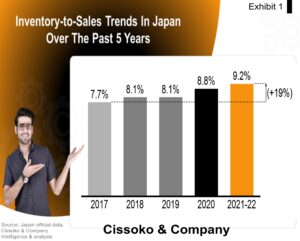
Our research and analyses revealed emerging and converging trends in Japan—the birthplace of Just-in-Time. To our great surprise, since the COVID-19 disruptions and the ensuing inflationary threats worldwide, companies across Japan have been increasing the size of their inventory as a precautionary measure for risk management regarding their supply-chain disruptions. This paradigm shift contrasts sharply with the old dogma of Just-in-Time. Simply put, their supply-chain strategies are moving from Just in Time to Just in Case. For example, their inventory-to-sales ratio has jumped by 14% since COVID-19 started compared to the average of the preceding three years.
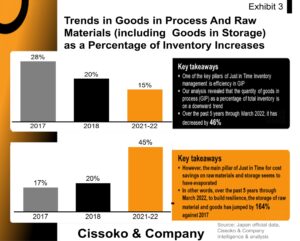
Indeed, beyond the communication exchanges of supply chain partners in Just-in-Time manufacturing, efficiencies derived from freeing working capital by receiving inventory just when needed are the holy grail. That is, firms buy inventory frequently in small batches just at the right time before the need arises. Moreover, as orders arrive, they are consumed immediately. As a result, companies deploying a Just-in-Time (JIT) strategy can effectively save significant money by reducing waste regarding inventory storage, which in industries such as automotive parts can cost over 25% of the cost of goods, including insurance costs. In other words, the capital outlay can be prohibitive.
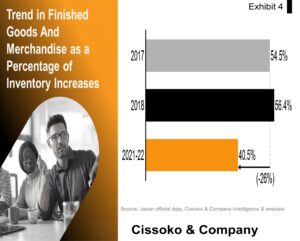
In many ways, Just-in-Time (JIT) can be considered a manufacturing philosophy. However, one of the litmus tests of this strategy is inventory reduction. Thus, when we use this measurement, considering our findings regarding the emerging trends across Japanese industries, it is safe to say that the new game in town is the Just-in-Case strategy. In other words, building supply chain resilience is taking center stage across boardrooms.
Get in Touch
We will respond to your message as soon as possible.
Insights to Win
Subscribe to our newsletter for in-depth analysis, reports, and our perspectives on business and economic issues related to the Japanese market and the global economy.