
Beyond Resilience: Grasping Disruptions for Better Responses in the age of AI
A Google search for the word coronavirus gets over 4.6 million results. The staggering number attests to the magnitude of the disruptions—like no other over nearly a century. Since 2000, COVID-19 has been unique in its global reach and economic costs, unlike other previous infectious disease outbreaks. It has resulted in an unbelievable human tragedy.
The grim COVID-19 fatality projections with precaution are 100,000 deaths and over 200,000 deaths without social distancing in the United States alone. With just 35 ICU beds per 100,000 and the dire shortage of ventilators, the United States’ troubles exponentially compounded. Moreover, Japan – the world’s third-largest economy—pales in comparison, with just 7 ICU beds per 100,000 people with nearly one-third of the US population. Furthermore, across the OECD nations, there are almost 11.5 practicing nurses. However, they have been overwhelmed by the surge in COVID-19 cases and dying patients.
As a result, the world economy has been grinding to a halt from extreme measures such as draconian lockdowns, social distancing, and the 14-day quarantine for people diagnosed positive with the virus. The obvious economic implications have been supply chain disruptions, negative consumer sentiment worldwide, and evaporating demand, ultimately sending the global economy into a deep recession. Consider this: more than 4.8 million firms worldwide have either tier 1 or tier 2 suppliers in the Chinese region where the coronavirus outbreak began, noted Dun & Bradstreet. That’s why, according to the IMF chief, it will be more severe than the great recession that commenced at the end of 2007, during which nearly 40,000 firms went bankrupt within the year through September 2008 in the United States alone, which was and is still the largest economy in the world.
More troubling still, the Congressional Budget Office suggests that it anticipates the US unemployment to surpass 10% in the second quarter of 2020. In fact, according to the Economist Intelligence Unit, the global economy will contract by nearly 3% in 2020 if all restrictive measures are lifted on time. Otherwise, it will get worse than this figure suggests. Indeed, the profound ramifications of the pandemic’s economic downturn will vary by region and country. Make no mistake: sovereign debt crises across several countries—such as the European ones—should not be ruled out as the health crisis-induced hangover.
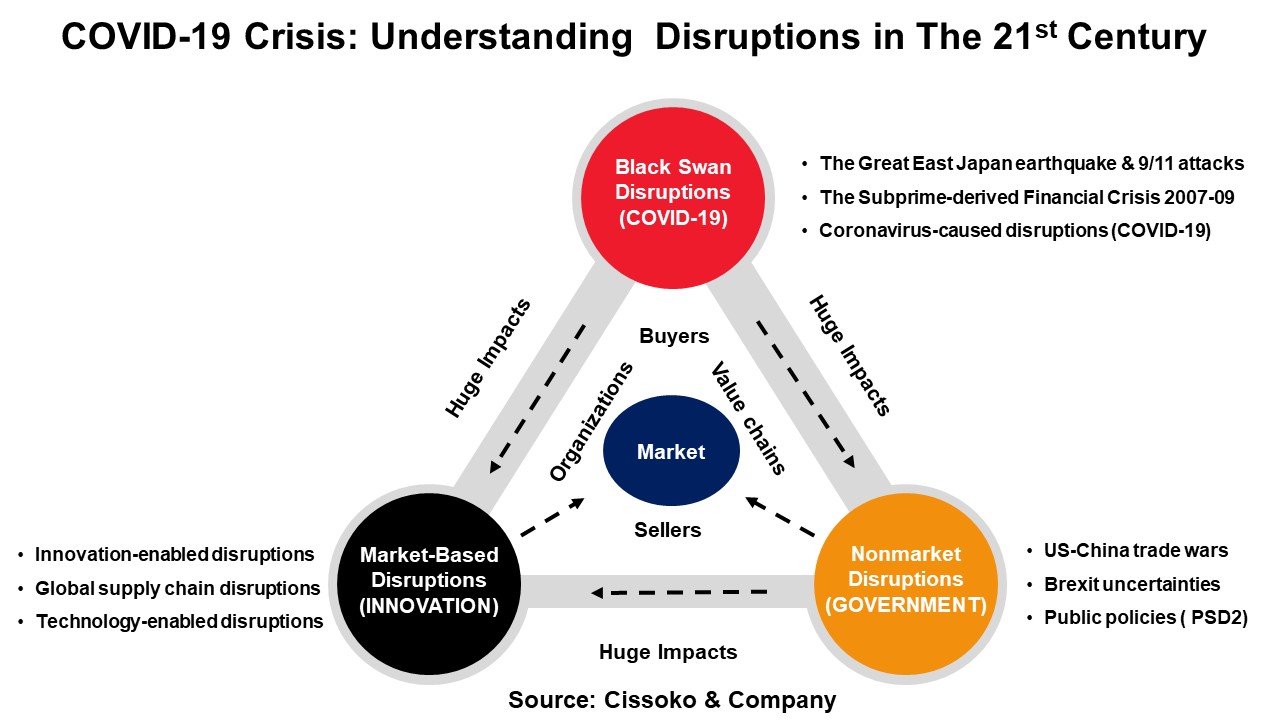
Indeed, in the 21st century, as the world becomes increasingly globalized, volatility, uncertainty, complexity, and ambiguity are the new normal. As a result, many firms are increasingly being disrupted—given that most firms have been taken off guard when threats become imminent. Our experience suggests that there are broadly three types of disruption: the first category comprises market-induced disruptions such as supply chain risks, network-related risks, cybersecurity, crime-related risks, and disruptive innovation.
The second category of disruptions is nonmarket, such as geopolitical risks (Brexit), public policy risks (US-China trade wars), and the European Union’s second payment services directive (PSD2) and GDPR regulatory compliance. The third category is the Black Swan disruption, which can be either market-originated or nonmarket. However, unlike other types of disruption, its probability is much lower, but its magnitude is exponentially higher than others. Classic examples of such dangerous disruptions are the great recession of the last decade and the COVID-19 crisis, in which the private and public sectors are fighting to contain the damages. Our experience suggests that there are five drivers of disruption.
Social-Environmental Pressures
- Climate change
- Epidemic and pandemic
- Natural resources scarcity
- Demographic shifts
- Demand pressures and volatility
- Technological and hypercompetitive pressures
- Dependency and business model pressures
Network Structure Constraints
- Single sourcing
- The Complexity of global supply chains
- Reliance on outsourcing
- Centralize distribution
Dependency Pressures
- Customer dependency
- Dependency on a few key suppliers
- Dependency on a single, outdated, or complex technology
Cost Pressures
- Inventory reduction pressures
- Lean management pressures
- Efficiency improvement pressures
How Organizations Can Respond to Disruptions Through Anti-Fragility
In our experience, the more an organization can anticipate disruptive threats, the better its responses are. That’s why we believe that firms need to learn how to build organizational resilience in the age of the coronavirus crisis. Indeed, the most well-known tool in this regard is scenario planning. It entails monitoring the uncertainties and trends across different areas such as technology, the value chain, economic indicators, etc. Organizations need to develop plausible future scenarios and prepare accordingly.
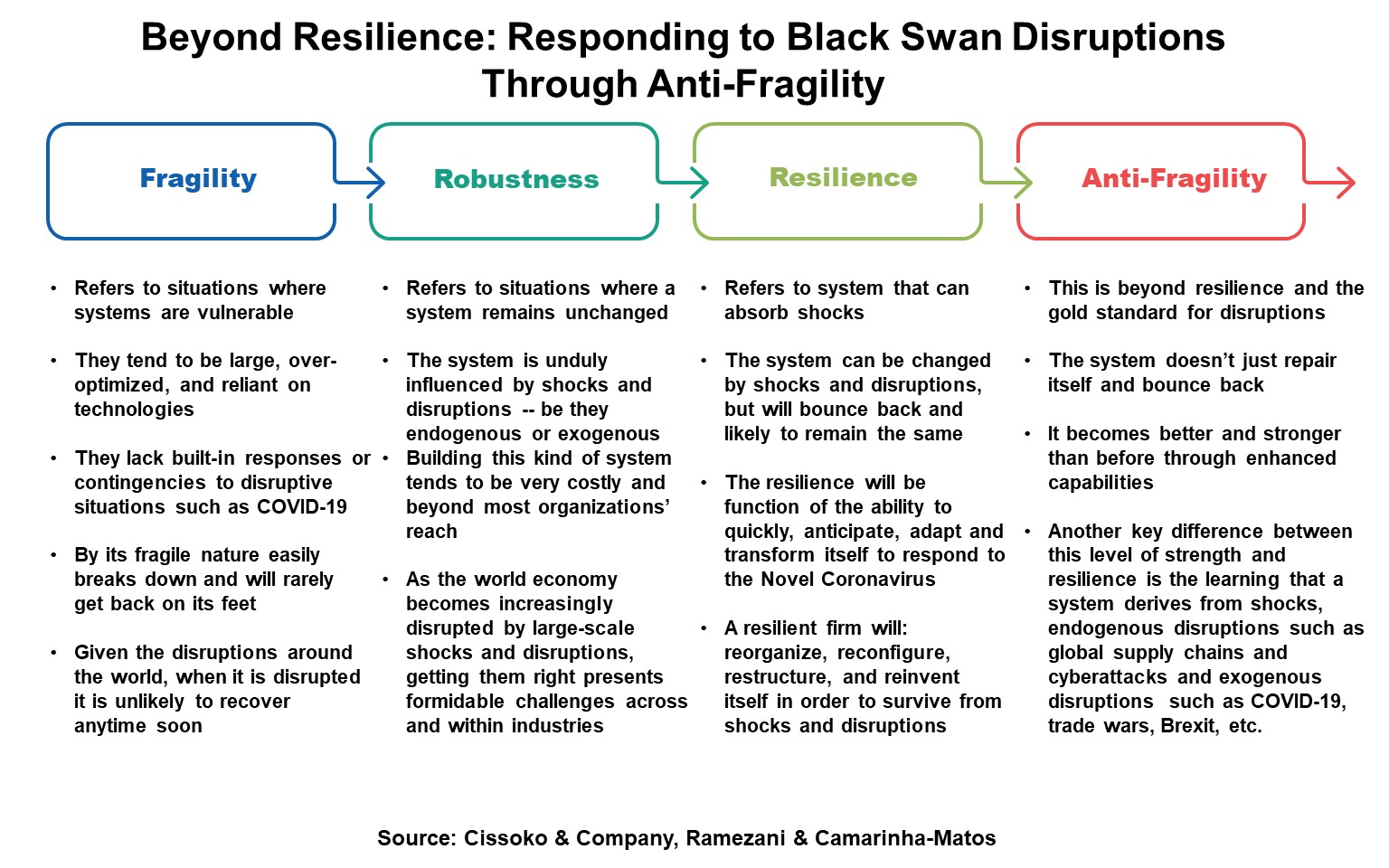
The firm needs to ascertain its readiness under plausible scenarios. Dynamically mobilize the necessary resources for thriving under these scenarios. The firm enhances its readiness regarding the key success factors in those plausible scenarios by doing so. Also, this exercise can enable firms to prepare their mitigation plans for the downside risks whenever the potential becomes material. For example, organizations can ascertain the strength of their respective balance sheet in weathering storms in a given scenario. At the response stage, an organization’s success will depend on its dynamic capabilities about its ability to quickly translate the threat signals into resource deployment by reconfiguring, reorganizing, and reinventing itself through:
- Agility
- Timeliness
- Risk sharing
- Information sharing
- Decision-making, etc.
Last but not least, we believe that the firm can use the learning from disruptive situations to become better and stronger. This last part—is one of the key differentiators between a resilient firm and an antifragile organization. In other words, organizational resilience is better, but it isn’t enough for the emerging world of Black Swan disruptions. Thus, we believe that firms must not just bounce back; they must become stronger and better than before. Becoming an antifragile organization is the gold standard of the 21st century.
Get in Touch
We will respond to your message as soon as possible.
Insights to Win
Subscribe to our newsletter for in-depth analysis, reports, and our perspectives on business and economic issues related to the Japanese market and the global economy.