
Leadership During Covid-19 Crisis: How to win With Remote Teams
The coronavirus crisis has caused unprecedented damage to the world economy—such as loss of lives, panic, contagion, plunging stock market indices, and disruptions of the global supply chain, just to name a few. As a result, economies on both sides of the Atlantic are at a virtual standstill. In fact, as of this writing, the number of coronavirus cases has topped one million, with over 50000 deaths pronounced so far. The grim milestone has sent shockwaves around the business world. As a result, several millions of people have lost their jobs, and thousands have had their pay slashed by as much as 70% in some industries, such as hotels, aviation, and sports.
To defeat COVID-19, governments worldwide have adopted stringent measures – including social distancing, stay-home orders, and lockdowns. Thus, most firms have adopted remote work practices as the new normal. The good news is that over 70% of employees in nearly 79 countries have once used these technologies—as a project management method for managing local and global teams—whenever necessary.
Indeed, working in a virtual team with all the comfort and savings presents formidable challenges that organizations, small and big, need to address to unlock value and productivity through their remote teams. Unfortunately, many firms are still ill-prepared for these challenges. Since bureaucracy is still running amok, many organizations rely on hierarchical leadership, which is poorly suited for delivering a stellar performance during the COVID-19 crisis.
More troubling still, organizations need to navigate intercultural communication across global teams, which comes with its own set of issues regarding religion and cultural norms. For example, direct communication is favored in some Western countries versus indirect communication in Asian countries such as Japan. On top of this, global firms must address the thorny issues of countries and interpersonal identity conflicts across organizations. For example, when team members’ beliefs and values and those of the organization clash, it can dramatically impact teams’ performance, satisfaction, and engagement levels, ultimately hindering corporate performance.
Thus, all these hurdles make global collaboration across teams much harder than necessary in an offline setting, let alone in managing a virtual team across borders. Furthermore, with the rise of artificial intelligence and automation within firms, managing a virtual team’s collaboration with the machines will be even harder without the necessary training and experience at these organizations. Given these hindrances, delivering a stellar performance gets harder as organizations suddenly adopt remote work as the new normal—without the requisite experience in delivering expected results as in a traditional office.
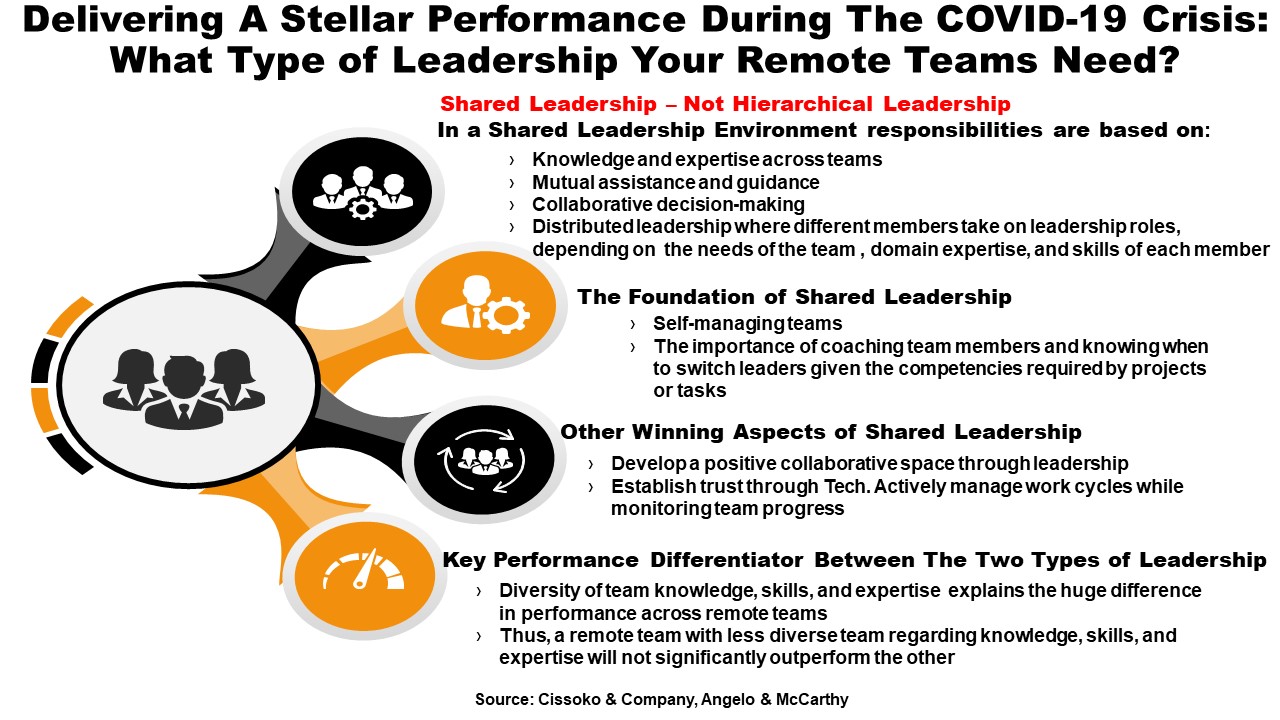
Our experience suggests that there is a better and time-tested way for the challenges many businesses are facing during the coronavirus economic crisis—which we believe will be deeper than those we’ve seen in recent memory. This kind of leadership is called shared leadership for managing remote teams. Unlike hierarchical leadership, shared leadership is based on distributed leadership, where different team members take on the team’s leadership depending on the project and challenges to be addressed. It entails mutual assistance and guidance while encouraging collaborative decision-making. It is grounded on the knowledge and expertise across the team by assigning the leadership of the project to the most suitable team leader.
To make shared leadership a success story, it must be grounded on the right foundation. At its core, the method requires self-managing teams. In this kind of environment, coaching is critical in that it allows the team members to know when the leadership needs to be switched—given the requirements of the project at hand—concerning skills, knowledge, and expertise.
Another great aspect of shared leadership versus hierarchical leadership is establishing trust in using digital technologies. It also enables active management of work cycles while monitoring teams’ progress. Above all, it is important to note that the key performance differentiator between shared leadership and traditional hierarchical leadership is the diversity of the team members. That is, the more diverse the team is regarding skills, knowledge, and expertise in a shared leadership environment, the greater the difference in performance compared to the other.
As such, organizations need to strive to have a functional, diverse team when adopting the shared leadership model. By doing so, we believe they will reap the dividends of this new model of virtual team management. Our experience working with large organizations suggests that the shared leadership model greatly outperforms the traditional remote team management models. Thus, thriving rather than surviving the coronavirus crisis is the winning approach for remote team productivity and performance in this chaotic COVID-19 corporate environment.
Get in Touch
We will respond to your message as soon as possible.
Insights to Win
Subscribe to our newsletter for in-depth analysis, reports, and our perspectives on business and economic issues related to the Japanese market and the global economy.