
Gender Diversity Rankings of the 3,812 Largest Firms and Countries in OECD — REPORT

The impact of gender diversity on corporate performance is well-established concerning the high correlation. Indeed, the International Labor Organization (ILO) studies revealed the positive impacts of gender diversity. For one, 60% of companies said gender diversity resulted in profitability and productivity improvement, nearly 57% said it enhanced the ability to attract top talents, and 54% said it resulted in greater creativity, innovation, and openness.
Besides the business case for diversity, equity, and inclusion (DEI), our research and experience suggest that the D in diversity stands for dignity in work, meaning human dignity is the sine qua non of diversity, equity, and inclusion (DEI). Thus, building a corporate culture worthy of human dignity needs to be one of the top priorities of purpose-driven organizations worldwide. Therefore, management practice that creates a hostile work environment for women is inconsistent with business ethics and can be considered an assault on competent women’s dignity. That is, either inherent or earned dignity and sometimes the combination of both.
Many governments worldwide, particularly in Europe, have stepped in through quantitative targets regarding gender on corporate boards, given the timid actions of industries’ bellwethers. For example, the leading countries at the forefront of these measurable targets are Denmark, with a women target of 44%, France (35.8%), Germany (32.7%), Japan (30.3%), Australia (21.6%), Spain (20%), Luxembourg (20%, and Austria (19.2%).
Given that our global economic impacts are driven by the power law, where small things have a dramatical impact on performance, we believe that a report based on the state of gender diversity on boards, in C-Suites, and top management positions across the 3,812 largest firms in OECD by market capitalization can provide a better picture of the landscape. For one, consider this: in the United States, publicly listed firms in 2015 represented just 0.06% of the total number of companies in the country, but they accounted for 51% of total private-sector pretax profit, 41% of sales, and 31% of employment in the sector. Moreover, the S&P 500’s aggregate profits were $1.2 trillion in 2017, greater than Mexico’s entire GDP in the same year.
While companies’ performance ultimately differs by category of progress, some countries, such as Japan, are truly lagging far behind others. In other words, it is paradoxical that in a great country called the Land of the Rising Sun, “the diversity sun” is in sunset mode. Japan is among the three worst-performing countries at the bottom of the 27 countries in the analysis. Again, the paradox of the Land of the Rising Sun stems from the fact that it is among the countries with the highest gender targets in the OECD league. Thus, we believe that meaningful work is still needed. Otherwise, the status quo will still prevail.
We categorized the firms and their respective countries into four groups based on their progress in beating the three key OECD average benchmarks. That is the average percentage of women on corporate boards across each country, in C-Suites and top management leadership roles.
The “Perfect Trifecta” Club the Best Performers
In the first group, we have the largest companies in countries that surpassed or at least met the three key gender benchmarks mentioned above: women on boards, in C-Suites, and in management positions. We call these best performers the “Perfect Trifecta” club.
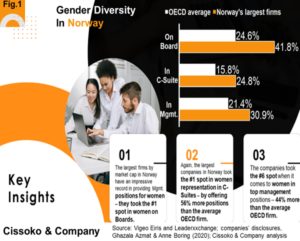
Gender diversity in Norway (Figure 1) shows the commitment to purposeful actions reinforced by regulatory targets. The country took the #1 spot among the 27 countries in women on boards and the #1 spot in women in the C-Suites category while taking the #6 spot in women in top management positions in the OECD league.
The “Perfect Exacta” Club of Firms and Countries
For the second group, we combined the largest firms in countries that matched at least two or beat two key benchmarks. We call this group the “Perfect Exacta” club.
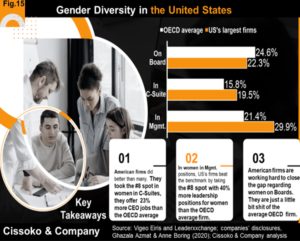
American largest firms, on average, belong to this club, propelling the United States to the “Perfect Exacta” club in OECD. The US took the #8 spot regarding women in C-Suites and top management positions. Indeed, American firms offer 23% more job opportunities in C-Suites and 40% more top management opportunities than the OECD average. Similarly, they are working hard to close the gap regarding women on corporate boards.
The “33%” Club Beating (or Matching) One out of the Three Categories
In the third group, we put together large firms in countries that beat or at least matched one of the key benchmarks above. We call this group the “33%” club.
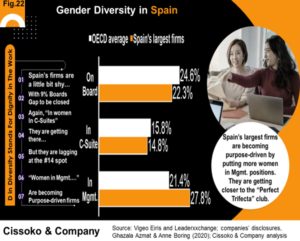
Among the three key benchmarks, women in management positions are an area where Spain shines. However, in the other two areas, the firms and the country need to work harder by doubling down on purpose-driven actions.
In the “Persona non-Grata,” Club Competent Women Seem not Welcome
Finally, the last group is where we combined the worst-performing companies across three countries. We call this group the “Persona non grata” club. Given the vast gap between them and other firms across the OECD, it seems that within these countries’ largest firms, highly qualified women are not welcome at the top levels of management. In other words, competent women’s dignity is under assault through fairness deficit, which, in our experience, is inconsistent with business ethics.
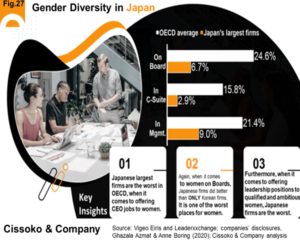
Paradoxically, this is the club where the Land of the Rising Sun found itself compared to others in the OECD league. In just two years, women in management positions decreased by 28, a stunning reversal.
Get in Touch
We will respond to your message as soon as possible.
Insights to Win
Subscribe to our newsletter for in-depth analysis, reports, and our perspectives on business and economic issues related to the Japanese market and the global economy.