
Gender Diversity in Japan: Minding Japan’s Gender pay gap — The “25% Gender tax”
Make no mistake: the D in diversity stands for dignity in the work. Thus, winning as a purpose-driven company requires building a corporate culture worthy of human dignity. In today’s highly competitive business world, self-centered thinking is misguided. Winning calls for purpose-driven action grounded in a genuine commitment to be a profitable force for good. As such, corporate Japan needs to change course before it is too late. For one, it is paradoxical that the “diversity sun” is in sunset mode in the Land of the Rising Sun, sending a dangerous signal worldwide.
Our analysis revealed that the terms “gender diversity” and “fairness” seem missing from corporate Japan’s lexicon in this age of great resignation and inflation expectations disrupting businesses across the global economy.
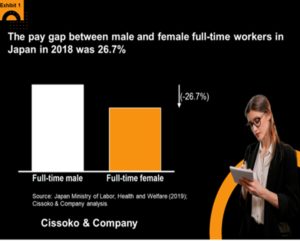
Moreover, highly qualified and ambitious women have become “persona non grata,” meaning they are not welcome at the top levels of management. This management practice is inconsistent with business ethics and can be considered an assault on hard-working women’s dignity, with severe implications for the talent war.
Japan’s Gender pay gap “The 25″ Gender tax”
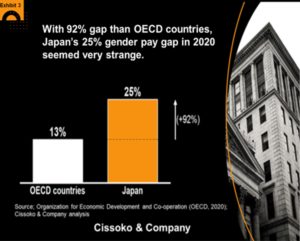
Regarding the gender pay gap, which we call the “gender” tax, Japan stands out with a 25% pay gap, 92% larger than the average OECD of 13% in 2017.
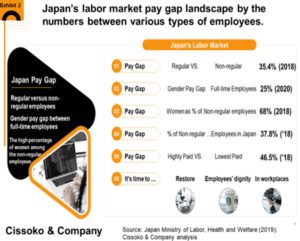
Moreover, women accounted for nearly 70% of non-regular employees in 2018. In combination, these factors have affected Japanese women for decades.
Furthermore, the pay gap between the highest-paid and lowest-paid employees is staggering; according to the Japan Ministry of Labor Health and Welfare, it stood at 46.5% in 2018.
Comparing the Gender pay gap Across Developed Countries
Japan’s gender pay gap is in stark contrast to Scandinavian countries. In 2017, the gap was 6.3%, 7% and 10% in Denmark, Norway, and Sweden, respectively. Moreover, comparing the Land of the Rising Sun with the same countries regarding women in management revealed that Japan lags far behind.
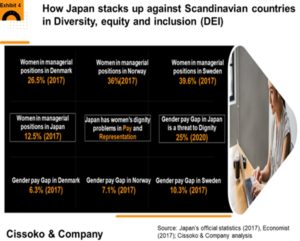
For example, consider Sweden. In 2017, women occupied nearly 39% of management positions, compared to Japan’s, which has deteriorated to 9%. In other words, women’s share of the top management levels sank by 28% in just two years through November 2019.
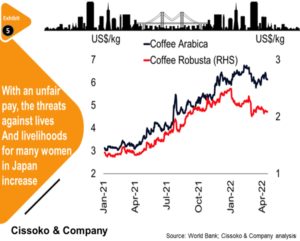
Furthermore, our analysis of the 3,812 largest firms across the OECD revealed the degree to which the state of Japan’s diversity needs urgent attention from boards. Consider this: across the C-Suites of Japan’s most prominent companies (571), women occupy just 2.9% of the positions—meaning the Land of the Rising Sun is struggling at the bottom with South Korea.
Japan’s diverse landscape has become more frustrating than countries such as Sweden, where women, as competent as men, occupy 24.5% of the C-Suites. That is, 35% above the OECD average. Across the nearly 4,000 companies, women hold 15.8% of C-Suite positions and 21.4% of boards; when it comes to management positions, women are more represented, given that they occupy 24.6% across the largest companies in the OECD. By contrast, women in the most prominent Japanese companies occupy 6.7% of boards and 9% of management positions.
The Threats Posed by Rising Inflation to the Lives and Livelihoods of Japanese Women
The Japanese economy has struggled in a deflationary environment for quite some time. However, as of this writing (mid-September 2022), the prices are rising out of control. For example, overall energy costs have increased by 17%, electricity bills soared by 21.5%, and overall shopping costs, excluding fresh foods, have gone to the roof, too.
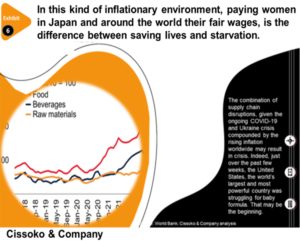
Before the Russian invasion of Ukraine, the prices of many commodities were already rising, but slowly, worldwide; thanks to the COVID-induced supply chain disruptions, Russia’s invasion of Ukraine worsened the economic threats by pushing prices further.
In this economic environment, paying employees fair wages, regardless of gender, matters greatly. It is the difference between saving lives and unjustified starvation for many women worldwide, including hard-working Japanese women, given the 92% gap between Japan and other countries in the OECD in 2020.
In short, human dignity and fairness need to be at the core of a firm’s strategy. Failure to rethink the issue through this lens can jeopardize the well-intentioned goals of many organizations worldwide. In other words, the status quo is a losing option. The second-order effect is poor corporate performance associated with mediocre employer brands.
Get in Touch
We will respond to your message as soon as possible.
Insights to Win
Subscribe to our newsletter for in-depth analysis, reports, and our perspectives on business and economic issues related to the Japanese market and the global economy.