
Japan’s Great Resignation: Trends CEOs Need to Know to Craft a Winning Strategy
 DOWNLOAD THE 26-PAGE REPORT HERE
In this age of so-called Great Resignation, business leaders in Japan or those exploring tapping into the talent pool to win need to know the hidden talent trends disrupting Japan Inc.—and even the Japanese government. These disruptive talent trends can threaten CEOs’ and HR departments’ agendas without a proactive strategic response. Thriving in this shrinking talent pool hinges on adapting and deploying a proactive strategy based on these emerging trends shaping Japan’s talent landscape.
Japan’s Great East Earthquake and Fukushima disaster have been disruptive and have had profound and lasting impacts, including economic disruptions ranging from supply chains to infrastructure across Japan. Recent studies of the impacts of the disasters revealed that they resulted in Japan’s real GDP growth declining by nearly 0.5% in 2012. Research assessing the implications of the Great East Earthquake and Fukushima meltdown on businesses suggests that companies with customers and suppliers in the affected areas were hit very hard – their growth nosedived between 3% and 4%, respectively.
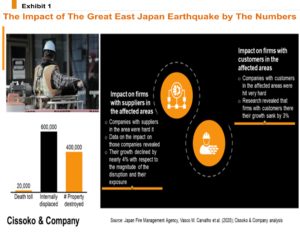
Above all, the number of casualties regarding the death toll is eye-watering, given that nearly 20,000 died from the disasters and around 60,000 Japanese were still internally displaced as of 2018, while 400,000 houses were destroyed, according to Japan’s Fire and Disaster Management Agency.
Japan Style Great Resignation: Hidden Trends About Talent Exiting the Country
The discussion about Japan’s aging population resulting in lower productivity misses the mark, given that in recent years, the number of Japanese citizens living abroad has been increasing at an alarming rate. As of 2017, the number of Japanese staying overseas topped 1.35 million, soaring over 14% since 2011. However, those obtaining permanent residency abroad jumped higher than those living abroad over the same period to more than 484,000, which means an increase of more than 20% between 2011 and 2017, according to Japan’s Ministry of Foreign Affairs.
The talent exodus trends emerged in silence. That’s one of the reasons many Japanese CEOs and other business leaders still don’t understand the nature of the problematic talent disruption, as they have received scant attention from the media. Simply put, warning signs are flashing for Japan’s competitive landscape, where just 5 in 1,000 firms have existed for 100 years or more. Japan’s poor record on gender diversity in C-Suites, on boards, and in management leadership can be found in our latest global diversity report and rankings.
Understanding the Favorite Destination of Japanese Overseas Talent
Western countries have been and continue to be the preferred destination for living abroad. However, one country that has stood out in recent years is Australia. After the United States, the genuine reasons why Japanese talents like Australia more than other countries are not known. What we do know, however, is that after the Great East Japan Earthquake and Fukushima disasters, Japanese talents exiting the country to become Australian residents soared by more than 30% to nearly 97, 000 from 2011 to 2017, according to data from Japan’s Ministry of Foreign Affairs.
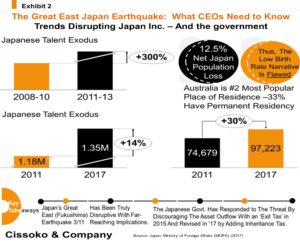
Indeed, one trend stands out among Japanese residents in Australia: the number of those becoming permanent residents. From the aftermath of the twin disasters to 2017, the number of Japanese permanent residents in Australia increased by 33%.
Opportunities Offered by COVID-Induced Hybrid (Telework) Environment
The trends created disruptions in Japan’s shrinking talent pool. However, in this age of hybrid work, companies and their leaders can still tap into this Japanese talent pool to fill those positions that have been opened for months – even years without being filled through game-changing strategies.
In other words, Japan is notorious for its shortage of skilled bilingual professionals. It is ranked 78 among 112 countries in the English proficiency index. Moreover, according to the OECD, Japan’s ranking is poor compared to its counterparts in the G7 regarding digital transformation skills regarding eGovernment (digital tools) for digital document submission to relevant authorities. For one thing, among G7 countries, Japanese people’s interactions with authorities through eGovernment were around 9% compared to 30% for other G7 countries.
To thrive, here are three options firms can consider. First, rehire those living abroad, such as in Australia, by providing them incentives to return home if your company is still running like the pre-pandemic era. The second option is for the firms operating in the hybrid model. In this model, businesses can hire bilingual talents with permanent residency on either a full- or part-time basis through remote work arrangements.
The last option companies can deploy is the cost-saving model of hiring Japanese talent living in Australia with English proficiency. This option can boost savings, given that traditionally, Japanese firms hire people in Japan to work abroad or send those already working in their Japanese offices to foreign offices because of fear of cultural or language barriers. Hiring native people who are already living abroad can unlock value for companies.
Indeed, talent geography has no border in this age of COVID-induced hybrid environment. To remain competitive, many firms are moving toward the “work anytime, anywhere” model through advanced technologies.
Get in Touch
We will respond to your message as soon as possible.
Insights to Win
Subscribe to our newsletter for in-depth analysis, reports, and our perspectives on business and economic issues related to the Japanese market and the global economy.