
The Age of Purpose: Leading Through Institutional Logic
The coronavirus crisis is begging leaders to prove they are worthy of their titles—by standing up—not standing by. In this age of stakeholder capitalism, the COVID-19 crisis provides one of the best leadership opportunities. Thus, leading in these times of health crisis means marching into hell for a heavenly cause—by being not just a corporate leader but the champion of the people as well. In other words, what does leadership in times of the coronavirus require?
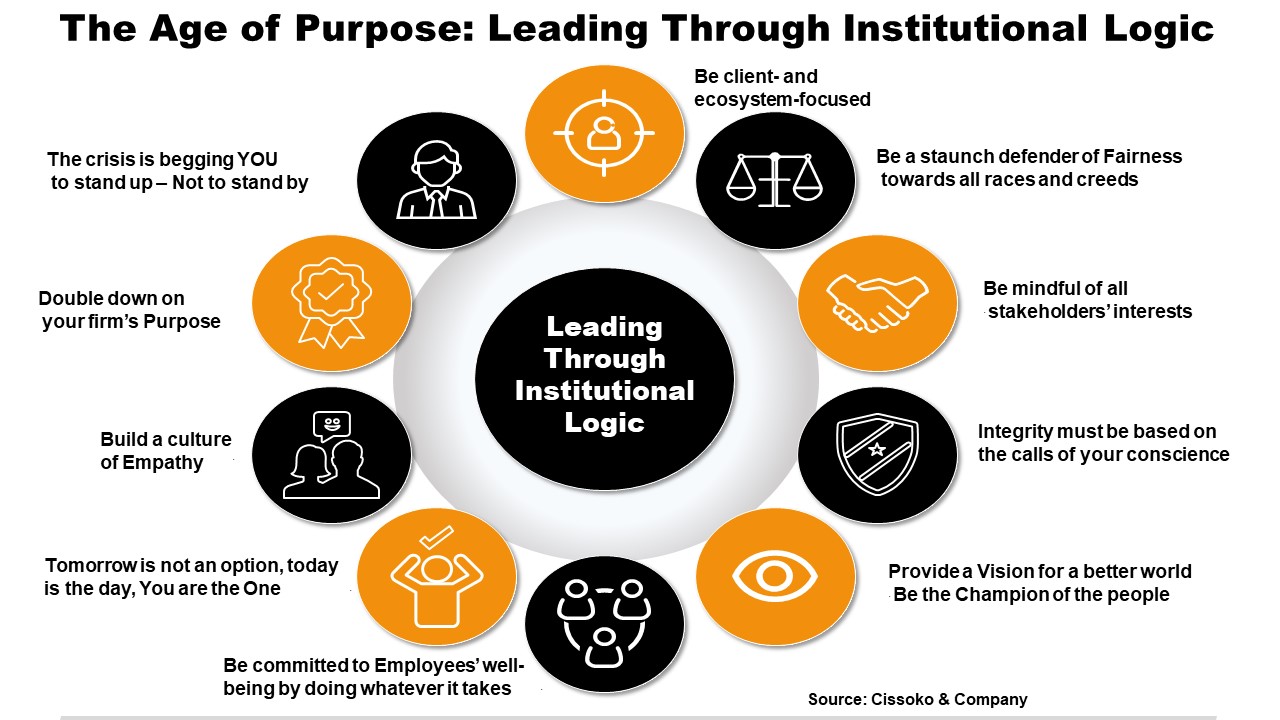 It calls for using your unused muscles of compassion and empathy. It entails unlocking the positive energy of your company’s purpose to do whatever it takes to support your employees, community, the refugees, the healthcare workers, and the world at large. This may require the courage to stand up to some selfish shareholders and board members when wanting to do the right thing at the right time—by being a force of good. Churchill once said: “Courage is the finest quality.”
Dr. Kimbro similarly agreed by stating “Leaders should remind themselves that the most valuable asset they will ever have is how they are known to others—their reputation for honesty and fair dealing.” Moreover, he continues, “No one needs to be worried about losing his wealth—given that when wealth is lost, nothing is lost; when health is lost, something is lost. But when integrity is lost, all is lost!” Thus, leading means living up to the very best within you and setting up a standard everyone can follow.
Furthermore, Dr. Kimbro argued, “The problem of waiting until tomorrow is that when it finally arrives, it is called yesterday. The question is, what did you do with yesterday’s opportunity? We waste tomorrow as we wasted yesterday, as you are wasting today. The clock is ticking! Time offers opportunity but demands a sense of urgency. Now is the time, this is the place, and you are the one… Thus, Those who leave a legacy of achievement master the art of living in the NOW – the ability to make each moment count.” Given the wisdom behind his argument in this age of crisis, we think this period is the best time to share his insights, given how inspiring the arguments are.
Similarly compelling is his statement: “All of us love courage, but we shrink from courageous acts of our own! We live like others, think like others, and we run our business like others.” Again, in his view, what does leading through the coronavirus crisis demand? “It requires not giving in to popular opinions. It calls for courage to refuse customs and rights that run contrary to our sense of decency. Much of today’s unhappiness rests with weakness and indecisions. In other words, the lack of courage to stand on our own by forging our own path by being different.
Consider this: A generous couple left more than $9000 in a restaurant in Houston to assist staff in getting through the crisis. Another guy from Illinois volunteered to pay over $1000 in rent for a waitress. How? While watching a CNN show, a waitress explained that she couldn’t afford her rent due to restaurant lockdowns. What the gentleman did is called leadership through empathy while providing examples of the types of action the world needs during this crisis. We call this: to stand up through empathy—Not to stand by!
Similarly, many well-known firms are standing up. Netflix has established a fund of $100 million to help the creative community out of work. Apple made over 20 million protective masks to plug the woeful shortage across the United States. Alibaba and its founder, Jack Ma, have taken amazing actions to alleviate the distress, from providing around $ 14 million of aid to making or sourcing COVID-19 ventilators for the state of New York and beyond. Furthermore, Bill Gates and his foundation established a $100 million fund for the crisis. Again, Jack Dorsey, the CEO of Twitter, pledged to donate around a quarter of his fortune to alleviate the coronavirus distress worldwide.
This is what is required in times of unprecedented crisis, where lives and livelihoods are at stake—the courage to do what needs to be done when it needs to be done. Leaders need to remind themselves that the clock is ticking. The crisis has offered leadership opportunities, but that chance calls for urgency. In this age of company purpose, we urge firms to double down on their organizations’ purpose beyond profit-seeking, given that a firm’s purpose is its raison d’etre. Indeed, the purpose of a firm is greater than any profit it will make, greater than any product it will launch, and greater than any strategy it will ever craft. In other words, as Ghoshal once said, “Purpose – not strategy is why a firm exists.”
Like a corporation’s purpose, the emerging age of stakeholder capitalism calls for a holistic view of the landscape as before; not only the shareholders’ interests need to prevail, but also the interests of other key stakeholders—such as employees, partners, vendors, and suppliers worldwide. Thus, we believe that leading with purpose entails double-downing on institutional logic to succeed.
Get in Touch
We will respond to your message as soon as possible.
Insights to Win
Subscribe to our newsletter for in-depth analysis, reports, and our perspectives on business and economic issues related to the Japanese market and the global economy.