
Japanese market entry: Winning in Japan’s ¥40T Food Industry — A CEO’s Briefing
 DOWNLOAD THE 20-PAGE CEO’s BRIEFING
Over the past few years, Japan’s food and beverage industry has been one of the most disrupted industries. It was already struggling before the COVID-19 outbreak. The Coronavirus-induced global economic freefall worsened the situation, compounded by supply chain issues and lockdowns. However, beyond these challenges, other issues are upending firms’ profitability and growth strategy in the Land of the Rising Sun. Chief among them are food product recalls and sustainability issues related to food waste management.
Japanese market Food Industry Profitability and Market Share Trends
Between April 1, 2017, and March 31, 2022, Japan’s food industry lost 7% of its combined B2B and B2C sales, which amounted to ¥3.2 trillion. Moreover, it lost nearly 6% of its share of Japan’s manufacturing sales (B2B and B2C combined).
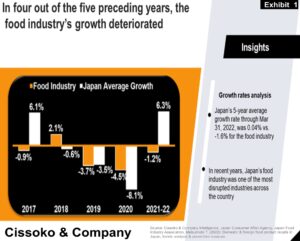
In other words, during the first quarter of 2017, the industry had 11% of the manufacturing sales, but its market share fell to 10.4% over the following five years. The litany of issues in Japan’s food industry can also be spotted across the manufacturing sector. Over the past five years through March 2022, the average growth rate of the sector was 0.5% compared to -1.6% for the food industry.
(Food Import) Manufacturers’ Product Recalls Are Disrupting Profitability
Japan has stringent food regulations that must be considered regarding the food supply chain, including the go-to-market game to win in the Land of the Rising Sun. They include Japan’s Food Sanitation Law and Japan’s Food Labeling Act, among others. Consider this: Between 2017 and 2019, over 700 recalls occurred yearly, which amounted to over 159 tons of disclosed food loss on average in 2018 and 52 tons in 2019.

The disruptions to growth and profitability can be traced back to poor supply chain management regarding what it takes to follow Japan’s food regulations. Most recalls were related to violations of Japan’s Food Labeling Act, which stood at 59%, and Japan’s Food Sanitation Law, which accounted for nearly 39% of the recalls over the three years through 2019.
Boosting Profits – Becoming Purposeful by Tackling the Food Waste Problem
It is paradoxical – across an industry with only an average operating profit margin of 3% in a country with a food self-sufficiency rate of 39% in 2019 – to see thousands – if not millions – of tons of food waste each year in this age of sustainability. However, our analysis of Japan’s food value chain suggests that not all players are created equal. Indeed, while the players across the upstream levels (manufacturers) account for the lion’s share of the food waste, they have done an excellent job over the years by confronting the problem creatively through recycling. However, downstream players such as food retailers and restaurants still have a long way to go.
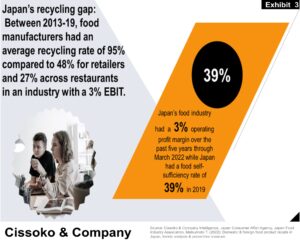
In fact, over the six years through 2019, manufacturers, on average, recycled nearly 95% of their food waste compared to 61% for wholesalers, 48% for retailers, and 27% across Japanese restaurants. In other words, the downstream players failed to reach even the industry’s average of 58% over 2013-19, which is very sad in this age of purpose-driven leadership regarding sustainability in Japan and beyond.
By combining a low food self-sufficiency rate and a market size of over ¥40 trillion, Japan provides an excellent growth opportunity for foreign food manufacturers. However, given the poor average operating margin across the industry compounded by Japan’s regulatory hurdles, food manufacturers—domestic or foreign—need to address the key issues disrupting their growth and profitability prospects mentioned elsewhere in this CEO’s briefing to win in the Land of the Rising Sun.
Get in Touch
We will respond to your message as soon as possible.
Insights to Win
Subscribe to our newsletter for in-depth analysis, reports, and our perspectives on business and economic issues related to the Japanese market and the global economy.