
Japan’s Fast-Lane Growth Strategy®: The Winning Game in Town Across Food Industry
The combination of an aging Japanese population, poor profitability, and innovation across general foods in recent years led to the rise of the so-called health foods or foods with health claims (nutraceuticals) in the Land of the Rising Sun and beyond. Yet the emerging segment provides winning opportunities for boosting growth on steroids.
Growth Game Across Key Segments of the Japanese Food Industry
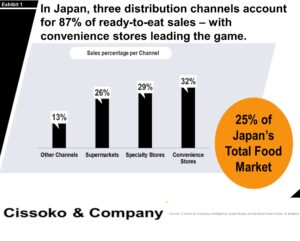
With a market size of more than ¥40 trillion, the ready-to-eat segment topped the ¥10 trillion mark in 2017 and counting—equivalent to nearly 25% of the total Japanese food market. However, the segment is not growing as fast as its leading firms wish. On top of this, winning calls for focusing and tailoring the distribution game for better customer experience in the game of market penetration.
In addition, the Halal food segment, which had fewer than 790 restaurants in October 2017, has become a growth catalyst for Gyomu Super through its 800+ stores in the country. Unlike this niche, the health and wellness segment within the food industry belongs to the category across Japanese industries we call Japan’s Growth Fast Lane®. In other words, this path can increase a company’s odds of becoming one of Japan’s Gold Medalists of Growth®—the firms that beat Japan’s average growth rate by three standard deviations yearly.
General Foods Consumption and New Product Development (NPD) in this age Wellness
Given the deficit of badly needed nutrients, many people’s food consumption is insufficient to meet their daily dietary needs. Moreover, busy work schedules can push people into abnormal consumption of fast food, ready-to-eat or frozen foods, increasing the risk of obesity. For this reason, people with wellness consciousness are turning to dietary supplements for the sake of health and well-being.
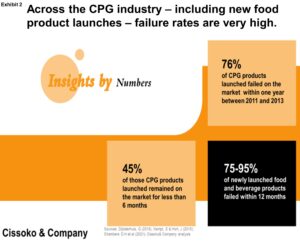
Beyond that, there is a mismatch between what food manufacturers make and what consumers want. That’s why many new product developments (NPDs) across the fast-moving goods (CPG) industry have been disastrous in recent years. Consider this: between 2011 and 2013, 76% of CPG products launched did not survive more than a year on the market. Worse still, 45% of those failed products remained on the market for just six months. Moreover, the disaster suggests it is time for a new playbook in the food and beverage industry, given that between 75 and 95% of newly launched products failed within 12 months. Our research into new product development (NPD) revealed early-stage matters. At the same time, common failure reasons include poor coordination across teams and flawed market research—including analyses and assumptions—grounded on outdated views and over-hyped management fads.
For one, it is convenient but dubious to argue that a business process or new product development is religiously adhering to the Gospel of the latest management fads that competitors are deploying, regardless of whether the methods are the winning approaches for a given circumstance. As such, what seemed like a headwind turned out to be an embarrassing product development disaster in the making. Behavioral scientists have studied this situation, and they call it social proof. Indeed, faced with uncertainty, most people (including firms) look at the actions and behavior of others to determine how to act and behave. Thus, when the others are wrong, you will get it wrong, too. Therefore, besides being evidence-driven, CEOs and other business leaders today need to be discerning through good judgment powered by critical thinking.
Japan’s Growth Fast Lane® 2023: Wellness and Health Segments of Japan’s Food Industry
Unlike traditional medicines, dietary supplements are not considered medicines. For one, they are mostly consumed by healthy people. By their nature and type of nutrients, most do not need the same high standard of safety and efficacy through clinical trials required in the biopharmaceutical industry for regulatory approval. For example, in Japan, as of this writing, foods with nutritional claims are self-certified—while food with specified health uses (FOSHU) accounts for 29% market share and food with functional claims (FFC), which grew by 500% between 2015 and 2020 powered by 350 products and counting—are required to provide evidence of physiological benefits.
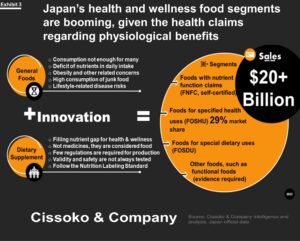
To be sure, just six years after functional foods got Japan’s authorities’ green light in 1991, the segment grew very fast over the past 20 years to 2017. One of the fast-growing segments—food with specified health use (FOSHU)—had a spectacular growth rate of nearly 500% over the same 20-year period. The other high-flying segment, foods with functional claims (FFC), which grew around 500% between 2015 and 2020, is gaining CEOs’ attention. The other category, foods for special dietary uses (FOSDU), is also doing well.
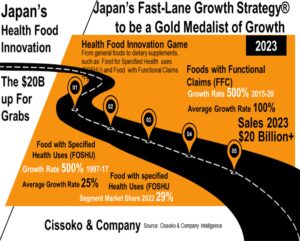
In short, winning in the Japanese —let alone—the struggling food industry, which has been losing market share over the past five years, is a tall order. However, our decade of experience suggests that being on Japan’s Growth Fast Lane® can be a game-changer. Indeed, sustainable competitive strategy, crudely speaking, is all about above-average profitability. Moreover, in our experience, when it comes to superior profitability, it is the industry in which a firm chooses to compete—not the strategy itself—that distinguishes winners from the pack. As such, today, the Japanese wellness and health food segment provides just that—a winning opportunity.
Get in Touch
We will respond to your message as soon as possible.
Insights to Win
Subscribe to our newsletter for in-depth analysis, reports, and our perspectives on business and economic issues related to the Japanese market and the global economy.