
Aging Japanese Population and Japan’s Food Imports Boom Ahead
 DOWNLOAD THE 15-PAGE CEO’s BRIEFING HERE
We believe winning in the food and beverage industry is almost impossible without having deeper insights into the people who produce the food—our lifeblood—and the implications for business in Japan and beyond. Through this research, our analysis revealed the golden opportunity we call Japan’s boom ahead —the combination of emerging but silent trends in Japan’s agricultural industry over many years—thanks to the aging Japanese farmers.
Like many developed countries, Japan’s aging population will be disruptive. While most of the headlines regarding this matter have pointed fingers at the low birth rate, they failed to consider the impact of Japan’s Great East Earthquake of 3/11 on the depopulation, given that many Japanese people left the country for other places thought to be less prone to seismic disruptions like the Land of the Rising Sun, given the government’s prediction in 2012 of a high likelihood (70% chance) of a major earthquake in the next 30 years that will kill several thousand people.
Given that we have already published a report regarding the 3/11 earthquake-related disruptions that led to Japan’s “Great Exit” before the phrase “Great Resignation” (coined many years later by an assistant professor at Texas A&M University) and how companies can win the Japanese talent war, this CEO’s briefing will investigate the opportunities presented by this graying Japanese population in areas most forgotten in strategy discussions across many boardrooms—meaning the shrinkage of Japan’s farming (agricultural) talents owing to Japan’s aging population on the cusp of providing Japanese market’s Fast-Lane Growth Strategy®.
Combination of Trends that Will Lead to Japan’s Food Imports Boom Ahead
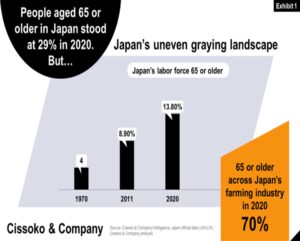
This year’s official data revealed that Japan’s population has again decreased by more than 500,000 to approximately 125.4 million. Worrisome as this may be, the trend across the farming population from 1980 to 2020 is even more disruptive, given that the number of farmers has decreased by a massive 71% to around 1.4 million. Moreover, thanks to the graying trends across the country, where the number of people aged 65 or older stood at 29% in 2020 and 13.8% across the labor force, the number of farmers aged 65 or more, as a percentage of the total over the decades to 2020, has dramatically risen to nearly 70% in 2020.
To be sure, beyond age-related issues, other factors are at play in the hazardous agricultural (farming) industry in Japan and beyond. For one, the country’s annual farming-related fatal incidents recently topped 375, with most—if not all—of the incidents happening in the livestock segment. Indeed, more than 90% of agricultural management entities are categorized as self-employed or family-owned by Japanese officials, but to be in the industry, you must have insurance. While not all incidents in the cattle-breeding industry are fatal, evidence from Japan’s Northern region of Hokkaido suggests that over 50% of the people injured in recent years required more than a month of treatment.

Moreover, as the farmlands decreased by roughly 14% from 1990 to 2020, this silent trend disrupted production by almost 10%. For this reason, recently, Japan produced nearly 12 million tons of its vegetable needs while importing the majority—over 3 million tons from abroad — mainly from China, which accounted for more than 51% of the vegetable imports. A breakdown of this category revealed that nearly 65% were fresh vegetables. Further analysis of the import volume suggests that onion topped the list with 220,000 tons in the vegetables category.
Below the Public Radar, the Government Has Been Working Hard to Reverse the Trends
To tackle some of these threats stemming from the so-called less-favored area (LFA) —which broadly refers to areas under increasing geographic, economic, social, and natural threats, such as communities on the cusp of disruptions in mountainous and coastal regions, people inhabiting poor farming climates and soil conditions, and those in low farming productivity regions, among others, that may lead to abandonment while worsening regional depopulation. Since 2000, the Japanese government, like other developed economies, has adopted policies to reverse the trends. It enacted several legislations since then through WTO-allowed payment subsidies by promoting rural community development through the revitalization of soon-to-be abandoned farmlands.
Indeed, in 2017, the Japanese government directly disbursed over 77 billion to the LFA-accepted members while trying hard to reverse the disruptive trends of farmland abandonment. Over 395,000 hectares of farmland have been deserted across the Land of the Rising Sun—with more than 53% belonging to the less-favored areas (LFAs) for farming. As such, the Japanese government has demonstrated its commitment to the communities eligible for the subsidy payments, given that over 71% received the payments. Again, to boost farmlands’ productivity, more than half of the payments are aligned to these goals, and the rest for other community activities.
We believe that these well-intentioned policy responses will not be enough to reverse the combination of disruptions across Japan’s farming industry that have been taking shape over many decades. These policy interventions will soften the blow expected in the years to come. However, they can’t reverse the trends altogether, and these trends, combined with other macro trends, will provide a fertile ground for one of Japan’s subsequent booms from 2030. As the French chemist and microbiologist once said: “Luck favors only the prepared mind.” This will be true for firms that get their strategies together by seizing these huge opportunities thanks to aging-related disruptions in the Land of the Rising Sun.
Get in Touch
We will respond to your message as soon as possible.
Insights to Win
Subscribe to our newsletter for in-depth analysis, reports, and our perspectives on business and economic issues related to the Japanese market and the global economy.