
Building Agile Organizations: What Separates the Leaders From the Rest?
Over the seven years through 2018, more than 45% of projects were not completed on time and within budget, according to the Project Management Institute (2018). Yet firms for decades have been spending huge resources to get their projects right—while professionals spent their time and resources on training but to be disappointed—given the scope creep, cost overruns, and poor transition from waterfall to agile and competing agile frameworks, etc., to name a few challenges. The question is: What are the key success factors of agile in 2020? In other words, what separates the winners from the rest in project management?
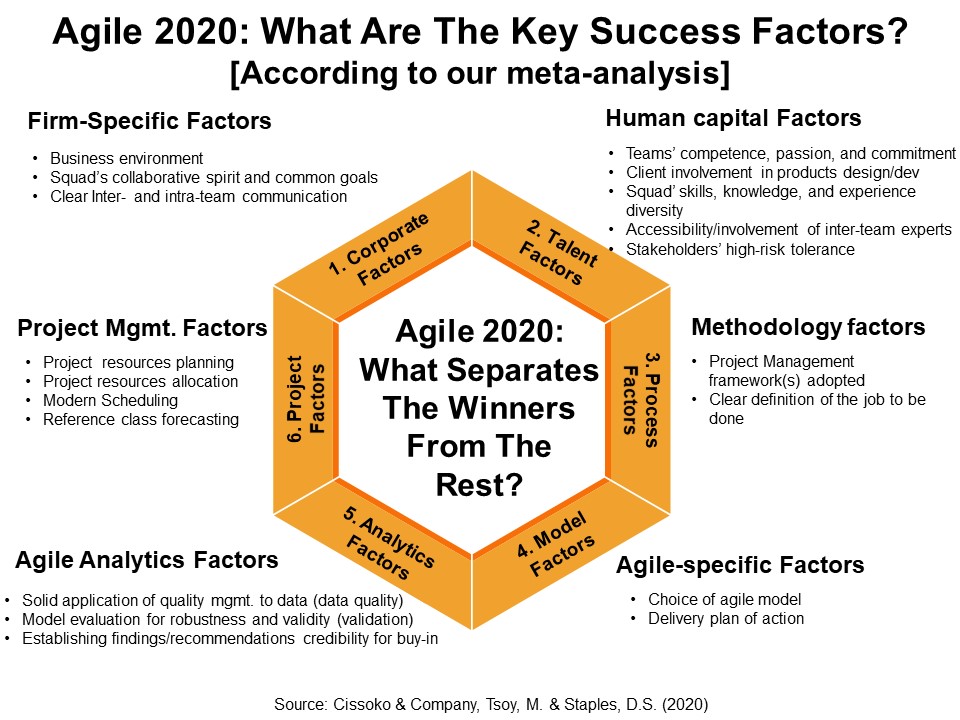
Like the confusion regarding the concept of digital transformation, organizational agility has been confused with product development agility across the board—given the root of the concept nearly two decades ago. As a result, many firms have been distracted by focusing their attention on just this strand of agility. Our experience suggests that leading and digital-ready organizations have won the agile battle by adopting four rules of the game that enabled them to compete better than their peers.
Cultural Agility
The first rule deals with the firm’s business, including its assumptions, beliefs, and what it tolerates, rewards, and punishes. To be clear, firms must challenge their long-held assumptions and values with respect to the competition, customer experience, suppliers, employees, their industry with its artificial barriers, technologies, sustainability, and society at large. This means they must move from a “This is impossible and can’t be done” mentality to “This is possible and can be done soon.” This requires a little dose of futurism. Thus, firms need to learn how to build a digital culture for the digital age.
Product Development Agility
The second rule deals with the innovation process: prototyping, experimenting, and developing an intrapreneurship mindset through feedback loops. This part of the agile strand is the most familiar to many people. Indeed, incumbents (established firms) must learn to think like the startups and challengers considering disruptive attacks.
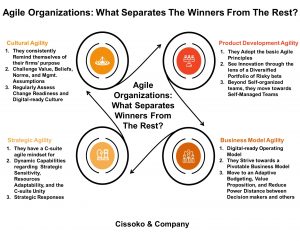
In contrast, they need to see innovation through the lens of a diversified portfolio of risky bets like the financial portfolio managers, where each innovation project comes with its own risk. This wisdom has worked in the financial world for decades, and there is no reason why it can’t be used across non-financial businesses. A mindset such as this can be greatly benefit in managing innovation portfolios through perspectives from different industries. Non-financial firms should not focus their return on individual innovation investment projects. But, on the return of the whole portfolio. Given the high return potential of the whole portfolio, if one innovation project loses money—the return from any other successful innovation project will be high enough to recoup the investment from the loss-making projects—while providing the whole organization with a satisfactory return.
Beyond the venture capital world, several industries, such as the book and movie industries, have used the same principles of a diversified portfolio if risky bets for decades. Given that many traditional movies or books turn out to be money-losing projects. However, the firms in those industries have hedged their bets through the mix of titles and other related rights. For example, a stunning book deal happened recently across the publishing industry when a leading book publisher, Randon Penguin House, acquired Barrack and Michelle Obama’s fiercely competitive book publishing rights by bidding over $60 million, according to Garrahan and Bond in 2017.
The mind-boggling deal raised several head-scratching questions across the industry regarding how the publisher will recoup its investment. What is clear, as mentioned above, is that the veteran publisher knew what it was doing by hedging its bet through a portfolio of book-related rights. The caveat in the innovation world is that for this strategy to work, the innovation projects need to be disruptive or game-changing enough, not just a portfolio of incremental innovation projects as is currently practiced across shoals of organizations in several industries we have worked with over the years. A firm may need to tap outside collaborators or partners to ensure its success.
Design thinking is closely related to product development agility—the creative and iterative problem-solving process that encourages businesses to empathically focus through experimentation on the people for whom they are creating products. So, by drawing on systematic reasoning with the combination of contextual domain logic and out-of-the-box imagination, firms can solve complex problems through innovative and creative solutions.
The Design Management Institute findings suggest, design-fueled companies delivered stellar results over the past decade than the Standard and Poor’s (S&P 500). Indeed, they doubled their growth rate during that period. Also, design-powered firms launch more products annually than traditional businesses (Design Management Institute, 2015). In addition, software-powered devices are increasingly getting more idiosyncratic in today’s millennial world. However, customer experiences are also becoming more important in winning. So, design thinking should be one of the top priorities in an organization’s arsenal. Given that it enhances the customer experience regarding regular interactions with products and the firm.
Strategic and Execution Agility
The third rule deals with the exploitation, exploration, and quick adaptability to the increasingly fast-paced digital environment. On the one hand, businesses need to seize on current opportunities by efficiently relocating resources to enhance the firms’ value, such as M&A and incremental innovation. On the other hand, they must shift resources to future value-enhancing opportunities by making big bets on strategically important and technology-fueled innovation opportunities with the potential for high payoffs.
Consider this: the coronavirus (COVID-19) is a classic black swan disruption to which most firms are ill-prepared—given the deficit of strategic agility across the board. Our experience suggests that the C-Suite’s entrepreneurial mindset highly influences the necessary unity in the boardroom. Indeed, companies with strategic sensitivity with respect to changes in the external environment win in times of disruptions with low probability but dangerous implications for their businesses. In short, winning in today’s digital world of disruption everywhere entails becoming strategically agile—the combination of strategic sensitivity to the changes in the external environment, dynamic capabilities for reconfiguring corporate resources, and the C-Suite unity—which creates a fertile ground for product and business model innovation necessary for exploiting and exploring external opportunities.

In short, companies need to be structurally ambidextrous to win (O’Reilly & Tushman, 2004) by simultaneously managing today and tomorrow by combining two structures of the day-to-day routines and the intrapreneurial projects for the future. Yet contextually ambidextrous to explore and exploit emerging opportunities to enhance their adaptability regarding the external environment, said Turner et al. in 2018. However, unlike previous decades, where innovations were given artificial horizons, innovation cycles are becoming shorter in today’s fast-paced world. So, according to Steve Blank, firms must avoid the pitfalls of buying into the questionable assumptions of time horizons for their contextual ambidexterity to succeed. On top of that, organizations need to be quick at spotting trends in consumer behavior and environmental signals and, above all, double down on customer-experience-enabling capabilities.
Business Model Agility
The fourth rule regarding the operating model deals with how agile the firm is in delivering its value proposition through people, processes, and technologies using detailed customer journey maps. However, given the root of the agile concept in software product development, many still believe that organizational agility is the same as new product development agility, which is different. Rather, it is just one component of the whole organizational agility. Thus, thinking otherwise in our experience will result in siloing the concept.
A Google search of disruption provides 636 million results, indicating its impact on the digital landscape and industry after industry. One of the best remedies for this phenomenon is agility. Firms must mobilize resources efficiently when market conditions and the competitive landscape suddenly change; this is one of the hallmarks of thriving in the digital age rather than surviving it. It should be clear that digital technologies and their induced transformation are here to stay.
However, many firms are still dragging their feet. They are allergic to the key principles advocated by the software developers’ community through agile propositions, its fundamental values, and the new mindset to introduce new products in a speedy manner—in a few hours or days—as opposed to months or years in the traditional dogma belonging to a bygone era. To be sure, the importance of an agile team or organization can’t be overstated. However, an agile team or company is not the same as a resilient team or a resilient organization. Thus, we believe that it will be good for organizations to go beyond agile teams by thriving through team resilience and organizational resilience in this age of COVID-19.
Get in Touch
We will respond to your message as soon as possible.
Insights to Win
Subscribe to our newsletter for in-depth analysis, reports, and our perspectives on business and economic issues related to the Japanese market and the global economy.