
From Just in Time to Just for Resilience Strategy: Rethinking Value chain
The COVID-19 pandemic is a wake-up call for a rethink of the Global Value Chains (GVCs). The crisis has laid bare the cracks of the Just-in-time (JIT) supply chains around the world. For starters, the assumptions underpinning the Just-in-time supply chains borrowed from Toyota decades ago are no longer adequate for an era of trade wars, tsunamis, earthquakes, and, above all, a global health pandemic. Given that it works well for a stable economic environment.
At its core, Just-in-time relies heavily on communication and information exchange between the upstream producers and the downstream buyers. As such, in case of a crisis such as the one unfolding with life-threatening implications, the resilience of firms within the Just-in-time arrangements becomes mutually dependent, which can exacerbate the ripple effects of the disruptions. Many firms have no poor visibility across their supply chains—from the Tier 1 supplier to the Tier X down the line. Moreover, organizations need to have a firm grasp of the direct and indirect implications of their value chain disruptions. That is, they need to know in detail their suppliers of their suppliers in a granular fashion to have a firm grasp of the degree to which they are—or may be exposed—to future disruptions from far-flung regions.

Furthermore, Just-in-time supply chains are skewed towards proximity – meaning most of their suppliers are concentrated in one broad region, which, no matter how efficient it may seem, is a dangerous gamble in this increasingly turbulent world. Consider this: when the COVID-19 outbreak began in Wuhan (Hubei, China), thousands of Western organizations had their Tier 1, or Tier 2 suppliers concentrated in that region. Thus, the seemingly well-coordinated vertical integration—for ruthless efficiency—resulted in dangerous contagion worldwide. For one thing, as of two years ago (2018), China’s contribution to global exports was nearly 13.5%, and its share of global manufacturing was nearly 30%. Moreover, the G7 (the club of the most advanced countries) imports nearly 2% of its annual economic output ($1 trillion) from China. Since China joined the World Trade Organization (WTO) in 2001, the country has made impressive progress on these two fronts and may keep growing.
Again, putting all your eggs in one basket by sourcing most, if not all, of their inputs from just one country can also spell a disaster. For example, many organizations in Korea, Taiwan, and Mexico used to source over 15% of their input from China. As such, when the COVID-19 outbreak began in the Chinese province of Wuhan, they were badly disrupted while spreading the contagion across their respective countries. That’s why countries such as Japan and the US are providing incentives to their respective national businesses to move out of China. Because even getting the necessary face masks for their citizen was a serious challenge in the first quarter of this year.
Thus, we believe that in many cases, the downside risk of disruptions from Just-in-time seems greater than the upside efficiency potential gained across many industries today. Thus, while each organization’s context may differ, moving to vendor-managed inventory (VMI) or customer-managed inventory (CMI) can save the day for many organizations. Firms must learn to be optimally redundant to weather the crisis going forward, and that’s why we believe it is imperative to understand first how disruption works in the 21st century for better responses to COVID-19. Second, how to build organizational resilience by capitalizing on $700 billion opportunities. Third, how to lead with purpose by revamping toxic corporate cultures in the age of COVID-19. Fourth, how to build an effective corporate culture to tackle the challenges of COVID-19. Fifth, how to develop CEOs’ strategy IQ to deliver a gold medalist’s performance. Six, we believe CEOs need to master the strategy tools and techniques for pre-emptive and defensive strategies in the age of COVID-19. Seventh, crisis leadership, how to develop a new digital vision for the age of disruption. Eighth, beyond agile teams, how to build resilient teams. Below, we discuss the differences between traditional supply chains and digital platform ecosystems.
From Supply-Side Economies of Scale to Side Economies of Scale
In traditional businesses, such as manufacturing, one of the objectives has been to scale the production of goods and services to have economies of scale—referring to the benefit regarding fixed-cost savings that firms reap as a result of the size of the output—which ultimately reduces the average per-unit cost—called supply-side economies of scale.
However, in the platform model, the top priority has shifted to creating positive network effects — the positive effect that one user of a good or service has on the value of that product to other people. When a positive network effect is in full swing, the more users from each side who join it, the more valuable the platform is to the overall users, which is a classic demand-side economy of scale. For example, transactions within marketplaces such as Fiverr and Reedsy become more valuable when more sellers or book editors join.
Consider the ongoing battle between Walmart and Amazon, the champions of cost leadership, which is a competitive advantage derived from the lowest operating cost in the industry. The former had nearly $500 billion in revenues, with close to $18 billion in online sales, while the latter had more than $149 billion in online-related sales as of September 2017. However, the financial market is giving lavish endorsements and thumbs up to Amazon, given its innovative platform business model with a market capitalization of almost $770 billion versus Walmart’s nearly $279 billion as of February 2018—a substantial decrease caused by Amazon’s fear of upending the retail industry. Fast forward to September 23, 2020, the same view from the market hasn’t changed—Amazon’s market cap is $1.5 trillion versus Walmart’s $390 billion. Thus, it is clear that digitally powered businesses were more valuable than legacy business models. The COVID-19 economic storm has widened the valuation gap between the two models.
Walmart—the paragon of retail excellence—has responded by spending several billion dollars to buy Jet.com and shutting down nearly 270 stores. By now, the message should be clear: Physical assets and cost structures that used to be formidable barriers to entry across many industries are increasingly becoming serious liabilities in our robot’s age. Even though the acquisition of Jet.com may not be enough to close the gap between the two retail titans, Amazon is still far ahead. For this reason, it seems that Walmart has been issuing distorted information regarding the growth of its e-commerce results.
According to one former director of business development at the retail heavyweight who filed a lawsuit against the Bentonville-based behemoth on March 15, 2018, the firm used dishonest and unfair practices to enhance its sales volume to close the gap between the company and Amazon. These allegations, if true, suggest that Walmart is desperately fighting to stay afloat in the cutthroat competition of this new digital and fast-changing landscape. Indeed, there seems now to be a consensus, at least in the financial markets, that platforms are more valuable than asset-heavy businesses in our increasingly AI-powered economy.
From Controlling the Value Chain to Platform Ecosystem Coordination
Vertical integration, where the firm owns and controls the whole gamut of its supply chain—and horizontal integration, the combination of firms at a similar position within the supply chain of an industry or a totally different one, has been for many years mainstays of the manufacturing business — to control costs and enhance quality to delight target customers. However, today, billions of devices such as smartphones, tablets, and PCs are connected to the Internet around the globe, and this number will only keep increasing. For example, sensor-powered equipment for remote monitoring is gaining ground in the shipping industry by enabling tracking across the increasingly complex global supply chain.
These digitalization trends present upside potential and serious challenges in supply chain management worldwide and will continue. With the convergence of smart things regarding cities, homes, devices, and factories toward the IoT and industry 4.0—business as usual—is a thing of the past. For instance, consider Alexa, Amazon’s artificial intelligence-powered voice assistant that rivals Google Home and Apple’s Siri. Amazon’s goal is to develop Alexa into a powerful Internet of Things (IoT) industry standard. As such, as far as a platform ecosystem is concerned, platform orchestration (coordination of ecosystem activities for mutual benefits) will be crucial in this IoT arm’s race between Amazon, Google, and Apple.

Indeed, the once-dominant hierarchical structure worked well in the atomic age. However, in this digital era, this is a non-starter. Legacy businesses get things done through formal authority in light of the organizational structure. At the same time, platforms use influence to foster a collaborative and innovative atmosphere that gives lots of autonomy to third-party software programmers and partners. In this way, the platform proprietors create a fertile and harmonious ground that compounds the value created for the whole ecosystem stakeholders—the proprietors of the platform, the platform users, and the internal and external coders who develop apps to enhance value. For instance, consider LinkedIn’s leading platform. It enriches our experience through Lynda.com (education) and provides value to all of us by urging us to make presentations on SlideShare by adding multimedia to our profile.
Similarly, it keeps urging us to provide more relevant data about our current position by telling us that opportunities through high search ranking await people with current and detailed profiles. It allows us to blog through its publishing platform. So, we have content creators and recruiters, corporations, and advertisers on the other. In other words, it matches job seekers with potential recruiting organizations. In this way, it is not just LinkedIn that adds value to the ecosystem through notifications, education, and content but also bloggers and thought leaders (influencers) with their excellent posts and professionals who interact with these contents; these positive interactions exponentially enhance the digital experience of the users of the leading professional platform.
Again, in its value creation efforts, the professional granddaddy has recently directed its efforts into helping professionals who need career advice or other professional assistance by matching them with experienced volunteer professionals on its platform. Moreover, for the sake of efficiency, the platform uses a machine-learning-powered algorithm through automation that provides huge cost savings to the firm. For example, when we receive an automated ad in our inbox when we like or dislike it, we train its algorithms to know us better and enable the platform to personalize its ads and other relevant messages for a better experience.
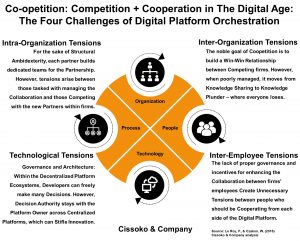
To be sure, digital platform ecosystems need to deal with four tensions for orchestrating (coordination) partnerships within the ecosystems to be fruitful. Our experience suggests that the following challenges need to swiftly get under control between platform owners, developers, and other content producers.
Inter-organization tensions—the noble goal of co-opetition is to build a win-win relationship between competing firms. However, when poorly managed, it moves from knowledge sharing to knowledge plunder—where everyone loses.
Inter-employee tensions—the lack of proper governance rules and partnership incentives for enhancing the collaboration between firms’ employees creates unnecessary tensions between people who should be cooperating from each side of the digital platform.
Intra-organization tensions—For the sake of structural ambidexterity, each partner builds dedicated teams for the partnership. However, tensions arise between those tasked with managing the collaboration and those competing with the new partners within the newly cooperating firms regarding resources, data, information, and privacy.
Technological tensions—The two key pillars of digital platforms are governance and architecture. As such, the authority of the decisions is distributed across decentralized platforms. Thus, the trust-building exercise is developed faster between the partners. However, across centralized platforms, the whole gamut of decision-making power remains with the platform owner, which can hinder the relationship regarding strategy and innovation within the ecosystems.
Get in Touch
We will respond to your message as soon as possible.
Insights to Win
Subscribe to our newsletter for in-depth analysis, reports, and our perspectives on business and economic issues related to the Japanese market and the global economy.