
Japanese Business and Management Lessons for Corporate Longevity
The ultimate corporate performance measure is survival. However, if history is any guide, compounded by the COVID-19 crisis, modern organizations fare poorly when comparing the time since their launch against their potential lifespan of 100 years or more. Consider this trend: the average lifespan of companies today is 13.5 Years. When it comes to listed companies, the average lifespan of companies on the S&P 500 was 61 in 1958. By 1980, it had been 25 years, and it had been 15 years by 2013. And it is expected to go down further.
Given its competitive and volatile high-tech environment, this two-part article shows strategies that CEOs in Japan and elsewhere can use to survive in the software industry. The findings and insights are derived from analyzing 800+ software companies over 12 years. For example, firms in the video game industry have a better valuation but have a higher risk of sinking. Second, we provide insights into the long-lived Japanese companies that doubled their net profit margin compared to the national average and lasted 100 years or more, called the Shinise firms.
Surviving in the Software Industry
With the rise of Software as a Service (SaaS), Platform as a Service (PaaS), and Infrastructure as a Service (IaaS), the software industry is one of the most competitive and innovative industries worldwide. Indeed, the sector is characterized by Schumpeterian dynamism with great ease of entry and high exit. The study revealed that the software rate of entry is 1.2 times the rate of the hardware industry and 2.2 times that of the pharmaceutical industry. The rate of exit from the software industry is two times that of the hardware industry and three times that of the pharmaceutical industry. In other words, software companies that rest on their laurels are forced to exit the sector in the Schumpeterian environment. Smart innovation and operational capabilities separate the winners from the rest.
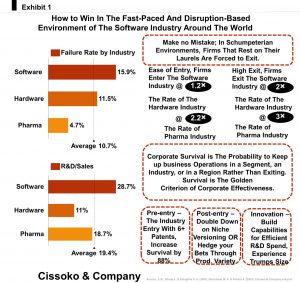
Again, corporate survival is the probability of keeping up business operations in a segment, an industry, or a region rather than exiting it. Indeed, survival is the golden criterion of organizational effectiveness. What separates the winners (firms that survive) from the rest?
Pre-entry strategy: The analysis suggests that software firms that enter the industry with six patents or more are more likely to survive.
Post-entry strategy: Firms that double down on niche versioning or hedge their bets through product variety survive. However, firms using both strategies simultaneously confuse their target market. To succeed, an organization needs to double down on one of the strategies—not simultaneously.
Innovation capabilities: It is understandable that by its nature, investments in research and development (R&D) are the hallmark of successful software firms. That’s why the industry spends 47% more on R&D than the hardware and pharmaceutical sectors. However, survival calls for both effective and efficient R&D spending. Similarly, in the software sector, experience trumps company size. Experienced people within the company and across teams pay huge dividends in the sector.
Lessons From Japanese Companies That Lasted for 100 Years or More
Most research and discussions on corporate longevity have been centered on public companies around the world, which is very unfortunate given that the majority of companies that have been in existence for over 100 years are small companies or privately held firms. Worse still, the statistical foundation of the research is weak, given that most of it used a sample of four to 18 public companies, which is a tiny sample. Above all, many touted companies failed just a few years after the study or book was published.

The Land of the Rising Sun is the home of many of the long-lived companies. Thus, the country is one of the best places to uncover the managerial mystery behind corporate longevity. Japan stands out, with 28,000 companies in existence for over 100 years. In other words, 5.2 companies out of every 1000 establishments in Japan are long-lived firms—called Shinise in Japanese. While the average net profit margin at Japanese companies is 2.7%, the Shinise companies have, on average, 5.5% net profit—that is, they make double the national average in the Land of the Rising Sun. What can companies learn from these firms?
Small is Beautiful
On average, there are 595 long-lived companies, such as Shinise. Kyoto, the former capital, is the intellectual home of nearly 1,900 of them. Among these long-lived firms, 59% have fewer than ten employees. They believe that small is beautiful, the title of the influential 1973 book on longevity written by the British economist E. F. Schumacher.
They believe larger firms are more bureaucratic, complex, and distracted by corporate politics. Thus, they have no time for customers. As a result, they fail to notice changes in the environment sooner; given the inward-looking aspect of their management, their potential for longevity is often disrupted.
Strategy Adopted by the Long-Lived Japanese (and U.S.) Firms
The strategic pillars of these companies in Japan and even the U.S., where 62% of them are private firms, are nearly identical. They are stakeholder-centric in managing the community, employees, and customer relationships. Above all, they jealously manage their trade secrets.
They Have a Unique Management Practice
Japan has seven long-lived companies (Shinise) founded before the year 1000. Their secret is that they are congruent with their values, identity, culture, and customer experience. They believe in belonging to and want to build harmonious relationships with their community. Even when opening a new branch, they make sure that their deeply held values are upheld. Unlike short-termism, which has damaged modern corporate strategic thinking muscle, long-lived firms (Shinise) have a long-term view of the game. As such, they don’t let themselves be distracted by short-term goals.
Continuation, not growth
Growth at any cost is the mantra of modern corporate strategic thinking—even if it requires sacrificing quality and efficiency regarding corporate finance. The word discipline is missing from the managerial discourse, even when fine-grained details of the strategy are missing, which is demonstrably dangerous in a volatile environment. If anything, the opposite will be a true flawed growth strategy. In other words, they want to grow without the discipline required to win the game of growth.
That’s one of the reasons that the failure rate has been increasing across many sectors of the economy. Consider the case of Japan Airlines, where growth took precedence over profitability. In 2010, the company had no choice but to file for bankruptcy. However, the long-lived firms (Shinise) have another playbook continuation, not growth, for the sake of growth.
For this reason, they do not believe in a deceptive marketing campaign and sales tactics to grow by pushing out low-quality products or cutting prices to increase demand. Instead, they believe in their time-tested approach, which comes from past generations. As a result, their profitability has been consistent and above the national average in Japan.
The lessons revealed here do not apply only to the software industry. Big or small companies can learn a great deal about what it takes to enhance profitability and build corporations that can last longer than the founders and CEOs could ever imagine. Business leaders can have their legacy written in stone when they apply the longevity lessons from the Shinise firms in this age of stakeholder capitalism and cashless Japan.
Get in Touch
We will respond to your message as soon as possible.
Insights to Win
Subscribe to our newsletter for in-depth analysis, reports, and our perspectives on business and economic issues related to the Japanese market and the global economy.