
Winning Through Strategic Decisions in the age of Disruptions
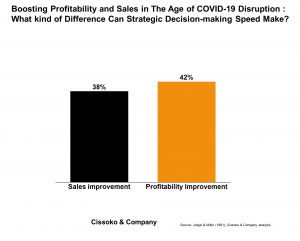
Organizations today are grappling with three serious challenges: COVID-19 economic chaos, decision inertia, and polythink (the opposite of groupthink). To win, we believe that firms need to double down on strategic decision-making speed to boost organizations’ profitability and sales. However, CEOs need to urgently address the internal ailments disrupting their decision-making processes to reap the fruit of decision speed.
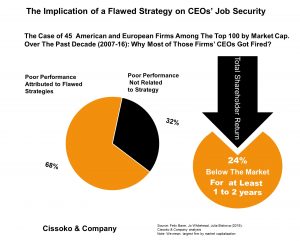
The economic storm stemming from COVID-19 is a familiar one. The disruption across the globe is like no other in recent memory. That’s why firms need to understand disruptions for better responses. Worse still, nearly a year into the crisis, no vaccine has yet been ready against the disease (produced en masse), spreading like wildfire. To be sure, before the COVID-19 outbreak, flawed strategies have been the key reasons why 68% of the 45 largest European and American firms have been disrupted over the past decade—meaning that their total shareholder returns (TSR) fell by at least 24% below the markets, while most of the companies got their CEOs fired. Firms making this list include Tesco, Target, Citigroup, Orange, Maersk, and BP, among others.
Indeed, many challenges remain even when vaccines are ready today (i.e., Pfizer and BioNTech vaccines). For one thing, it may take several years – up until 2024 at best – for everyone to get a vaccine. Given that we need nearly 30% of the global commercial fleet to carry the vaccines at the recommended temperature between 2 to 8 degrees Celsius. Another challenge that we must grapple with is the problem of vaccine refusal worldwide for whatever reason.
On top of that is the severity of the economic downturn, given the emerging second wave in the European Union and many regions worldwide, including the United States. We may be heading to lockdowns, which will exacerbate the previous supply chain disruptions many firms faced during the first quarter of this year. Until now, many companies have been struggling to get their value chain on track. As such, organizations will need to double down on building organizational agility and resilience for the foreseeable future.
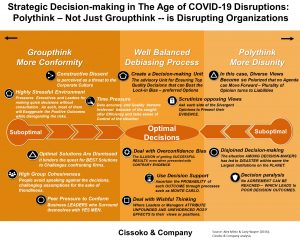
The second type of ailment is polythink, where decision-making becomes so polarized that reaching a decision can be nearly impossible given the divergence of opinions (perspectives) in the boardrooms or during the meetings.
Indeed, these kinds of C-suite decision-making flaws have exacerbated the troubles at many organizations worldwide. Many C-suite level decision-makers have a growth-at-all-costs bias exacerbated by poor financial risk management, compounding their troubles in a cutthroat competitive environment. Moreover, pressures from shareholders have made many business leaders victims of short-termism.
Given their embeddedness in the organization’s decision-making culture, company executives’ tenure can cause them to ignore decision inertia’s negative effects. This can make them victims of legacy decision-making procedures—particularly successful decisions—that may be outdated for making quality decisions in a turbulent environment.
In fact, during this COVID-19 economic storm, using routine decision-making processes adequate for a stable environment as a substitute for evidence-based alternatives grounded in procedural rationality can spell disaster. But what is Procedural rationality? It is the extent to which the decision process involves collecting information (data) while relying on gleaned insights from the data analysis for an evidence-based approach to decision-making. Because long tenure and past success create a fertile ground for complacency-induced status quo bias—the familiar argument—“This is how we do things here.” Above all, routine and non-routine problems require different intellectual and organizational resources.
A diverse perspective can enhance decision quality. However, divergent and polarized opinions—the polythink syndrome—can paralyze the C-suite decision quality. Experience suggests that the C-suite decision quality is a function of cognitive capabilities (diversity of skills, knowledge, abilities, and expertise of the top-level leaders) and the healthy interactions among the people making such crucial decisions on behalf of the stakeholders for enhancing corporate performance.
Dialectically styled team interactions can provide a better synthesis as a guide rail against polarized perspectives in the C-suite while enhancing the cooperation of the entire organization for the strategy execution. However, business leaders should not confuse an agreement during the decision-making process with a commitment to implementation because our experience suggests that a member of a decision-making team’s satisfaction and commitment to the execution is highly correlated with their influence over the decision about their inputs. In fact, it is better to have a healthy dose of disagreements during the process than in the later stages of implementation. That’s why the great Roman statement Cicero once said, “Diversity in counsel, and unity in command.”
When a cognitive disagreement (e.g., clash of perspectives from different functions, hierarchy, etc.) is perceived as a personal criticism, securing people’s commitment to implementing strategic decisions becomes challenging. At best, a semblance of agreement can be reached without a real commitment to achieving them.
Moreover, it is imperative to discern between functional cognitive conflicts that arise when perspectives are narrowly focused on the functional perspectives of the participants – and emotional conflicts (affective conflicts), where the decision-making process is misinterpreted as personal criticism sometimes mixed with corporate politics of gamesmanship. As such, understanding the extent to which the decision-making team members are satisfied regarding how the decision was reached can provide some insights. Similarly, knowing the extent to which the decision reached is consistent with some people’s priorities can be an eye-opener concerning the commitment sought for the implementation stage later on. This is important because conflicts can weaken the consensus regarding strategy execution.
If experience is any guide, we believe organizations need to improve their strategic decision-making speed because it will make a real difference in companies’ performance now—in these times of disruption—and the years to come.
Get in Touch
We will respond to your message as soon as possible.
Insights to Win
Subscribe to our newsletter for in-depth analysis, reports, and our perspectives on business and economic issues related to the Japanese market and the global economy.