
Beyond Agile Teams: Thriving Through Team Resilience in Times of Disruptions
The COVID-19 pandemic has been a perfect disruption storm across the global economy. People are losing jobs at an alarming rate. As of May 13, over 1.7 million people were out of work in Japan. The industries that have been the hardest hit are energy, hotels, sports, airlines, retail, and manufacturing. As such, as of March 24, the earnings revision and capital expenditure of multinational enterprises (MNEs) suggest the following: the airline industry (-116%), the energy sector (-208%), restaurants, hotels, and leisure (-41%). Indeed, the average earning revision for all industries was -30%. For this reason, companies in different sectors of the economy have been grappling with other types of responses for building organizational resilience to weather the disruption.

Like countries where we’ve seen some doing better than others regarding their resilience, companies too have seen varying success regarding how they were prepared, how quickly they responded, and how they could ultimately build their resilience muscle. While organizational agility plays an important role in helping a company weather disruption, such as the magnitude of the COVID-19 crisis, we found that emphasizing just organizational resilience at the expense of team resilience has misguided many companies in their battle to navigate the COVID-19 crisis.
Thus, we believe that the concept of agile has been misunderstood and over-hyped in business circles in recent years, resulting in dangerous confusion, particularly in times of rare economic and life-threatening disruptions such as the coronavirus pandemic. We hope to clarify the key aspects of an agile team that organizations need to understand for better responses to disruptions. Yet, get the insights for thriving rather than surviving in the age of coronavirus disruption.
Compared with the waterfall project management process, Agile has been, since its outset around two decades ago, one of the most effective ways to manage projects in our increasingly fast-changing world. However, different schools have been established over time emphasizing one thing or another—sometimes combining many approaches such as kanban and lean.
Thus, the concept has become an umbrella term such as artificial intelligence (i.e., machine learning, deep learning, computer vision, etc.). The combination of different styles of managing a team and project while keeping the core of agile regarding small team size. To be sure, there is nothing fundamentally wrong with enhancing or reforming a concept. However, the problem has resulted in the jingle jungle fallacy—referring to a situation where people use a wide variety of different terms and names to refer to the same concept. Indeed, in our previous article titled Building Agile Organizations: What separates the leaders from the rest? We provided more insights into the key differences between agile project management and an agile organization.
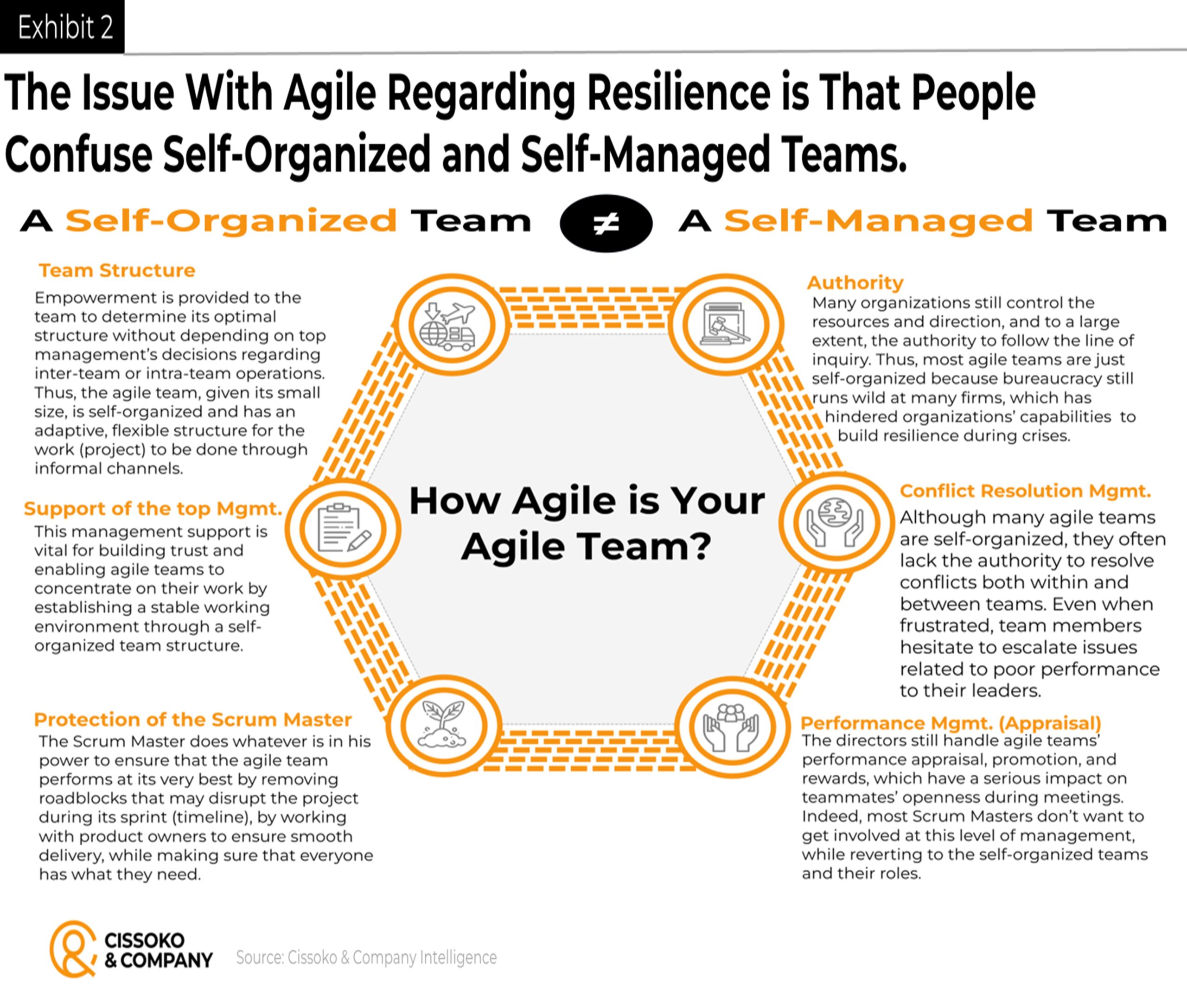
Similarly, the idea’s popularity has resulted in the so-called polysemy—where the same words or names are used inconsistently across articles and papers while referring to entirely different concepts or ideas. For example, in our experience, a self-organizing team is quite different from a self-managing team across agile teams within and across industries. Also, an agile team does not necessarily mean a resilient team. Confusing a self-managed team and a self-organized team can have dangerous implications in managing agile teams in times of disruptions. The difference truly matters. The insights are based on the 2019 findings of Simard and Lapalme regarding agile management of over 48,000 employees in more than 47 countries worldwide.
The Three Core Aspects of a Self-Managed Team
Team structure—Indeed, most, if not all, agile teams are empowered to work out the best team structure without relying on the top management’s decision regarding how the teams should operate with respect to inter-team or intra-team decisions. Thus, the agile team can be called self-organized, given its small size, flexible and adaptable structure for the project to be done through informal communication channels, as the teammates may like.
Top management support—Crucial to building trust while allowing the agile teams to focus on their work by creating a stable working environment through a self-organized style of team structure. Ideally, the resources are allocated on time without organizational politics.
Protection of the scrum master—he does whatever it takes in his power to ensure that the agile team performs at its very best by removing the roadblocks that may disrupt the project on its sprint timeline—on time, on budget, and through the pre-agreed quality standard—by working with product owners for smooth delivery while making sure that everyone has what he needs, such as the necessary information whenever required. Ideally, the scrum master will shield his team against organizational politics, criticism, and whenever failures occur.
The Three Critical Aspects of an Agile Team That Organizations Need to Revamp
Our experience suggests that with all the talks about agile, many are still not self-managed because of the reasons below that we believe organizations need to rethink in this age of the coronavirus pandemic.
Authority—Many organizations still control most, if not all, agile resources and, to a large extent, the authority to follow the line of inquiries. Given this, we believe that most agile teams, self-organized as they may be, are still not self-managed because bureaucracy still runs wild at many companies, which has hindered firms’ capabilities in responding to the COVID-19 disruptions.
Conflicts resolution management—many agile teams, while self-organized, lack the power to deal with intra-team and inter-team conflicts. In many cases that we are familiar with, even frustrated, many teammates don’t escalate other teammates’ underperformance issues to the directors at many companies. Indeed, many agile team members told us that the Retro is not a good forum for conflict resolution among team members.
Agile team performance management (appraisal)—the directors at many organizations still run the agile team’s performance appraisal, promotion, and reward, which seriously impacts teammates’ openness during meetings (debriefings). Indeed, using traditional performance appraisal in times of COVID-19 for an agile team does not work very well. Our experience suggests that most scrum masters do not want to get involved at this level of management while reverting to their role of supporting the self-organizing team. Thus, during times of crisis, the performance management role should be given to the agile team for the sake of efficiency and effectiveness in managing teams in times of crisis while getting better results.
Beyond the Agile Team (Adaptability): Thriving Through Team Resilience
An agile team is better, but not enough in this age of Black Swan disruptions. Indeed, the basic tenets of team agility revolve around team size, adaptability, flexibility, listening, etc. However good as these aspects may be, they are not enough to build team resilience, which is crucial for an organization to get back to a pre-disaster level of performance quickly. Indeed, since the outbreak of the COVID-19 pandemic, most companies have turned their attention to survival through the crisis while building flawed organizational resilience.
The missing elements in the discourse of organizational resilience are employees’ (individuals) resilience and the team’s resilience. This article will focus on the latter, given its crucial importance in revitalizing a company during economic shocks, disasters, and crises like COVID-19.
The Three Cs of Team Resilience in Times of Disruptions
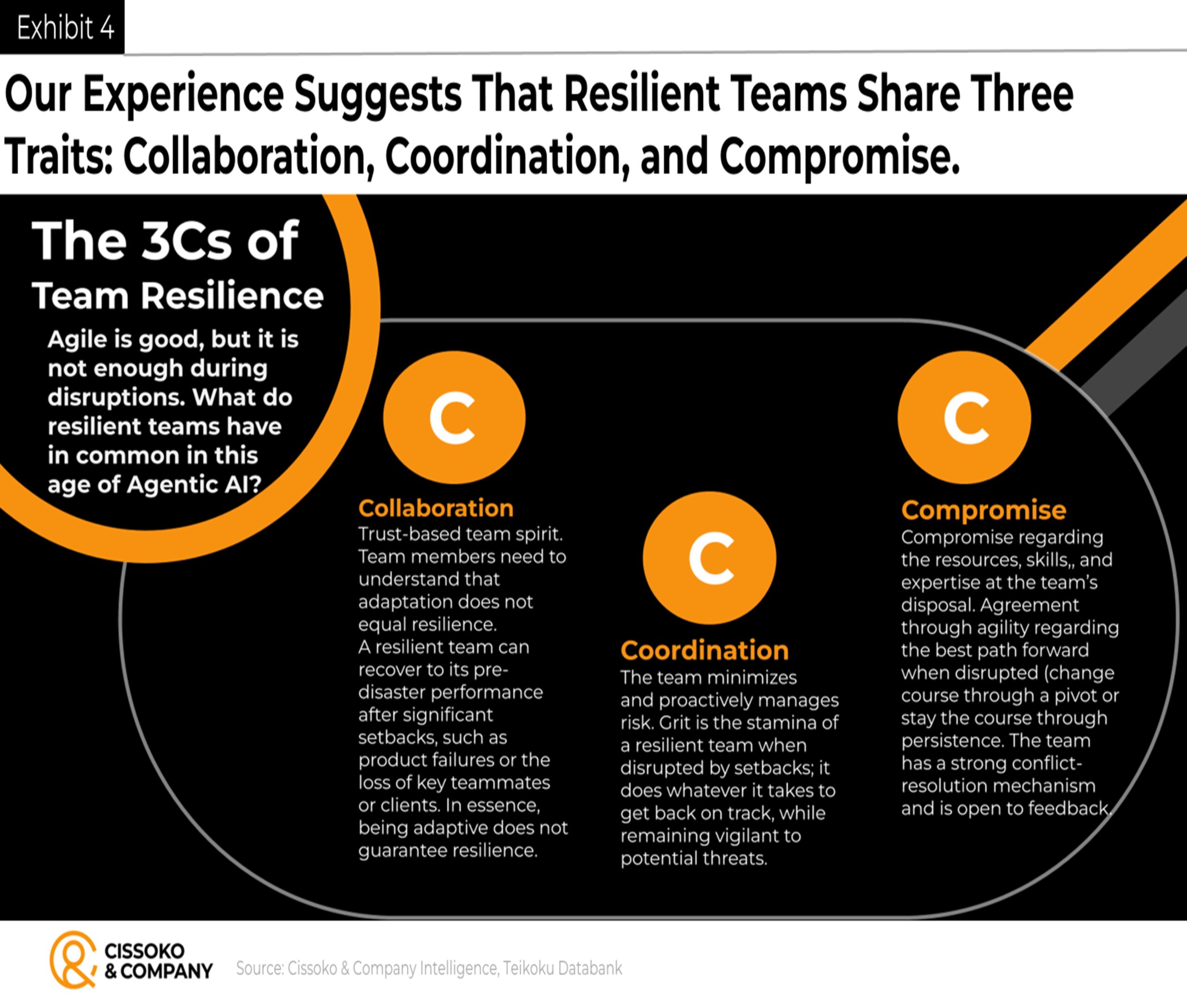
Compromise—the first aspect of team resilience is the degree to which it can quickly find a compromise during times of crisis regarding the divergent perceptions and perspectives of the disruptions within a company regarding the most effective and efficient response, given the skills, knowledge, expertise, and capabilities at the firm’s disposal. That is, the team needs to agree as quickly as possible through agility on the best options forward—change course (pivot) or stay the course through persistence. Conflict resolution and constructive feedback are imperative in times of crisis or disaster.
Collaboration—To be sure, an agile team’s badge of honor is its ability to collaborate. However, for collaboration to build team resilience, it needs to be clear to every team member that adaptation to COVID-19 or any disruption does not mean resilience. Thus, for a team to be resilient, it needs to bounce back to the pre-disaster level of performance after a huge setback, such as product failure or the loss of an important teammate or client while withstanding the disruption to reach the pre-disruption level. Indeed, an adaptive team does not necessarily mean a resilient team. The litmus test of a resilient team is the headwinds from disruptions, disasters, and crises while bouncing back as swiftly as possible—without those obstacles and bouncing back, the word resilience is meaningless.
Coordination—Similarly, while many agile teams are good at coordinating projects in the normal course of business, the resilient team goes a little further by minimizing and managing risks proactively within and across teams regularly. The resilient team persists during times of crisis and disaster by bouncing back to the pre-crisis level of performance through coordination. Indeed, in our experience, grit is the stamina of a resilient team; when upended by setbacks, the team will quickly do whatever it takes to get the project back on track. Another distinctive aspect of a resilient team is that it always remains vigilant. Thus, the agile teams that want to build such resilience need to understand that complacency is the enemy of resilience.
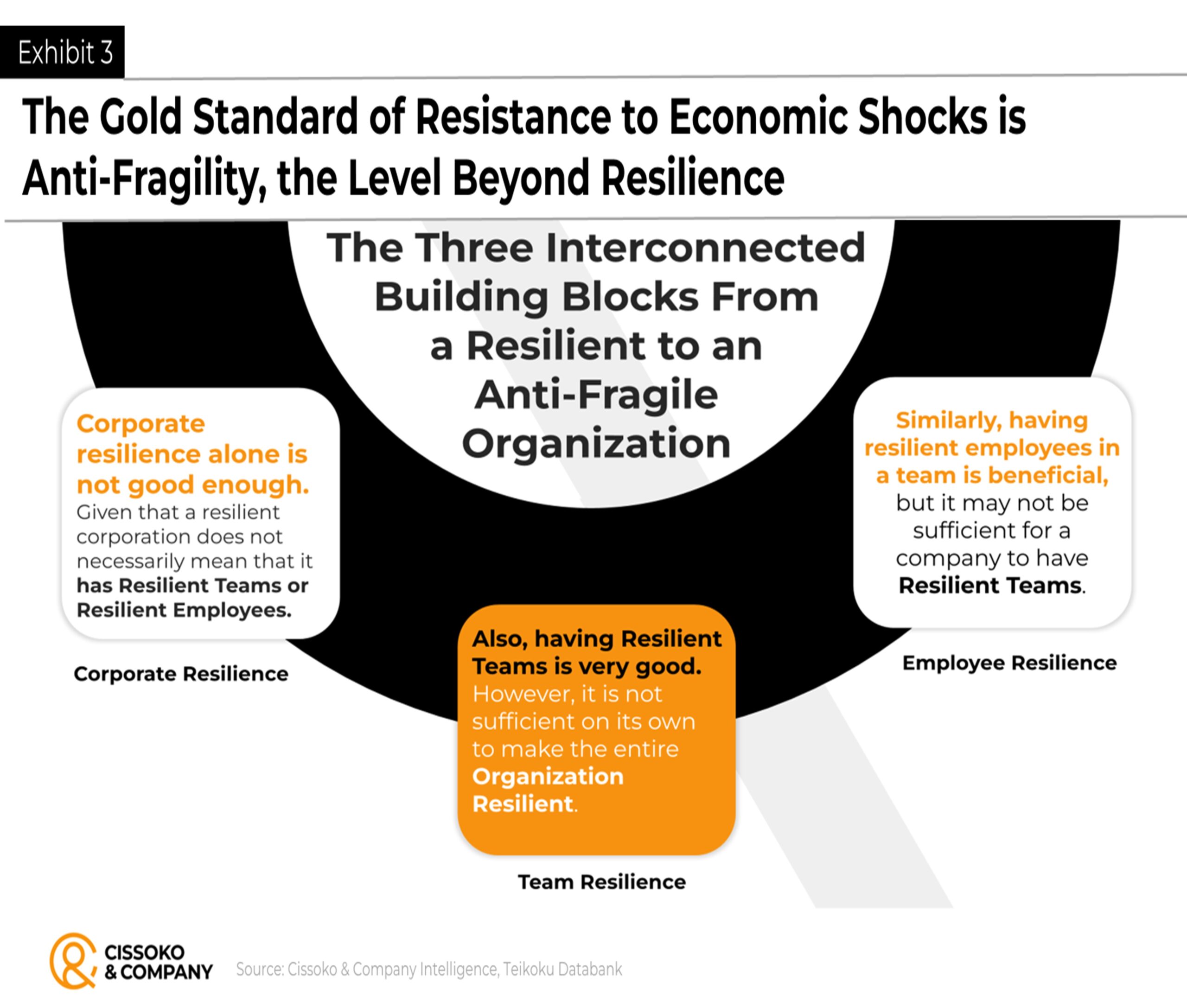
To be clear, adaptive and resilient teams differ in several ways. The core activity of an adaptive team is to adapt by staying on the course through persistence, changing course, or combining both. That is, changing behaviors, structures, processes, or strategies regarding adversity (shocks), disruptions, and setbacks. However, the core activity of a resilient team—like the firm itself—is to bounce back to the pre-shock level of performance (the litmus test of resilience). Above all, the word resilience is meaningless in the absence of shocks, adversities, disruptions, and the like. Without those adverse shocks, whatever a team or an organization does regarding its behavior, structure, or strategy is just an adaptation—but not Resilience. Thus, a resilient team is mostly adaptable. But not the other way, as explained above. A team of resilient individuals does not necessarily make a resilient team. Likewise, resilient teams do not necessarily make a resilient organization.
For companies that want to build organizational resilience for the age of disruption, here is our must-read collection for the coronavirus. Here, we discuss beyond resilience: understanding disruptions for better response. Also, how to build an effective corporate culture in the age of disruption.
Get in Touch
We will respond to your message as soon as possible.
Insights to Win
Subscribe to our newsletter for in-depth analysis, reports, and our perspectives on business and economic issues related to the Japanese market and the global economy.