
From Disruptors to Disrupted by COVID-19: Rethinking the Future of sharing Economy
The coronavirus crisis is a perfect storm wreaking havoc on the world’s economy. In China, the economy shrank by nearly 7% in the first quarter through March 31, 2020. Similarly, in the United States, mainly, the economic impacts of COVID-19 have been hair-raising. Within just nine weeks, the number of people who filed for unemployment benefits in the U.S. has reached nearly 39 million—equivalent to almost 15% of the unemployment rate—and the entire population of California. The sharing economy stands out among the sectors of the economy brutally disrupted. With a value of $14 billion in 2014, the sharing economy was expected to top $100 billion by 2020.
The industry bellwethers and top disruptors par excellence, Uber, Lyft, Airbnb, and WeWork have been badly disrupted by the COVID-19 pandemic. What does the future hold for the sharing economy in a world increasingly becoming contactless? People wonder whether any of them will survive, given that their business models are highly dependent on human-to-human contacts and barely make a profit. In other words, most of them before COVID-19 were loss-making machines veiled in the founders’ charisma and Silicon Valley’s high tolerance for patience, given that the world was awash with liquidity since the financial crisis of 2008-09. Thus, with easy money moving around, investors were very tolerant—by turning a blind eye while helping in the inflation of privately-held startup valuations. This phenomenon was amplified by establishing SoftBank’s Vision Fund in 2017, which was oiled with nearly $100 billion. The fund’s war chest is so huge that few VC funds could come close. It is larger than most funds—if not all—combined.

The COVID-19 Pandemic has Badly Disrupted WeWork and Uber Technologies
Before the COVID-19 crisis, WeWork (The We Co.) was struggling since its much-touted IPO went awry in the fall of 2019. From then, the disruptor’s troubles kept compounding. In its heyday, WeWork was valued at $47 billion in January 2019. With easy money flowing in and a lack of financial and strategic disciplines, the founder of WeWork, his wife, and associates began partying like never before, including house-buying sprees all over the United States with price tags in the double-digit millions.
With poor corporate governance at the firm, while Adam Neumann was running WeWork like a family business—troubles were brewing on the horizon. Poor corporate governance was the cause of many of Adam Neumann’s laissez-faire styles of managing WeWork—a modern corporation valued in double-digit billions for that matter. For this reason, Adam Neumann had the zeal to sell WeWork’s trademarks to the company’s shareholders. The ensuing public outcry was so loud that he made a U-turn by giving up his flagrant greediness of trying to appropriate shareholders’ money.
With a huge financial bazooka and a flawed vision of the future of digital technologies and disruptions, Masayoshi Son, the CEO and founder of the SoftBank group, erred by believing in the charismatic WeWork founder’s vision and business plan. Without hesitation, Masayoshi Son poured several billion dollars into WeWork—hoping to replicate its previous success of making over $100 billion when he invested just $20 million in Alibaba in its early days of the ’90s. As such, in the dreamland of WeWork, like a possessed leader, Masayoshi Son invested in 2017 more than $4 billion in WeWork as his first investment, and several months later, he doubled down on its investments in the company—while inflating the dubious valuation of the firm.
Indeed, this was classic cash for trash. In March 2020, after seriously re-evaluating its investments in WeWork—by refusing to invest another $3 billion more in the firm—the Vision Fund came up with a $2.9 billion DCF valuation of WeWork. This was a spectacular downfall from heaven for a previously valued company at $47 billion just 14 months earlier (January 2019). This eye-watering value depreciation is equivalent to 93% evaporation in WeWork’s value—which is jaw-dropping by any measure. As a result of all these quick and dramatic series of cascading events, the bromance between Masayoshi Son and WeWork founder and former CEO Adam Neumann became so strained that it resulted in the latter suing the former regarding the abortion of the $3 billion investments in WeWork as agreed (promised).
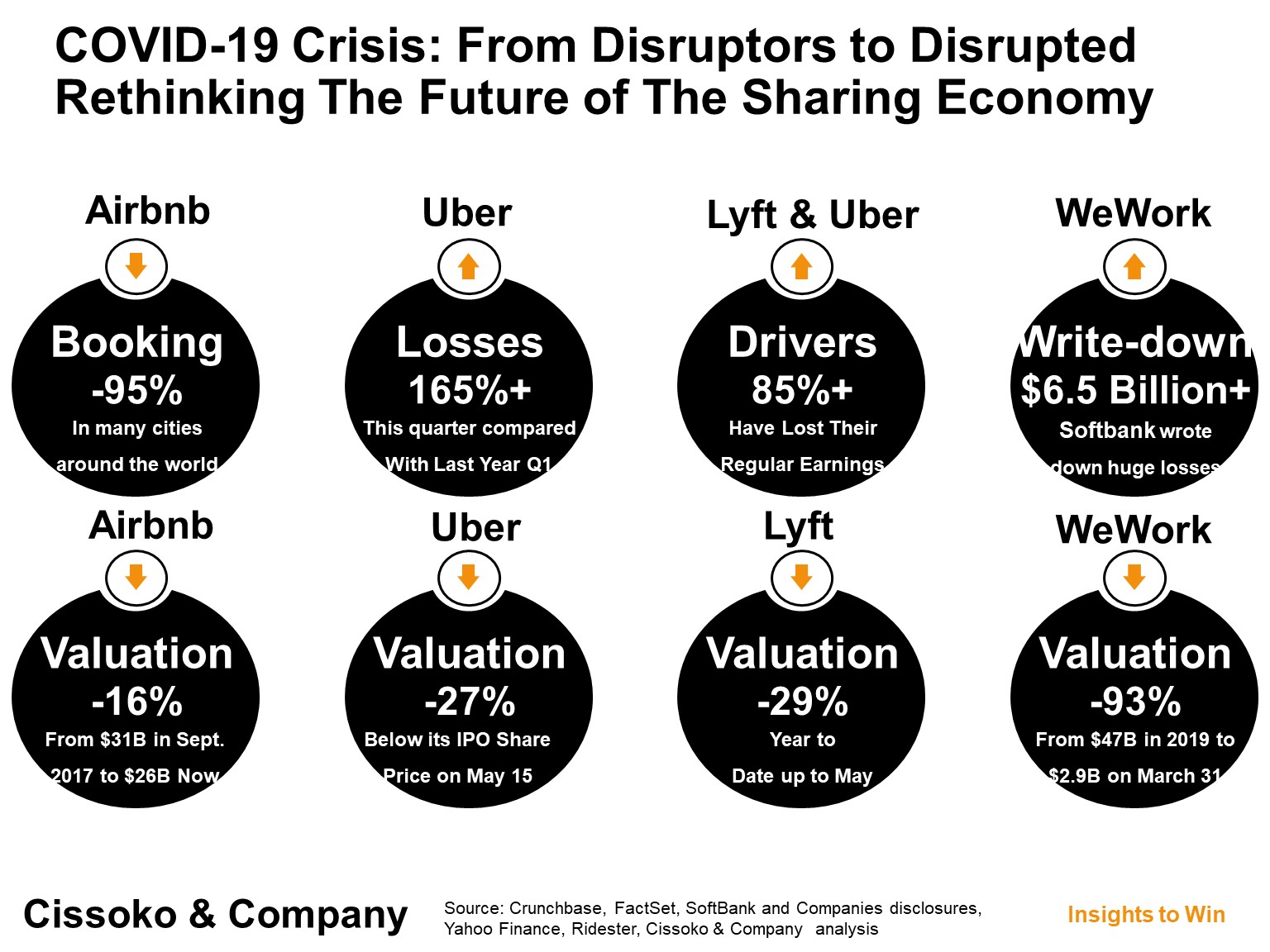
We anticipate that WeWork will file for bankruptcy in the coming months because the economics of its business don’t add up—that is, highly leveraged long-term lease obligation against the short-term lease strategy in this age of pandemic. This won’t work. The firm doubled down on those long-term property lease obligations given its prior $47 billion valuation, but now it is valued 93% below that eye-popping amount. In this fast-changing environment, this appears to be a house of cards. That’s why Masayoshi Son revealed that over 14% of his Vision Fund investments would go bust while acknowledging that it was ridiculous to have made that huge investment in WeWork and many others.
Like WeWork, SoftBank doubled down on Uber Technologies by buying a several-billion-dollars stake in the ride-hailing firm with the same kind of strategy based on the hope that through high growth but nearly zero profit over time, Uber will become highly profitable and ultimately make SoftBank and his Vision Fund investors fabulously wealthy. Unfortunately, Uber’s IPO was a disappointing and reputation-damaging experience for Masayoshi Son. As of this writing, SoftBank’s Vision Fund has poured more than $75 billion over nearly three years into Health Tech firms, FinTechs, Frontier Techs, Grab, Uber, and Didi.
The lion’s share of its investments is going to transport and logistics firms – comprising over $30 billion of the Vision Fund’s $98 billion investments. However, the pandemic-caused disruption is taking a life-threatening toll on Uber, Lyft, and the like. Indeed, over 85% of their drivers have seen their earnings evaporating overnight. At the same time, Uber Technologies and Lyft have seen their valuations plunging and losses compounding in tandem. That is, Uber lost nearly 165% more during 2020’s first quarter (including $1.8 billion write-downs) compared with the same period last year—while its market capitalization has tanked by nearly 30% below its IPO price. Similarly, Lyft saw its market capitalization plunge by almost 30% this year through May. To be sure, the coronavirus crisis has been traumatic within the sharing economy worldwide. For this reason, they have sacked more than 8,000 employees and counting—because we expect (not wishing) that more layoffs are around the corner.
The Coronavirus Crisis has Disrupted Airbnb’s Business Model
In early 2020, the coronavirus outbreak began in Wuhan (Hubei), China. Gradually, the severity moves from an outbreak to an epidemic—then a lethal and global pandemic. The top market-based disruptors such as Uber, Lyft, WeWork, and Airbnb were disrupted by a rare yet dangerous type of threat – the SAR-COVID-2 virus disruptions. As a result, the underlying assumptions behind their business models—human-to-human contacts, sharing experiences, and crowded places—became their biggest liabilities. Confusion and panic ensued at the cathedral of disruption. The disruptors wondered by asking how on earth the disruptors could be disrupted. Are there other types of disruption that we were not aware of?
Suddenly, lockdowns and social distancing were imposed, and outright travel bans worldwide made matters worse for the Airbnb business model that over-relies on travel and tourism within and across countries. To be sure, betting on the tourism-related industry was not bad in itself—given that the global tourism industry is huge—equivalent to one in every 10 jobs (330 million jobs) and contributing over 10% to the global economy in 2019, which is bigger than the car making industry. However, COVID-19-induced cancellations have become the new normal for Airbnb. Across many cities around the world, booking plunged more than 95%. Through panic and flawed risk management, the co-founder Brian Chesky sided with one side of its platform—the tourists and customers who booked rooms on its platform—by asking the property owners to reimburse the customers who want to cancel their trips and stay. Furious property owners demonstrated their anger and discontent on social media. Airbnb had to reconsider its decision by trying to bring fairness to the table.
As of this writing, Airbnb CEO and co-founder Brian Chesky reimbursed 25% of the canceled revenue amount back to property owners listed on its platform. Indeed, it was a smart move (maybe not enough) given the economics of his business—unlike other hotels around—Airbnb is a digital platform. Thus, fairness is required on both sides of Airbnb’s platform to succeed through this pandemic and beyond. Because the platform needs both tenants who wish to find properties within and across countries for their stay, it needs the property owners to join its platform by listing their properties there.
For economic equilibrium’s sake and for Airbnb to succeed, it needs as many people for rent as property owners wanting to list on Airbnb’s platform. As such, being unfair to one side, such as the property owners, while trying to please the renters, will be signing its death warrant. Only fairness to both sides can help Airbnb navigate the unprecedented disruptions on its digital platform. For the sake of its platform survival and future viability, Airbnb needs to sacrifice its short-term gain and profits for its future survival by accepting some financial losses in the weeks ahead through compensation, reimbursement, even subsidies, and the like.
Understanding the Three Types of Disruptions Upending the Sharing Economy
The sharing economy is trapped in the crosshair of three types of disruption. Given the hype associated with the sharing economy, competition, and disruptions are becoming brutal within the industry. For example, Uber’s competitors have increased alarmingly over time, with Lyft, Grab, Didi Chuxing, and Ola becoming its most prominent competitors. Similarly, Airbnb’s competitors are popping up worldwide, such as HomeAway, VRBO, HomeTrip, and HomeToGo, as well as Tripadvisor and Bookingcom. Against this backdrop:
The First kind of disruption the firms are struggling with is the deluge of new entrants across the globe — while trying to cure one of their biggest diseases—lack of profitability. Indeed, before the pandemic, profitability was an afterthought given the ease of access to VC funds. The startups and disruptors alike were urged to double down on an elusive growth path—the bigger, the better—they were told. Becoming a dominant startup with market power was all investors mistakenly cared about at the time. Thus, if the thinking goes through high growth, profitability will be certain. However, the coronavirus crisis has upended that assumption in the VC circles in Silicon Valley and beyond. Even their chief backer, SoftBank Vision Fund, won’t tolerate that kind of flawed calculus any longer given the mounting losses in its portfolio and its damaged reputation in the investment world. We do not sound the alarm about the sharing economy; instead, we are trying to shine a light on the industry’s challenges and future.
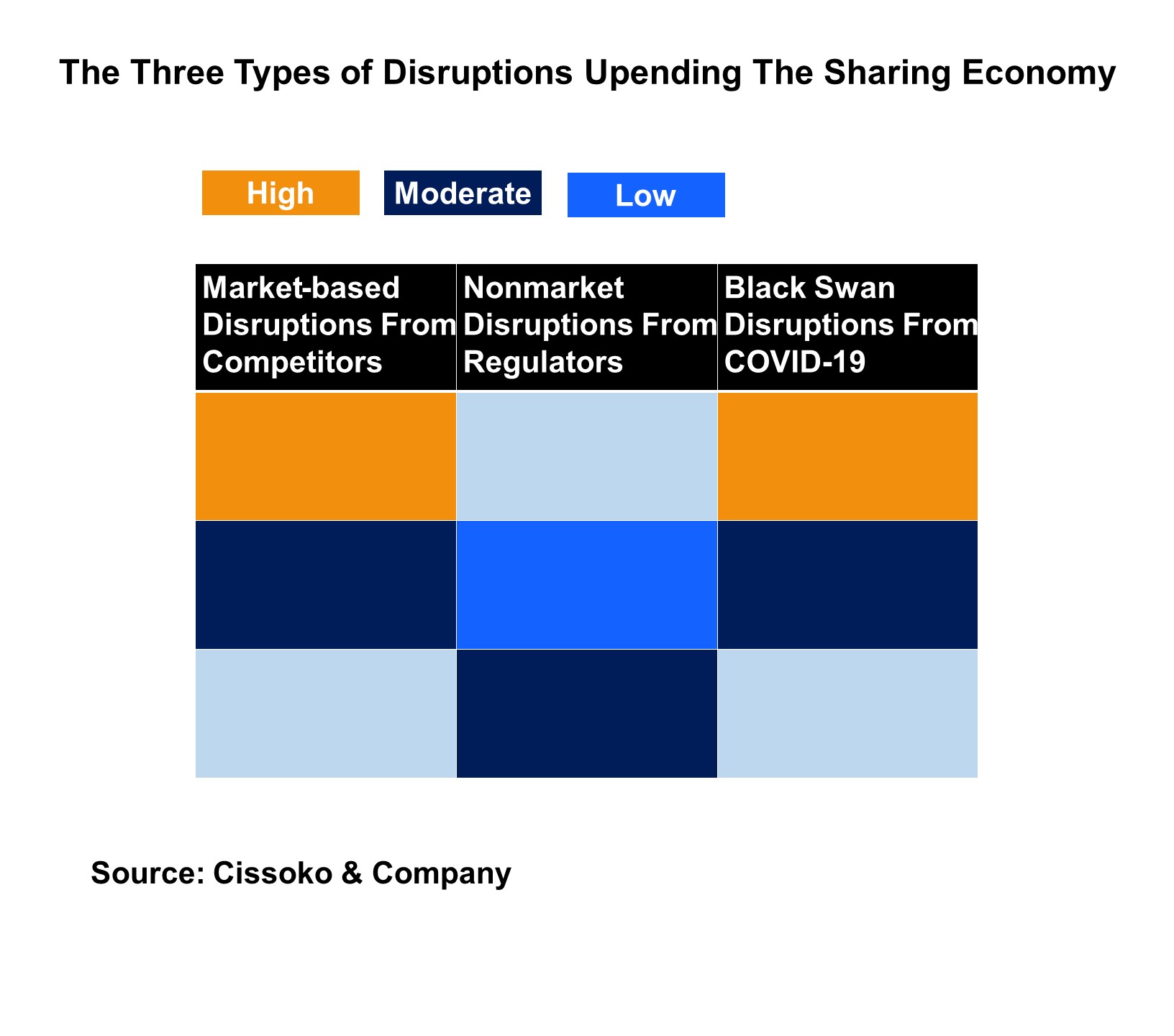
The second category of disruptions they need to navigate is the increasing nonmarket pressures coming from regulators worldwide—the U.S. and Europe in particular. Recently, many states across the United States, such as California and New Jersey, have reformed their state laws and regulations by redefining what constitutes a contractor. Similarly, they are increasingly becoming louder regarding the work conditions of gig workers—who have less job security—with wages in some cases below the state or national average. We believe that Airbnb, Uber, Lyft, and many other companies in the sector need to craft proactive responses against these threats to survive. Moreover, given that most of them are barely profitable, if at all, these new cost burdens will upend the assumptions of their business models and the notion of the gig economy in its entirety. To be sure, decent wages are essential for these drivers (and gig workers) to make a living. Thus, rethinking how they will navigate these emerging challenges will strengthen or upend them all.
The third disruption is the one we are all facing: the COVID-19 crisis. Unlike other disruptions discussed above, the coronavirus pandemic is stress-testing the sharing economy—particularly, the segment that over-relies on human-to-human contacts or crowded areas—which has become a persona non grata (not welcome)—where nobody wants to go until a vaccine or other medical options are found. The question now is: how long can they afford to close or lose money? Also, how long can the market and the VCs tolerate this kind of business model when the biggest backer, SoftBank, has been brutally hammered because of the huge losses? Given that even in the good times, they were primarily unprofitable businesses. Indeed, it would be incorrect to compare this era with Amazon’s early days when the e-commerce giant was not making a profit. Later, it became one of the world’s most successful companies—given its market power and strategic diversification.
Proactive and Strategic Responses Going Forward in the Sharing Economy
Among all these disruptions upending the sharing economy, the Black Swan disruptions from this pandemic must become one of the top risks under the firms’ radar. That is, through a partnership with academic institutions and other global medical experts—including epidemiologists—they must monitor and craft responses through scenario planning before the disaster—like the one they’re going through—strikes. Also, the companies whose businesses are based on the sharing economy must actively lend their support to organizations at the forefront of finding a cure.
This can be done through financial support to the organizations desperately looking for a cure on a tiny budget. It will not be wise to stand behind and hope for better days. Uber, Airbnb, Lyft, Grab, and other companies highly involved in the sharing economy can establish a prize for the first organization to discover a treatment or a vaccine. They need to help themselves by establishing a fund (s) to provide a helping hand. But unfortunately, the sharing economy bellwethers have been very silent in the battle against the COVID-19 pandemic. This is understandable given how they were disrupted—but not wise.
On top of this, for the sake of resilience, many firms within the sharing economy will need to pivot to weather the dangerous storm of the coronavirus. For example, strategic mergers and acquisitions (M&A) need to be on the card; that’s why Uber, with its war chest of more than $8.5 billion cash, is reportedly trying to acquire GrubHub, creating great cost synergy during this dangerous storm of panic in the industry. Uber Eats is growing and making up almost 18% of Uber’s sales. Still, given the intense competition in the food delivery industry—with DoorDash and GrubHub—Uber has a long way to go before UberEats can replace its core business in revenues.
Get in Touch
We will respond to your message as soon as possible.
Insights to Win
Subscribe to our newsletter for in-depth analysis, reports, and our perspectives on business and economic issues related to the Japanese market and the global economy.