
Win With Purpose: Building an Agile Dream Team for the age of Crisis
The age of purpose calls for purposeful leadership—which entails knowing how to build purposeful teams for the age of the coronavirus crisis. In a world where lives and livelihoods are under serious threats, to lead, organizations need to demonstrate their purpose by strongly reconnecting with people—such as employees, customers, and communities—they have been established to serve. Failure to lead on these fronts will be very damaging to an organization’s brand.
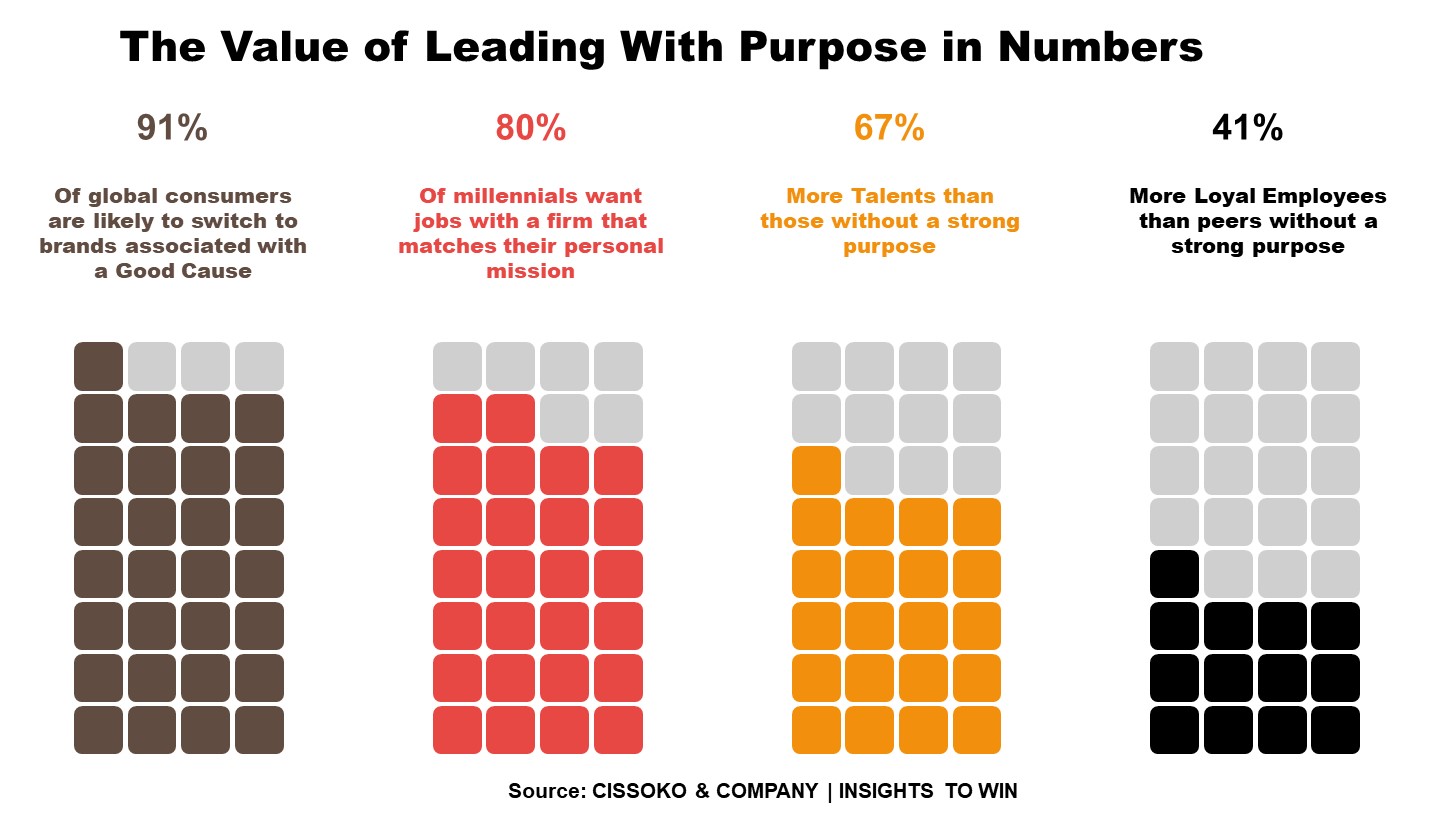
Indeed, our survey of 3,245 people across the globe revealed that firms with a strong purpose have 41% more loyal employees than peers without one, over 90% of global consumers are more likely to switch to brands associated with a good cause, 80% of millennials want jobs with a purpose that matches their mission. Also, organizations with a strong purpose attract 67% more talent than those without a strong one and 41% more loyal employees than those without a strong one.
As the world economy has dramatically changed in recent decades, working in teams—specifically in remote teams in this age of the coronavirus – is axiomatic. Our survey of 4713 employees across the globe suggests that people spend on average over 60% of their time in a team setting. With the COVID-19 crisis in full swing, we expect this number to swell even more. With the disruptions from the coronavirus grinding the world economy to a halt, we believe that the value of working through virtual teams will become more pronounced.
In other words, firms need to reimagine how to work to keep their productivity intact or increase it dramatically. That’s why companies such as Zoom have benefited handsomely from the crisis. Zoom saw its users swell by more than 2 million since the beginning of the year as people switched to teleconferencing as an alternative to face-to-face communications worldwide. However, whether teams across organizations work offline or online, the imperatives of high-performance teams can’t be overstated, particularly in these times of black swan disruptions from the coronavirus. If history is any guide, the blow of the pandemic will force many companies to restructure the entire organization, or at least they will have to turn around their failed business models, particularly those that over-rely on crowded places or human-to-human contacts.

Therefore, to be ahead of the disruption curve, organizations need to build high-performance and purposeful teams capable of delivering results no matter the state of the economy or the intensity of disruptions, which are here to stay. Below, we uncover the key building blocks for such a dream team. We call the purposeful teams this way in memory of the high-performance team of the NBA in 1992.
- The Selection Criteria
Each project is unique in terms of its constraints such as quality, time, and cost requirements. As such, selecting purposeful team members calls for a granular understanding of what is to be accomplished. Then comes the heavy lifting part by answering questions such as: do we need specialist experts, generalist experts, or a combination of both? What types of personality and experience are best for this project? What combination of skills and knowledge do we need? This list is not exhaustive. But we hope you get it. For example, independent team expertise comprises information exchange, communication, supporting behaviors, etc.
The next step is to ensure these talented people can work together – given that only individual knowledge, skills, and expertise can’t take a team so far. This is where the subsequent steps occur (“see below: Learning and development mindsets”). Organizations need to increase the exposure of teammates to one another to reinforce their bond and understanding of each strength and weakness while creating a forum for knowledge and feedback sharing, for example. Many skillful people failed to deliver results given this crucial component—working together. That’s why Henry Ford once said, “Coming together is the beginning, staying together is progress, and working together is a success.”
- Solving the Trust Equation
Firms need to solve the trust equation within teams; we mean most of the varieties of trust. Whether it is an institution-based trust or those elements the firm assumes to reflect trustworthy people. Thus, firms’ assumptions at this level of trust may need to be adaptive or reviewed for people of some ethnicities, personalities, races, cultures, or regions so that these people feel comfortable. This needs to be followed by what most people know about trust, which is trust in general. This element of trust is about being sincere regarding lies, manipulations, and cheating each other within teams. As such, it is very important as one of the foundations of a well-functioning team wanting to work together cohesively for a long time.
Other important elements of trust are dispositional trust, swift trust, and time-based trust, which can be developed over time while working with other team members—given that some take more time than others. For example, time-based trust can’t be developed on the spot after meeting a team member, but on several occasions, one proves to the other that he is worthy of that level of trust. Above all, our experience suggests that employees can accelerate the trust-building process by creating a working atmosphere based on empathy, mutual respect, and the ability to listen well, which is different from hearing something. Moreover, openness towards others while sharing crucial and critical information is an important attribute of a team trust-building method.
- Team Size Does Matter for a High-Performance
Like the Pizza rule of Jeff Bezos, referring to a team size that can be fed with a pizza—and agile team principle calling for smaller team size, we believe that for a squad team, the ideal size is eight people. For optimization and coordination, like the sub-unit of a military infantry, we recommend four people as the maximum, hence a fire team. Thus, a fireteam, as in military parlance, can enable an organization to be more agile in responding and adapting as the reality on the ground changes. Also, this small size increases the likelihood of knowledge creation and transfer among the team members. Moreover, smaller sizes improve the likelihood of great discussions among members, compared to larger ones.
Thus, if our experience and that of the elite military are instructive, having this smaller team dramatically enhances a firm’s performance. We believe that the higher the number of people within a team, the higher the complexity regarding communications, reporting, and getting everyone on the same page, just to name a few issues. Furthermore, with the rise of remote teams across organizations—and the critical importance of friendliness and learning orientation among team members—having a large team will make matters worse than in the offline world. We strongly believe that team size matters a great deal in enhancing corporate performance.
- Shared Vision and Cohesive Identity
First and foremost, the firm needs to provide shared meaning, fulfillment, focus, and alignment regarding what needs to be done. As each team usually has a leader, ensuring commitment to the team’s success is important. This can be done by successfully motivating each other to complete tasks and milestones. They need to hold each other accountable while taking responsibility for the success or failure of the projects.
In other words, the mindset works like, “The failure of any one of us is the failure of all of us.” And “We are in the same boat; only our very best through real collaboration and cooperation can we succeed.” This kind of mindset can improve the briefing and debriefing processes throughout the project duration. In fact, after the selection process mentioned above, everybody needs to be on the same page regarding the goals. At the same time, each member performs domain-specific planning, information gathering, and execution according to his expertise. All these steps must be aligned with the project goals to make any meaningful sense.
- Team’s Talent Diversity
With the buzz about diversity popping everywhere, many firms have been confused given the plurality of definitions regarding the concept of diversity and its impact on corporate performance. While diversity concerning race, sex, age, and ethnicity is important, our experience suggests that they are not good predictors of high-team performance. For diverse teams to deliver meaningful performance, teams need to be diverse regarding skills, knowledge, and expertise. In short, the emphasis must be on functional diversity, not on trait diversity.
Moreover, for teams—be they remote or offline teams—experience suggests that combining functional diversity with knowledge sharing is the key to unlocking the mystery of teams’ performance across large organizations today. Finally, teammates need to embrace religiously constructive dissent to gain insights and prevent groupthink from being normalized.
- Clarification of Roles and Responsibilities Within a Team
Like in sports, where every player has a clearly defined role, a team’s success largely depends on clarifying the goals. This allows everyone to know the minimum others expect from him in that role. But paradoxically, we discovered through our work that as good as this clarification may be, it should allow the minimum flexibility of some overlapping roles.
The stricter the role scope is, the higher the intra-team collaboration and cooperation will suffer – given that some team members will neglect the degree to which they need to support others—in meeting project deadlines. The fastest members may finish earlier than others and refuse to come to the rescue of others, which can be a serious blow to the team spirit. Make no mistake: One of the hallmarks of a high-performing team is the willingness to cooperate among different members. Thus, developing this skill needs to be taken seriously—be it through natural tendency or feedback and coaching to bring everyone up to speed.
- Mutual Support and Encouragement
The difference between human beings and machines is consistency. In other words, mutual adaptation—the degree to which teammates alter their roles to fulfill the team’s task requirements—is critical for a team’s success. Thus, direct ability—assigning roles and responsibilities to a different team member—is salient for meeting deadlines because some days may be bad days for one or several team members for whatever reasons.
Thus, it is imperative to be understanding while doing your very best as a cheerleader in such circumstances. This goes a long way. Members need to motivate each other for breakthroughs whenever they are stranded. This can be just simply figuring out what is slowing the other member—regarding task familiarity, task complexity, and time pressure—that you know to be as competent as you may be. Understanding this project stage is crucial for a better functioning team today and in the days ahead.
Similarly, to be an effective team member, besides doing your tasks well, a good teammate needs to be able to assist others to quickly complete tasks and goals not yet accomplished by other teammates. Also, task delegation calls for knowing which tasks a teammate can perform well and which ones can be passed to on others. Moreover, through mutual support and familiarity with one another, everyone, over time, realizes who can effectively perform a given task among the teammates. Our experience suggests that, like a marriage, where things go wrong sometimes, the lack of mutual support can sow the seed for dysfunctionality. When mutual support and encouragement are lacking, the inter-team dynamics become very toxic for the entire team’s productivity—given that it drains everybody’s energy along the way. As a result, a team’s performance can dramatically suffer.
- Learning and Development Mindsets
No one is perfect. Thus, for effective team performance, teammates need to be open to constructive feedback, members’ input regarding skill improvement, and effective cross-team communication. For example, with the sudden rise of remote teams, not everyone can be familiar with technologies or the new communication channels each team will adopt as its preferred method.
For better cohesion, flexibility will be imperative regarding psychological safety—where people are allowed to freely express their views on the matters or tasks at hand. To be sure, this role is not only for the teammates to play but also for the organization. It needs to be very responsive and attentive to the demands and requirements of the projects people are working on. As a result, it can be able to provide the necessary support needed on time.
This support can be the training some people may need within teams—given that many skills are becoming obsolete because of the rise of artificial intelligence and digital transformation across industries. That’s why Amazon announced in June 2019 that it is committed to upskilling 100,000 employees while spending $700 million in the process over the next few years. Moreover, this came at the right time. Because of the COVID-19 pandemic and the ensuing lockdowns, consumer spending on Amazon has grown more than 30% yearly, and it was comfortably hiring over 90000 employees while others are sacking and furloughing employees.
- Shared leadership
For an agile team to perform at its best, shared or distributed leadership is required. Basically, it entails switching the leadership role among teammates regarding the project and task requirements in skills, knowledge, and expertise. First, a self-managing team with its resources and direction is needed to make it a success. It also calls for coaching the teammates regarding when to switch a team leader.
Our experience suggests that this type of team leadership, with the right skills, expertise, and knowledge, significantly outperforms many organizations’ hierarchical models of team management. Distributed leadership is great for establishing trust among teams; it creates a positive collaborative space while enhancing work cycles and progress monitoring. Similarly, by moving from a hierarchical to a shared leadership model, teams can enhance their collaborative decision-making muscles. We are not saying that corporate hierarchy is outright irrelevant, but rather that team cultures need to flatten for better organizational performance. Hence—the agile hierarchy—flattens and bounces back, given the imperative of the moment.
Get in Touch
We will respond to your message as soon as possible.
Insights to Win
Subscribe to our newsletter for in-depth analysis, reports, and our perspectives on business and economic issues related to the Japanese market and the global economy.