
Boosting Japan’s Tourism: From Customer Experience to Tourist Experience
To boost Japan’s inbound tourism in a sustainable manner, firms across the industry need to devise a new strategy formula that addresses the four building blocks of the tourist experience (TX) while doubling down on the rapidly expanding halal economy. The tourism industry is a key pillar of the global economy. In 2019, it contributed 4% to the world’s GDP, created 1 in every 16 jobs, and accounted for 7% of global investment, 5% of all tax revenues, and 11% of consumer spending.
However, COVID-19 severely disrupted the industry, reducing the number of tourists from 1.5 billion before the pandemic to 400 million by April 2020. Worldwide revenues plummeted from $3.5 trillion to $1.8 trillion during the same period. Japan was no exception, as its tourism sector suffered greatly due to stringent measures implemented to curb the virus.

Today, the global tourism industry is nearing recovery, with Japan reporting three million inbound visitors monthly in 2024. This rebound is partly due to the nearly 30% depreciation of the Japanese yen, which has had mixed effects, influenced by Japan’s trade deficit and interest rate differentials with other leading economies.
While tourists and foreign investors benefit from cheaper luxury goods in Japan compared to countries like China, Japanese households face diminished purchasing power. This led authorities to increase the minimum wage by 50 yen to 1,054 on July 24, 2024. The Japanese yen’s rapid depreciation also boosted Japan’s Nikkei stock average, which surpassed its 1989 peak in February 2024.
However, the favorable conditions for foreign investors may be waning. The Bank of Japan has shifted from a dovish to a hawkish stance, raising interest rates to 0.25% and indicating further hikes, while the U.S. Federal Reserve has hinted at rate cuts. Consequently, the Japanese yen strengthened, causing the Nikkei to plummet on August 2, 2024.

In Japan’s revitalized tourism sector, the hotel and food and beverage industries are thriving, although the broader economic impacts present a complex landscape.
Enhancing Japan’s Inbound Tourism
From Customer Experience to Tourist Experience
While the Japanese tourism industry is recovering and benefiting from currency depreciation, it still has a long way to go to join the top 10 tourist destinations. To close this gap, Japanese firms need to focus on Halal tourism by enhancing the tourist experience for the growing Halal segment of the global market. Unlike the Japanese population, the global Muslim population is rapidly increasing, projected to grow from 1.8 billion in 2017 (24%) to 2.8 billion by 2050 (29.7%).

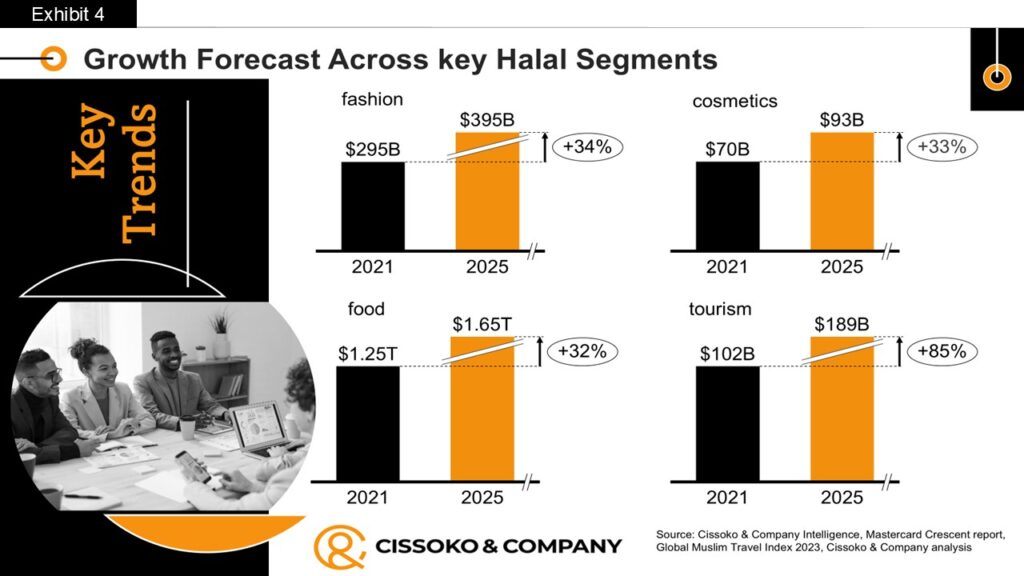
Many Halal market segments are forecast to grow alongside the Muslim population. Halal fashion is expected to increase by 34% between 2021 and 2025 to $395 billion, Halal cosmetics by 33% to $93 billion, and Halal tourism by 85% post-pandemic to $189 billion. Above all, the Halal food segment is projected to rise by 32% to $1.65 trillion over the same period.
Japan cannot afford to miss this opportunity if it aims to enhance its tourism sector and boost its share of GDP in the coming years. Research indicates that Japan must improve its tourist experience in areas such as destination environment, access, services, and communications. Japan lags behind the top 10 countries in most of these areas, except for the destination environment, where it performs slightly better due to its renowned safety, cleanliness, and politeness.
Providing more Halal-friendly services and facilities will be a significant advantage for Japan, given their importance to Halal travelers and the Muslim community in general.
From Japanese Food to Halal Food
Halal food (permitted food), a cornerstone of Muslim dietary practices, is crucial to maintaining dietary hygiene. That’s why over 68% of Muslims worldwide at least abide by some of the limitations imposed by halal diets. To be genuinely halal, food must adhere strictly to guidelines throughout the supply chain, from food ingredients procurement to production and storage to transportation and delivery. Numerous Halal certifying bodies worldwide assist companies in meeting these standards.
Countries aiming to enhance their tourism experiences, particularly those looking to attract Halal tourists, must significantly improve the availability of Halal groceries and restaurants. Failure to do so could signal to Halal travelers and the broader Muslim community that they are not fully welcomed.
Halal food constitutes 15% of the $8.1 trillion global agriculture and food market. Brazil leads with a 70% share of the frozen Halal chicken market. For Halal beef exports, Australia and Brazil together accounted for 64% of the global market, with Brazil holding a 55% share. Japanese tourism firms can source Halal livestock from these leading countries to cater to the rising number of Halal travelers.
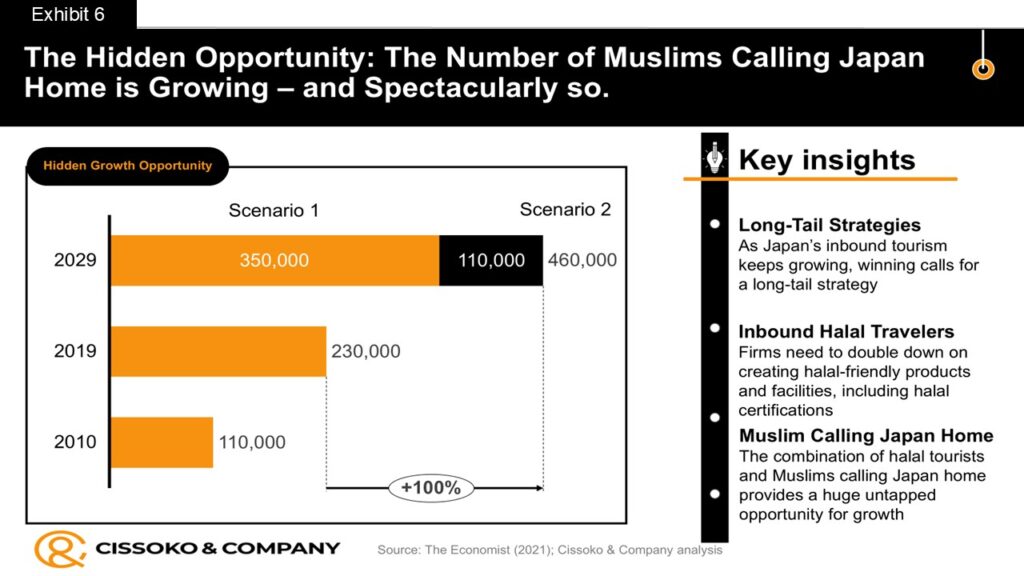
In 2010, Japan was home to approximately 110,000 Muslims. Ten years later (2019), this number has more than doubled to 230,000, indicating an average annual growth of 12,000. At this current growth rate, it is projected that by the end of 2024, the Muslim population in Japan will reach 302,000, and by 2029, this number may hit between 350,000 and 460,000 Muslims, depending on various scenarios. This growth is significant, especially in a country with a declining overall population.
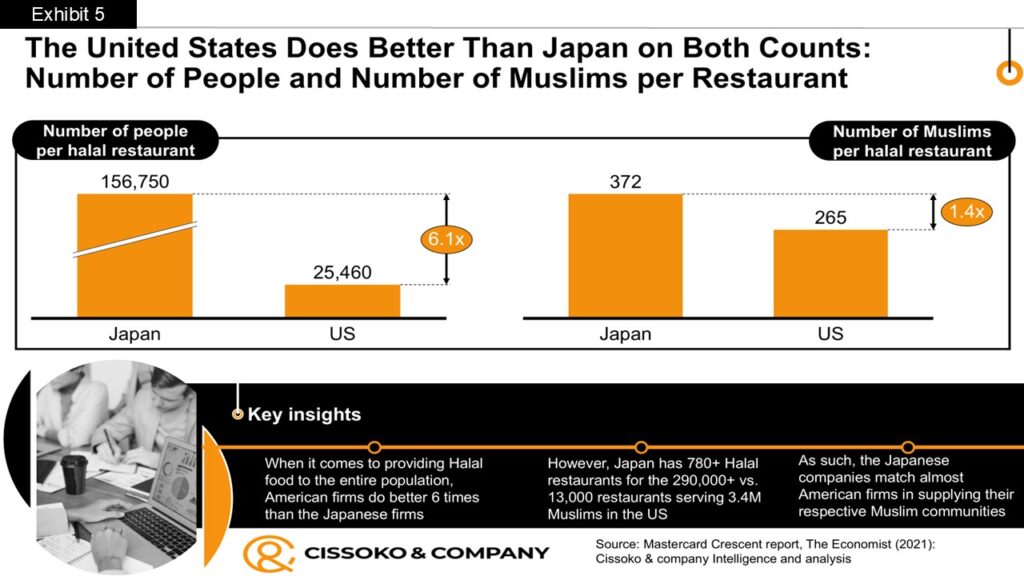
As such, Japan needs to expand its network of Halal restaurants. As of 2017, Japan had approximately 800 Halal restaurants, a number significantly lower than the United States, which had over 16 times as many. This equates to about 156,750 people per Halal restaurant in Japan compared to 25,470 in the U.S. However, when examining the number of Muslims per Halal restaurant, Japan and the U.S. are almost equal, with Japan having about 287 Muslims per Halal restaurant and the U.S. 265.
Improving Halal Certification and Boosting Halal-Certified Firms
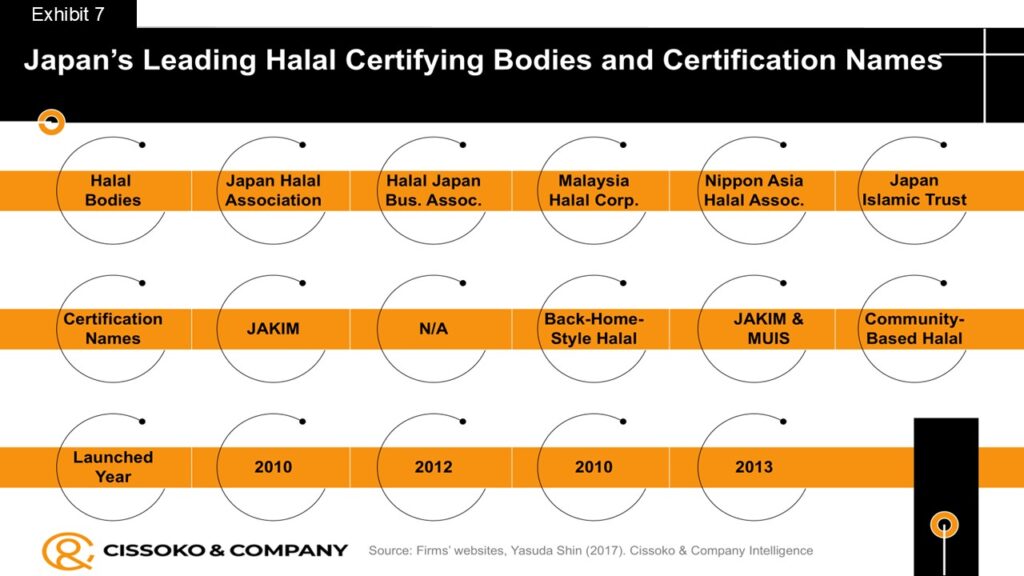
Japan has five recognized Halal certifying bodies, compared to 11 in the U.S. and approximately 400 globally. The primary certifying organizations in Japan are:
- Japan Halal Association
- Halal Japan Business Association
- Malaysia Halal Corporation
- Nippon Halal Association
- Japan Islamic Trust
Adhering to Islamic dietary laws through certification builds trust, attracts customers, and enhances sales from Muslim and Halal travelers.
The certification process typically involves three key steps:
Application and screening: The applicant submits a request to a Halal certifying body, which verifies compliance with Halal guidelines concerning materials, food ingredients, meat, poultry products, business operations, storage, and transportation methods.
Reviews and Certification: The certifying body conducts an on-site inspection of the entire supply chain and business operations, making recommendations as needed before granting certification.
Certification Renewal: Certifications are valid for a specific period. Upon expiration, the applicant may apply for renewal, which also requires adherence to additional food regulations enforced by stricter certifying bodies.
The global Halal certification system, with a market size of more than $ 13 billion, faces significant challenges, including a lack of uniform standards and potential conflicts of interest. Certifying bodies help firms comply with Halal dietary laws, manage logistics integrity, and handle their own accreditation. To ensure transparency and mitigate conflicts of interest, certifying bodies must be separated from accreditation agencies.
Additionally, interviews with Halal food providers indicate concerns about the certification cost, which may be between $300 and $1,000. Reducing these costs could significantly increase the number of Halal food providers in Japan and internationally, further expanding the market and accessibility.
Get in Touch
We will respond to your message as soon as possible.
Insights to Win
Subscribe to our newsletter for in-depth analysis, reports, and our perspectives on business and economic issues related to the Japanese market and the global economy.