
Measuring Productivity in the age of Agentic AI With Sales Data or SG&A Expenditure
The way many companies think about and measure productivity is problematic in the age of Artificial intelligence, and it costs them millions, if not billions, of dollars, since it’s often based on wishful thinking at best or on hallucinations, as in many AI outputs.
The quest for productivity gains, efficiency, and profitability has driven a boom in technology, innovation, and investment in artificial intelligence over the past few years in Japan and across the global economy. While productivity takes many forms, including economic (monetary) value, the age of agentic AI presents formidable challenges for CEOs and other business leaders in quantifying the productivity impact of AI use and deployment across organizations.
As a result, our experience suggests many firms will be left disappointed and frustrated by their hopeful quest, without a measurable benchmark for what true productivity looks like or what their baseline productivity should be before any AI deployment.
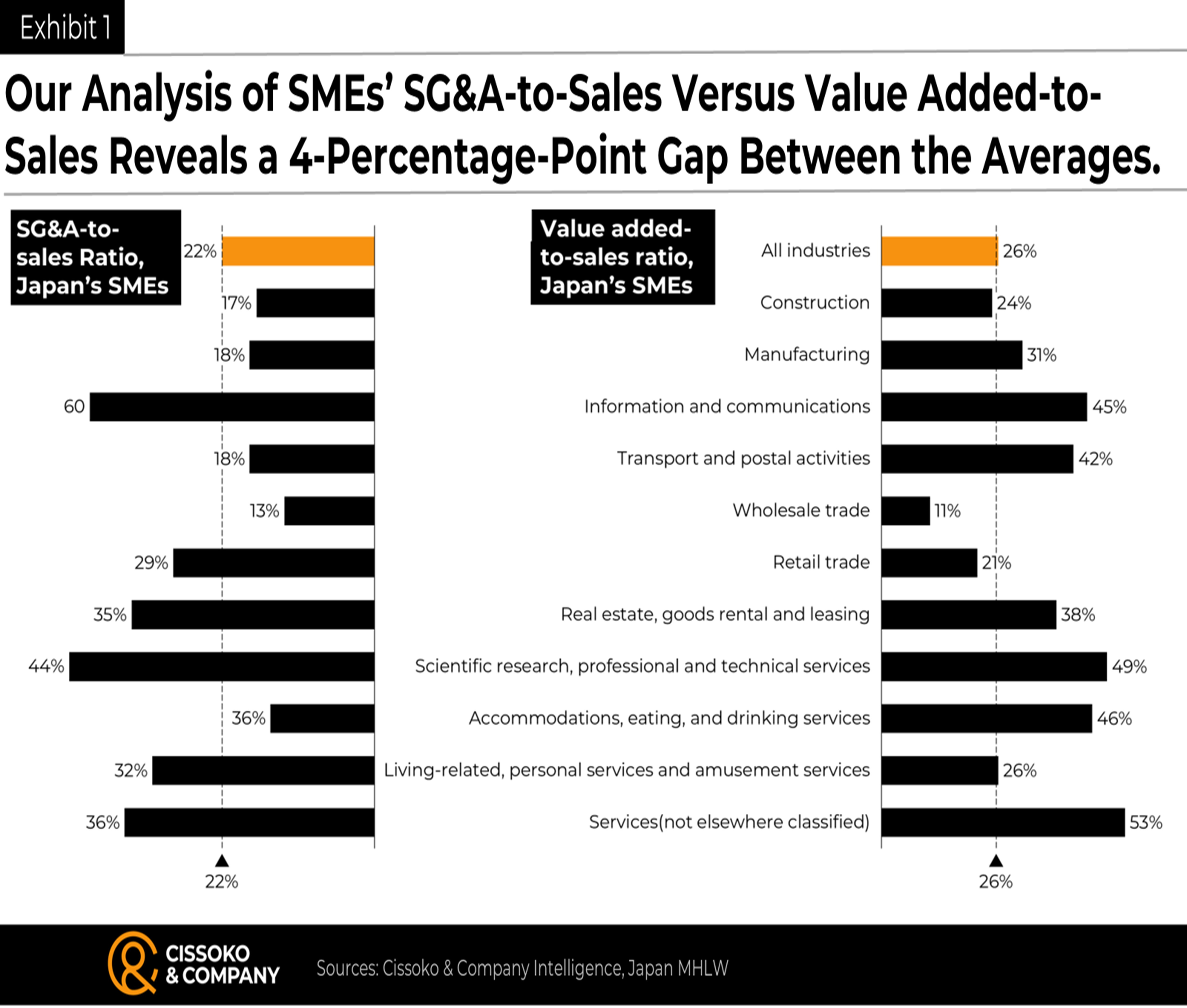
In other words, to what extent does an AI summary of a document qualify as productivity? To what extent does automation of a business operational process qualify as productivity? Do the ongoing corporate token costs amplify or dampen the sought-after productivity gain? Do the ambiguity and unpredictability of token usage costs amplify or hurt corporate productivity by ultimately reducing profitability? These are some of the tough questions CEOs and their functional teams need to grapple with.
In this article, we aim to show how to quantify productivity in monetary terms, known in economics as value added, and how to translate it into labor productivity per employee or per hour, using SMEs and large firms across the Japanese economy. The good news is that although the results may differ, the method is the same, regardless of the reader’s country.
Quantifying/Measuring productivity From Sales or Revenues Data
For many organizations, particularly small and medium-sized enterprises, quantifying productivity remains a formidable challenge in the age of artificial intelligence.
The exercise begins by measuring or estimating value added—a step beyond the practical reach of most time-constrained executives. We therefore reframe the question: how can firms of any size derive productivity directly from sales or revenue? Framed this way, the translation becomes straightforward; companies can apply the ratios from our industry benchmarks intuitively to their own circumstances.
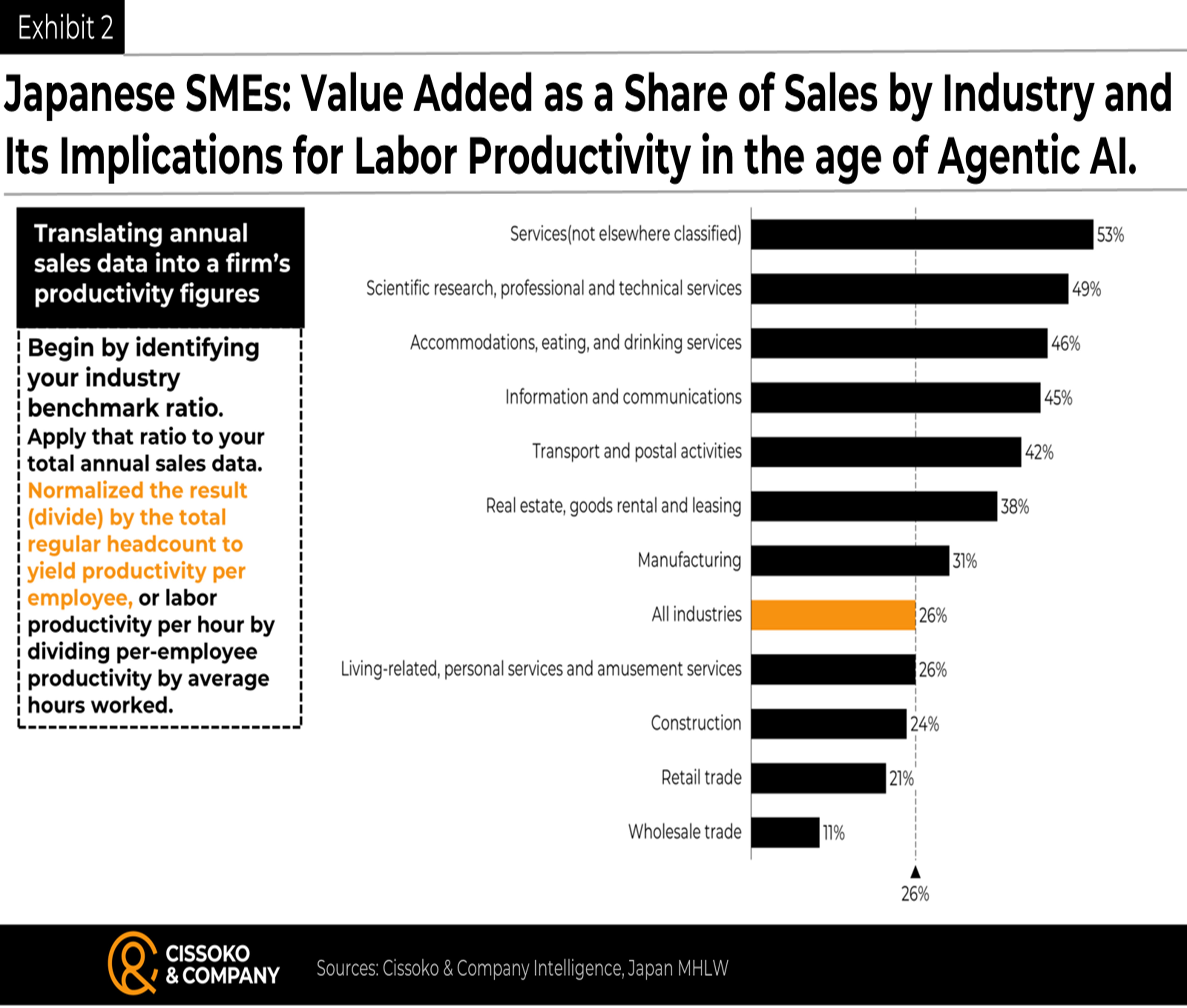
Consider a Japan-based manufacturing SME generating $100,000 in annual sales. Applying the corresponding industry ratio of 31% yields an estimated value added of $31,000. Dividing that figure by the number of regular employees yields productivity per employee; dividing it by the average hours worked per employee that year yields labor productivity per hour.
Quantifying/Measuring Productivity From Selling, General, and Administrative (SG&A) Expenses
Likewise, depending on the leader’s remit and data availability, SG&A expense may be the only input available for estimating value added. The question becomes: how do we translate SG&A expenses into value added?
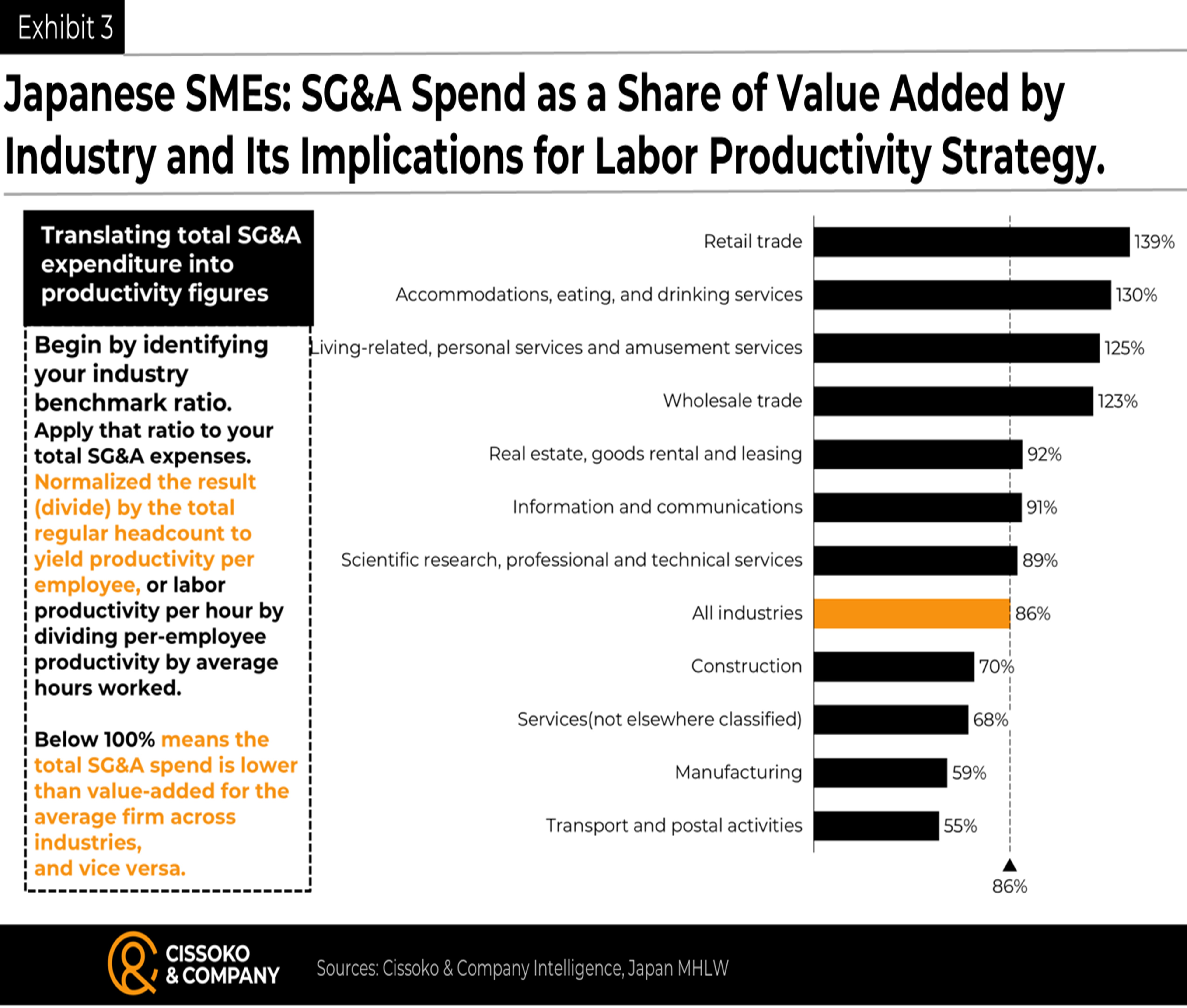
While bespoke, case-by-case productivity measurement remains ideal, few firms have the requisite expertise. We therefore quantified the relationship between total SG&A expenditure and value added across selected industries, as well as the cross-industry average.
Accordingly, firms should apply their industry benchmark ratio to total SG&A, then divide the result by total regular headcount to derive productivity per employee. Leaders should further divide by the average annual hours worked to derive productivity per hour.
Productivity Gap in Hourly Value Added: SMEs vs. Large Japanese Firms Across Key Industries
With two exceptions – accommodation, food and beverage services, and cross-industry services (not elsewhere classified) – large corporations command a substantial hourly productivity advantage over SMEs across most Japanese industries, in some cases reaching twice the level achieved by smaller firms nationwide.
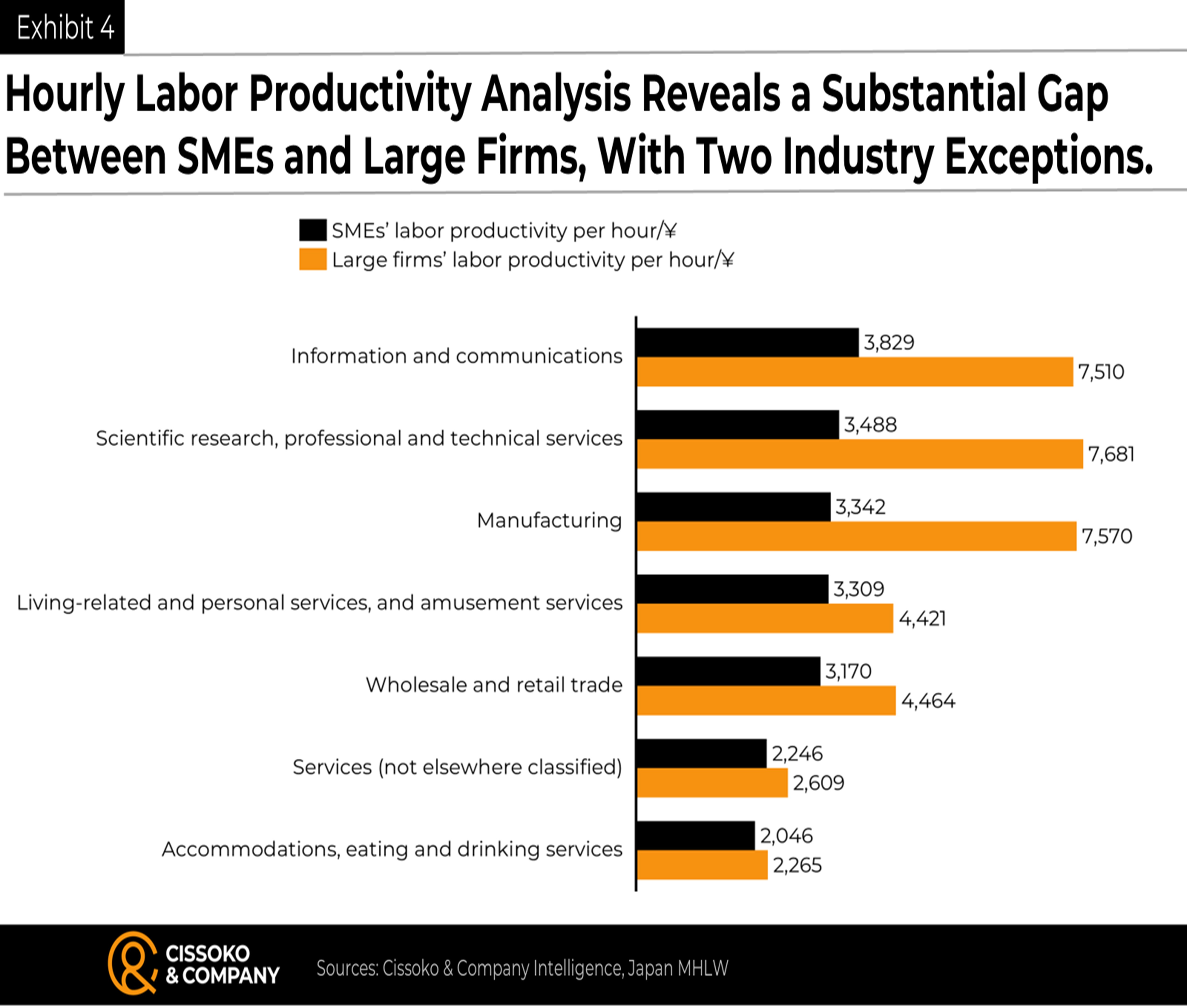
This productivity gap remains a defining challenge for startup disruptors competing with established incumbents in Japan and beyond. Innovation is imperative for any challenger, yet achieving dynamic efficiency at large-cap levels demands a bold, deliberate strategy to close the substantial productivity gap.
Firms need to move beyond the traditional cliché of just talking about hours saved to the real work of proving the productivity impact of artificial intelligence in dollars, such as labor productivity per employee and per hour. Then ask tough questions, such as whether productivity has improved since the technology was deployed. If so, by how much? Finally, CEOs need to assess how much ongoing operational expenditure on AI is required to make the technology economically viable, given that AI’s ongoing costs differ significantly from the traditional software pay-per-seat model, at least for now.
Get in Touch
We will respond to your message as soon as possible.
Insights to Win
Subscribe to our newsletter for in-depth analysis, reports, and our perspectives on business and economic issues related to the Japanese market and the global economy.