
Japan’s Talent Opportunities in the age of Agentic AI
In this era of artificial intelligence, particularly following the launch of ChatGPT and the emergence of large-language-model-powered generative AI, the future of work has become uncertain for both employees and employers. Indeed, although these technologies and tools have demonstrated considerable potential to enhance productivity and efficiency, many organizations may have overestimated their benefits and placed unwarranted optimism in their capabilities.
Numerous dedicated, talented, and committed employees have been dismissed in the name of GenAI, agentic AI, and extensive AI infrastructure investments amounting to tens of billions of dollars. However, many of these companies have failed to show tangible improvements in productivity. Regrettably, behind the scenes, many of these same companies that garnered headlines for workforce reductions are subsequently rehiring or recruiting new personnel to fill similar roles, after recognizing the disparity between AI’s potential for productivity and efficiency and the actual requirements for change management and operating model redesign, including the costs associated with deploying such technologies across their organizations.
For organizations implementing GenAI or agentic AI, encompassing automation driven by talent cost savings, it is advisable to consider the significant advantages of engaging Japan’s skilled workforce.
Understanding the Competitive Advantage Provided by Japan’s Labor Market in Recent Years
Recently, business leaders and CEOs have acknowledged that the adage “there is no free lunch in economics” applies to the use of artificial intelligence. Several have confidentially indicated that the expenses of deploying agentic AI seem to outweigh the benefits, due to the prohibitive and ambiguous costs associated with AI token consumption. This financial burden has shifted from a subscription model to a usage-based pricing structure, now costing hundreds of thousands to a million dollars per month for many corporations.
Thus, before implementing layoffs or investing corporate funds in agentic artificial intelligence without tangible outcomes, we contend that Japan’s talent landscape offers a competitive advantage in cost efficiency. Specifically, the continued depreciation of the yen enhances the attractiveness of Japan’s human resource pool.
Based on our experience collaborating with numerous leading firms both in Japan and internationally, a critical metric in human resources management is the talent cost-to-profit ratio.
This ratio is determined by dividing the total employee expenses—such as salaries, wages, welfare expenses, and bonuses—by the total profit, whether operating or ordinary. By analyzing the trend of this ratio over time, business leaders can make well-informed and strategic decisions.
Analyzing Trends in the Employee Expenses-to-Profit Ratio on a Quarterly Basis
Over 13 quarters, talent costs, measured as total employee expenses as a proportion of overall corporate profit nationwide, have decreased by 38%. Further investigation has indicated that the second quarter of each calendar year exhibits a significantly lower ratio compared to the annual average across all quarters.
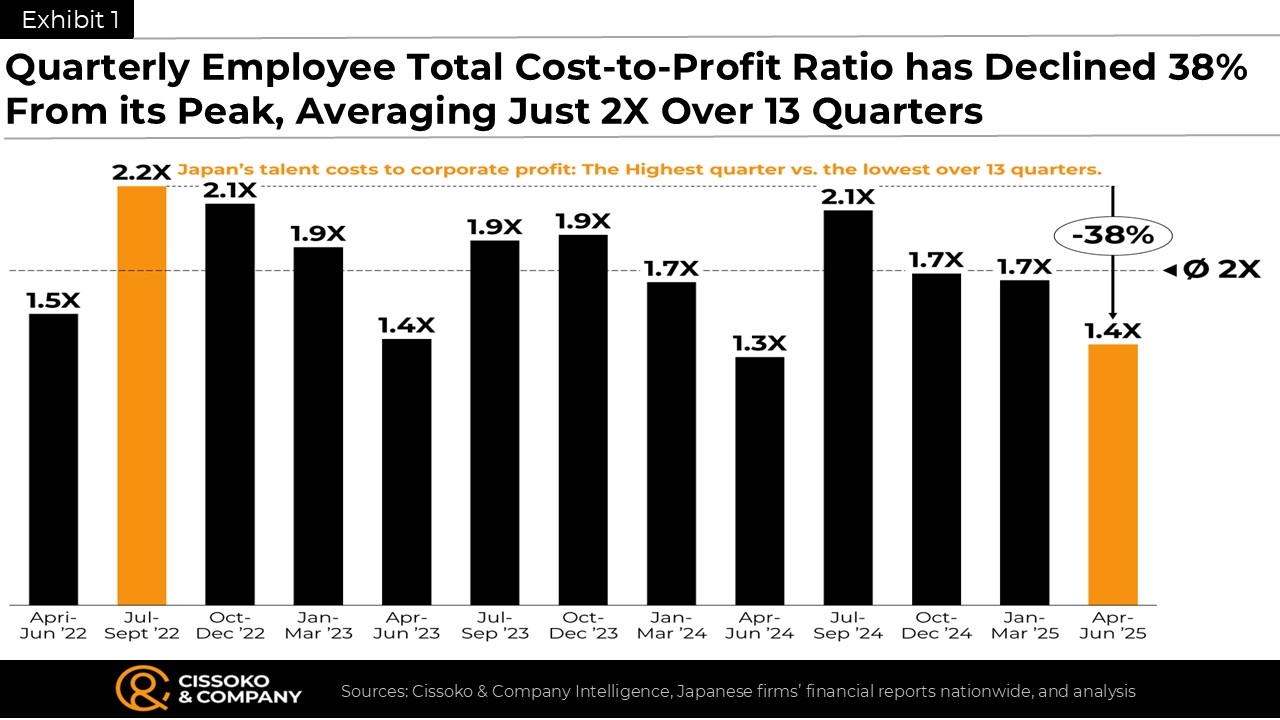
Considering that this period (Q2) is traditionally a peak season for recruiting new university graduates in Japan—who tend to be more economical than mid-career hires—this phenomenon may partially account for the reduced ratio observed during the second quarter.
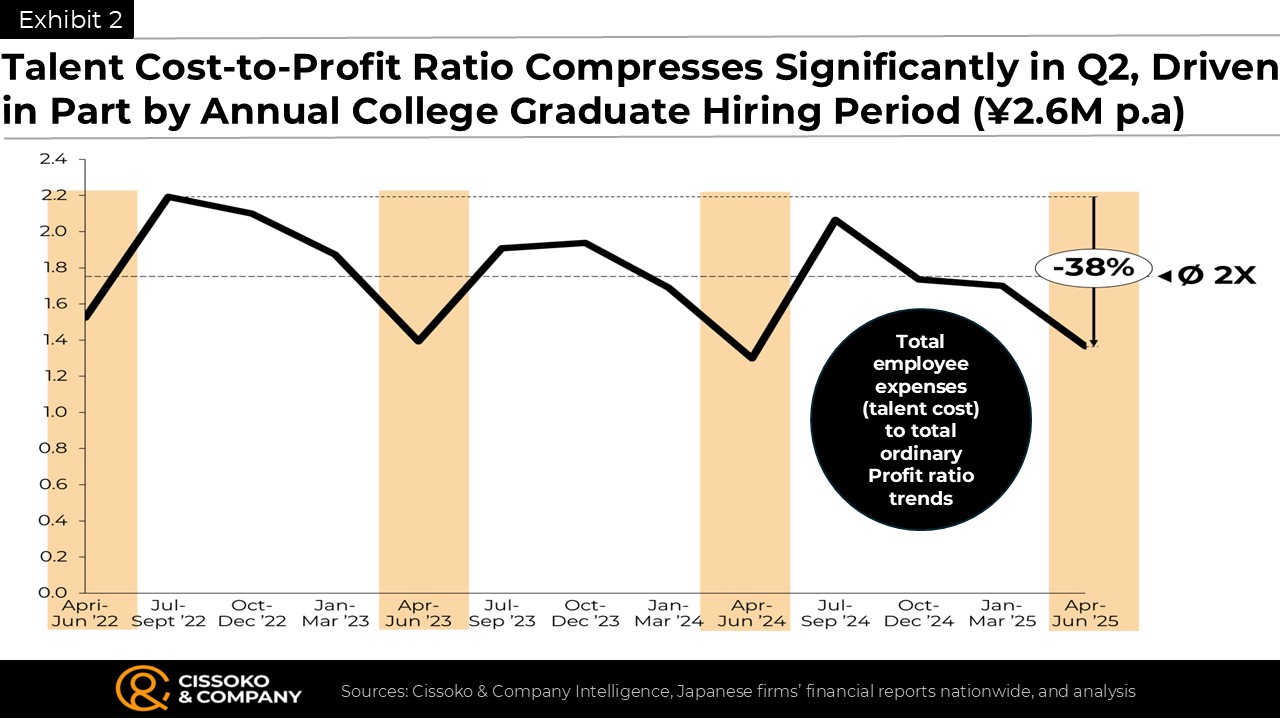
Historical data from 2006 to 2024 (fiscal year) revealed that the average salary for a university graduate was approximately ¥2,592,000, with male graduates earning ¥2,628,000 and female graduates earning ¥2,556,000.
Japan’s Talent Cost-to-Profit Ratio has Decreased by 36% on an Annual Basis
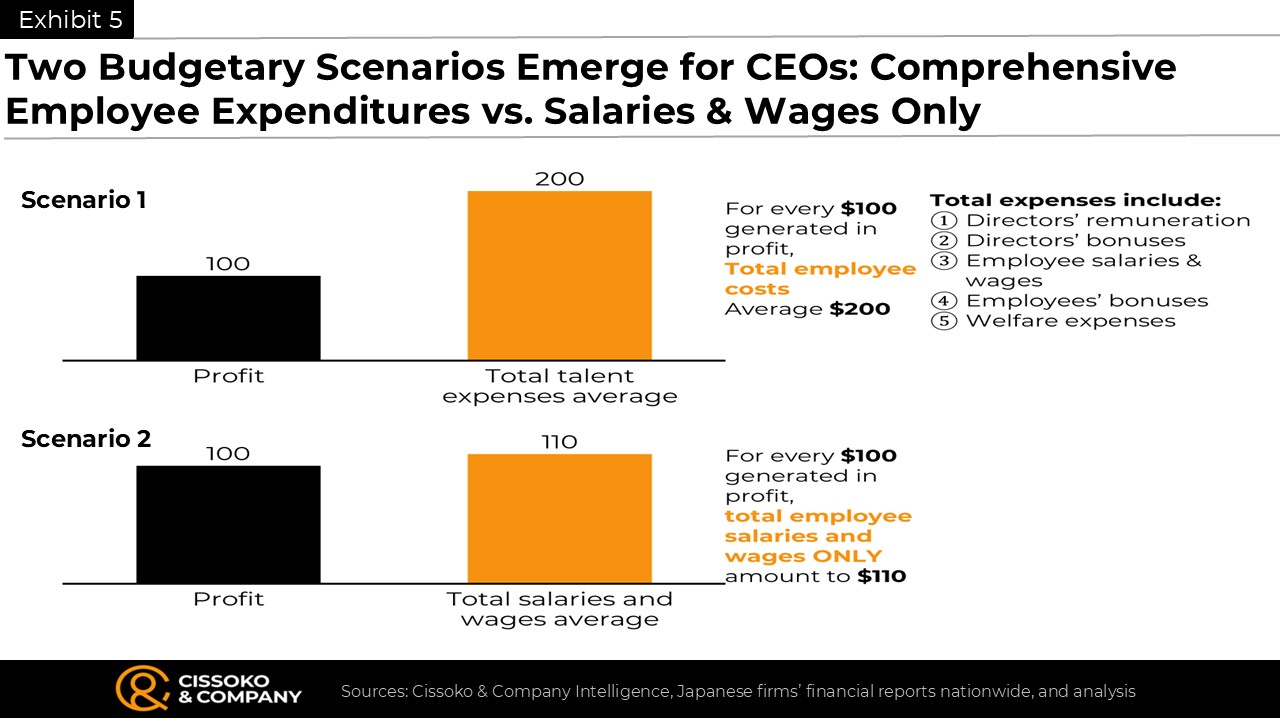
Indeed, total employee expenses (talent costs) as a percentage of total corporate profit have decreased by 36% since their peak during the COVID-19 pandemic, currently amounting to twice the total corporate profit.
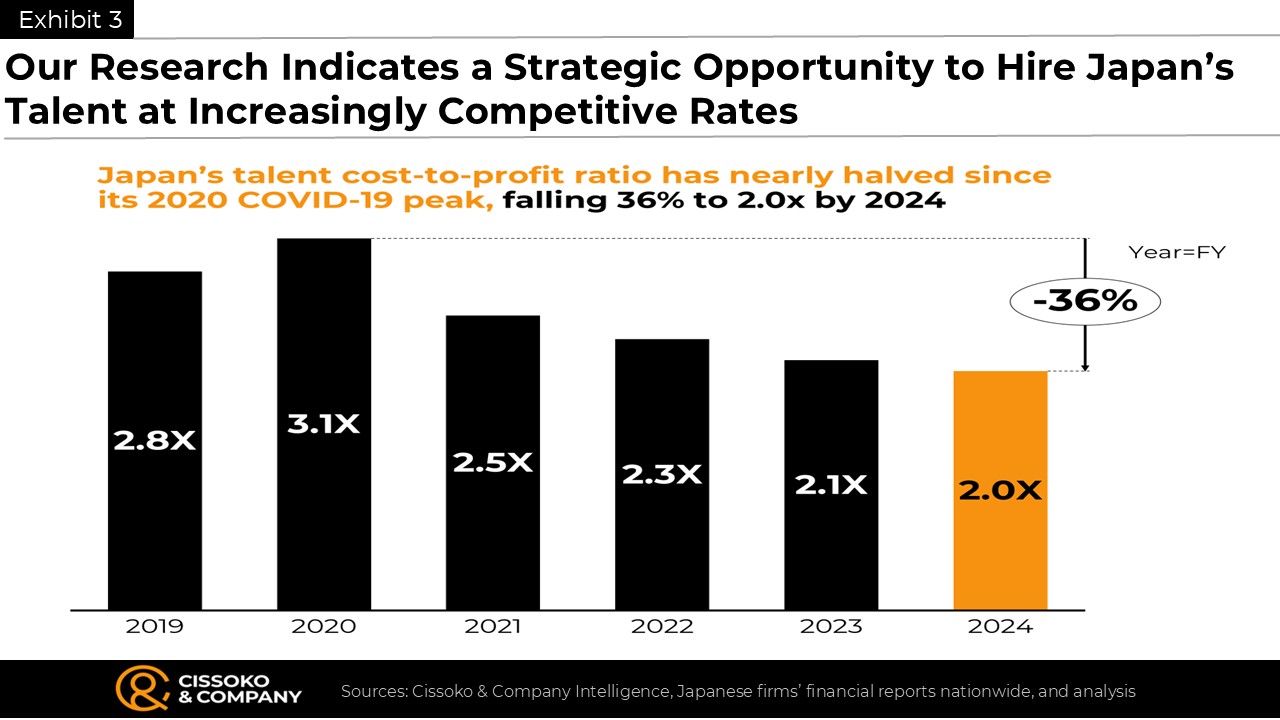
In other words, from a human resources (HR) budgeting perspective, this correlation indicates that a company aiming for a total ordinary profit of $10 million can allocate approximately $20 million to its HR budget.
Indeed, two concurrent trends are emerging: Japanese firms are achieving stronger profitability post-COVID-19, with the total corporate profit jumping by 23% nationwide.
During the same period, overall employee expenses, or talent costs, decreased slightly. Consequently, the financial burden associated with salaries, wages, director remuneration, and bonuses—comprising welfare expenses—has declined as a percentage of corporate profits.
Analyzing Total Talent (Employee) Salaries and Wages Only as a Percentage of Profit
Over the same period, when we isolate other employee-related expenses and focus only on total salaries and wages as a percentage of total corporate profit, the talent cost-to-profit ratio declines further.
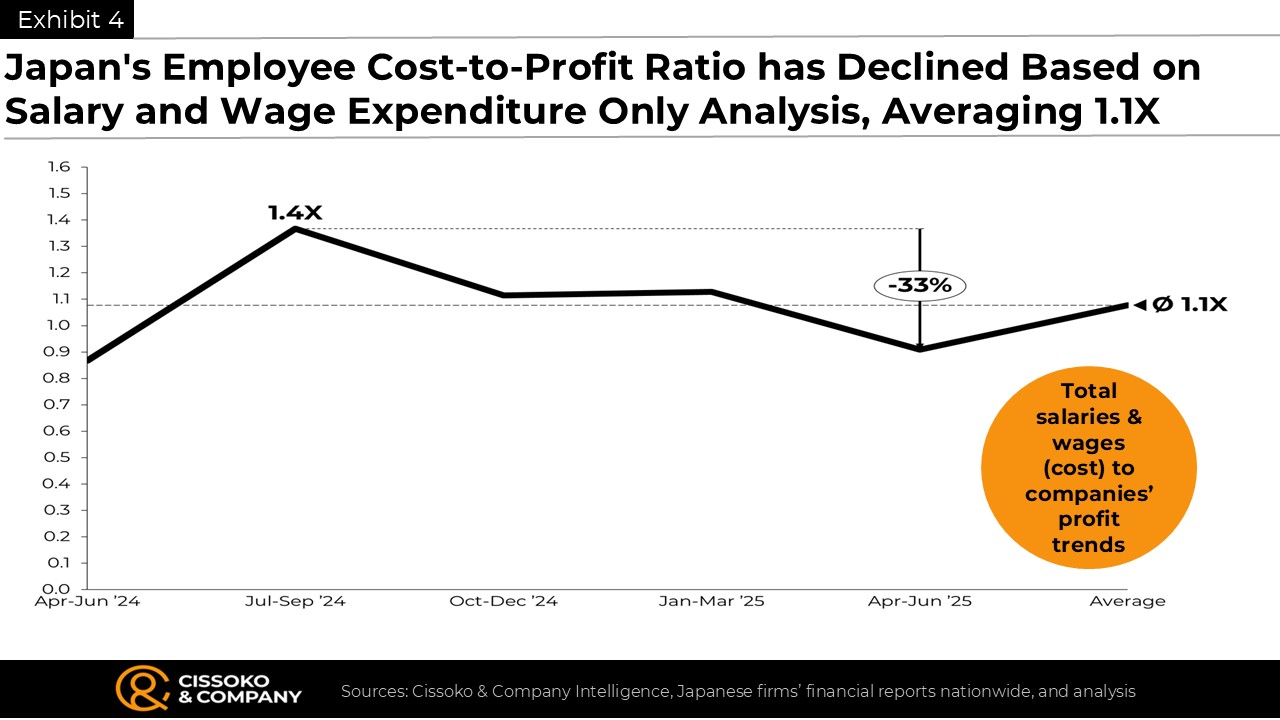
On average, total employee salaries and wages are 1.1 times total corporate profit. That is, for each dollar of total profit, firms allocate, on average, 1.1 dollars to employee salaries and wages.
Two Talent Cost Scenarios for HR Budgeting Purposes
Our analysis indicates that business leaders should consider two scenarios when budgeting for human resources-related expenses. The initial scenario encompasses most employee-related expenses, including remuneration and bonuses for top executives, employee salaries and wages, additional employee bonuses, and welfare expenditures. The subsequent scenario includes only employee salaries and wages, excluding all other talent-related costs.
We believe that artificial intelligence, including GenAI and agentic AI, will have a significant impact on all aspects of corporations, from strategy to operations and supply chain, from finance to sales to human resources management. Indeed, the potential for productivity and efficiency gains is huge, as are the costs of deploying these technologies at scale, including the workflow, operating model, and change management required to capture real value from artificial intelligence.
Thus, for pragmatic reasons and from a cost-benefit analysis standpoint, business leaders need to consider all productivity and efficiency-boosting options on the table, meaning those that have been proven to deliver results, before jumping on a bandwagon with a high probability of failure while wasting scarce corporate resources for a fashionable or headlines-grabbing PR stunt.
Get in Touch
We will respond to your message as soon as possible.
Insights to Win
Subscribe to our newsletter for in-depth analysis, reports, and our perspectives on business and economic issues related to the Japanese market and the global economy.