
Japanese Market Entry Strategy: Correlation Between Market Share and Profitability in Japan
The relationship between market share and profitability remains inconclusive and is still being studied. What we do know is that prior studies in 1970 linked high market share to high profitability. Later studies found the relationship weak or too noisy to draw a definitive conclusion.
However, many CEOs and business leaders still swear by the two words “market share.” In other words, many of these executives prioritize market share over profitability. In many cases, their mantra is growth at the cost of profitability. For these reasons, the founder of the Boston Consulting Group (BCG), Bruce Henderson, argued in a 1989 Harvard Business Review (HBR) article that “Market share is malarkey.” To the best of our knowledge, none of these studies were based on Japanese companies or industries.
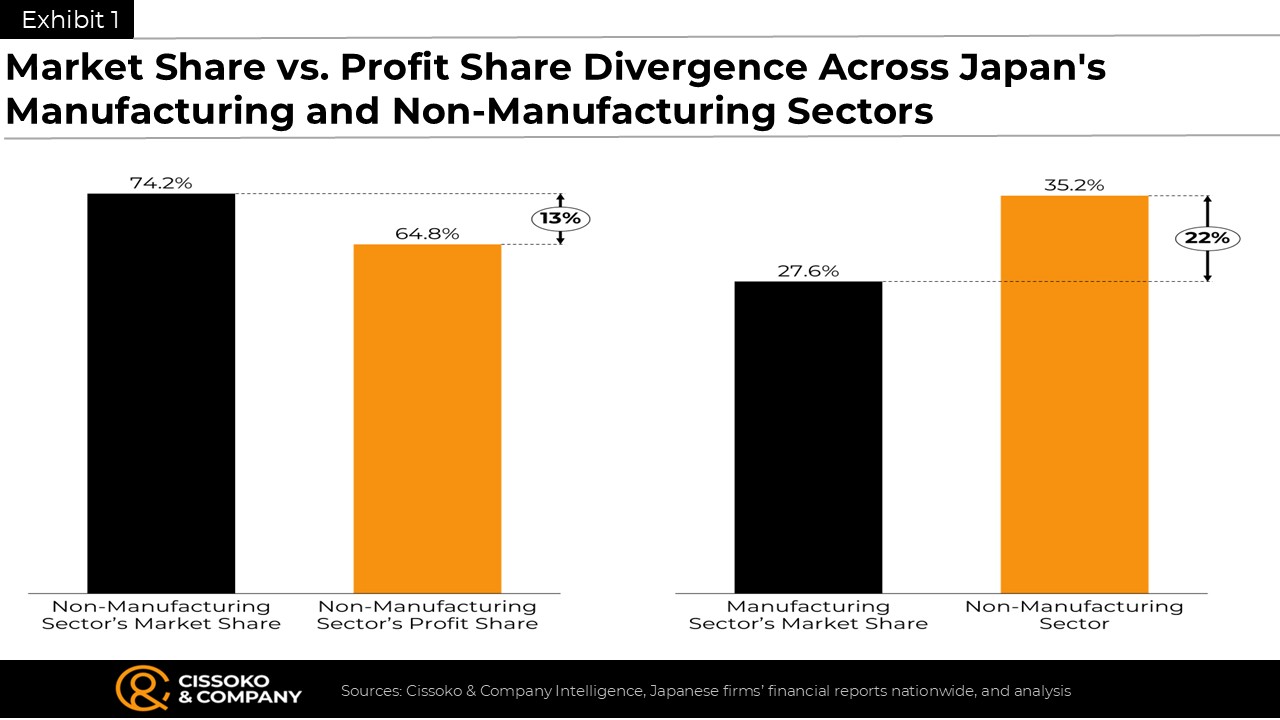
As such, we have reviewed market share and profitability across Japanese industries nationwide and across major economic sectors, such as manufacturing and non-manufacturing, to analyze the extent to which high market share, either nationwide or within a specific sector, translates into high profitability, as measured by profit share.
Relationship between market share and profitability (Profit Share) Across Japan’s Manufacturing and Non-Manufacturing Sectors
Japan’s non-manufacturing sector holds the largest share of total sales, at 72.4%. However, its share of total (ordinary) profit was only 64.8% in the fiscal year 2024-25, indicating a 7.6 percentage-point discrepancy between sales and profit shares.
Conversely, Japan’s manufacturing sector comprised 27.6% of the market share while contributing 35.2% to the country’s (ordinary) profit. Further analyses identified analogous patterns, with numerous industries exhibiting variances between their market share and profit share across both manufacturing and non-manufacturing sectors.
Assessing the Relationship Between Japanese Industries’ Market Share and Their Profit Share at the National Levels
When we compared the relationship between each major Japanese industry (including the two major sectors), we found that profit share exceeded market share in only twelve industries (57%). In only one industry (transport and postal services), which we call a “balanced industry,” market share was nearly equal to profit share.
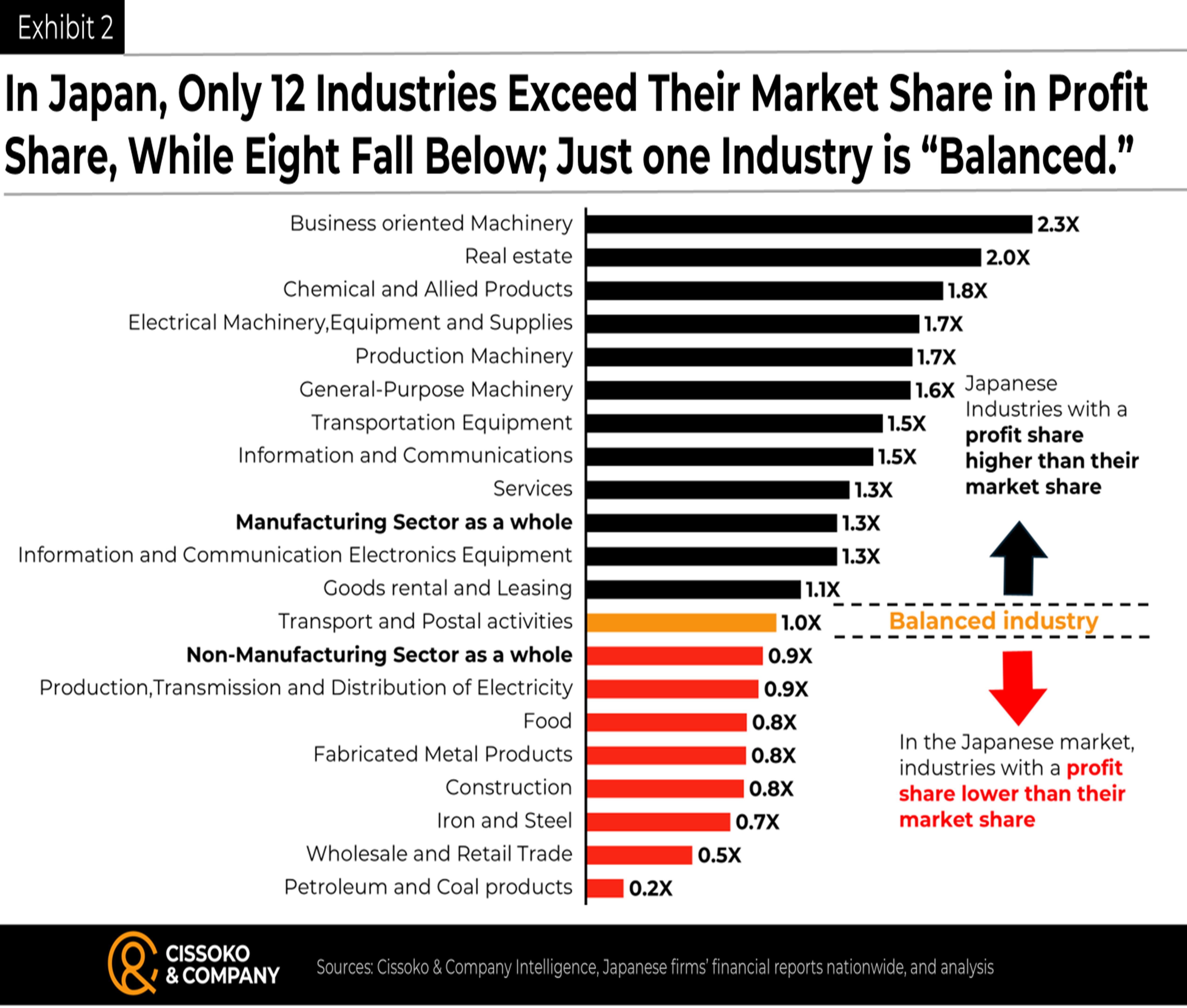
In all other industries, including the wholesale and retail trade (33.3% of Japan’s market share), profit share was lower than the corresponding market share.
Assessing the Market Share and Profit Share Relationship Across the Manufacturing Sector
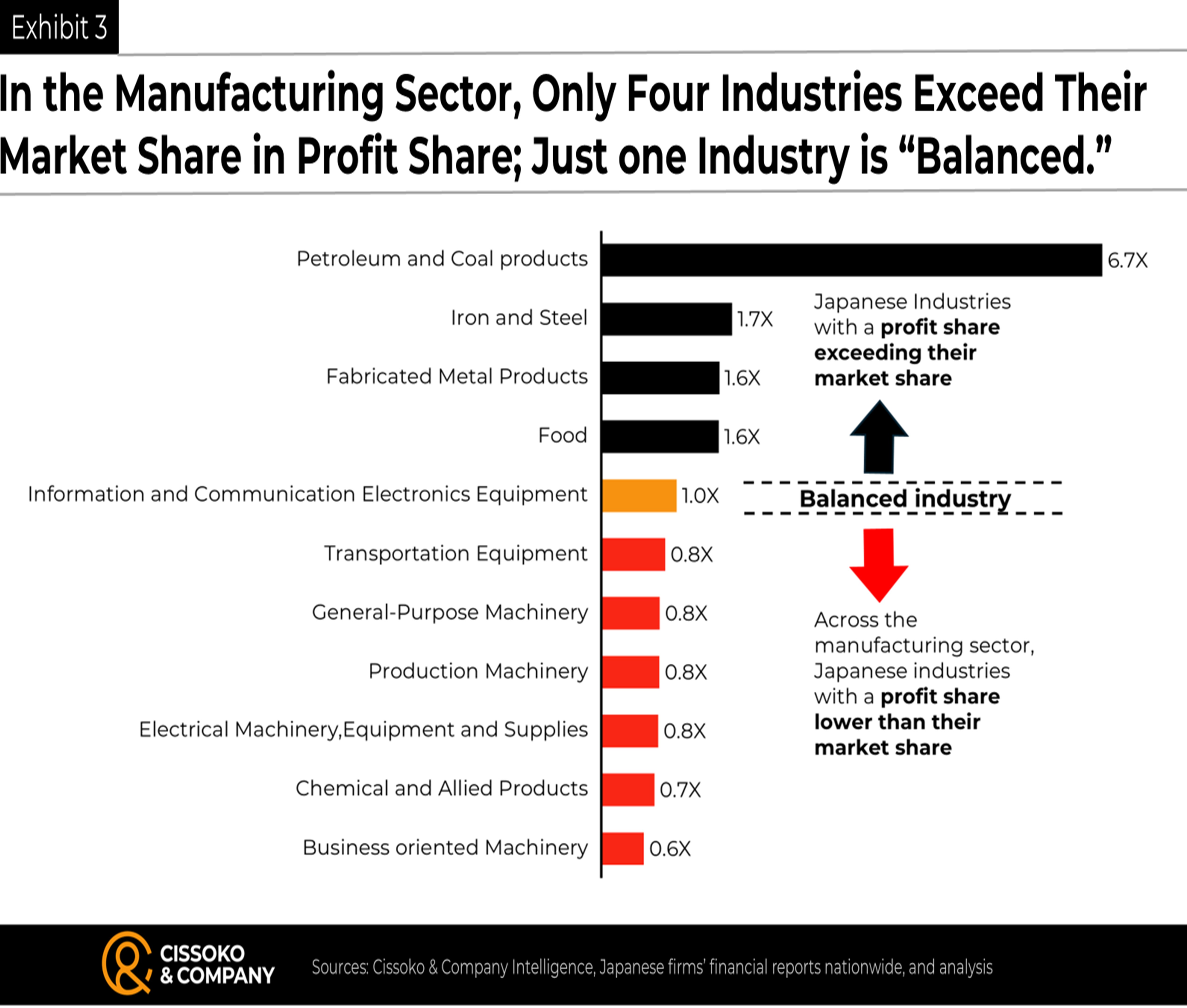
Similarly, among the eleven principal industries within Japan’s manufacturing sector, profit shares surpassed market shares in only four industries (36.3%). Once more, only the information and communication electronics equipment industry was identified as a “balanced industry,” while the remaining six industries (54.5%) had profit shares lower than their market shares.
Assessing the Market Share and Profit Share Relationship Across the Non-Manufacturing Sector
Furthermore, among the eight principal industries in the non-manufacturing sector, five had profit shares slightly above their market shares (62.5%), except for the real estate industry, where the profit share was 2.2 times the market share.
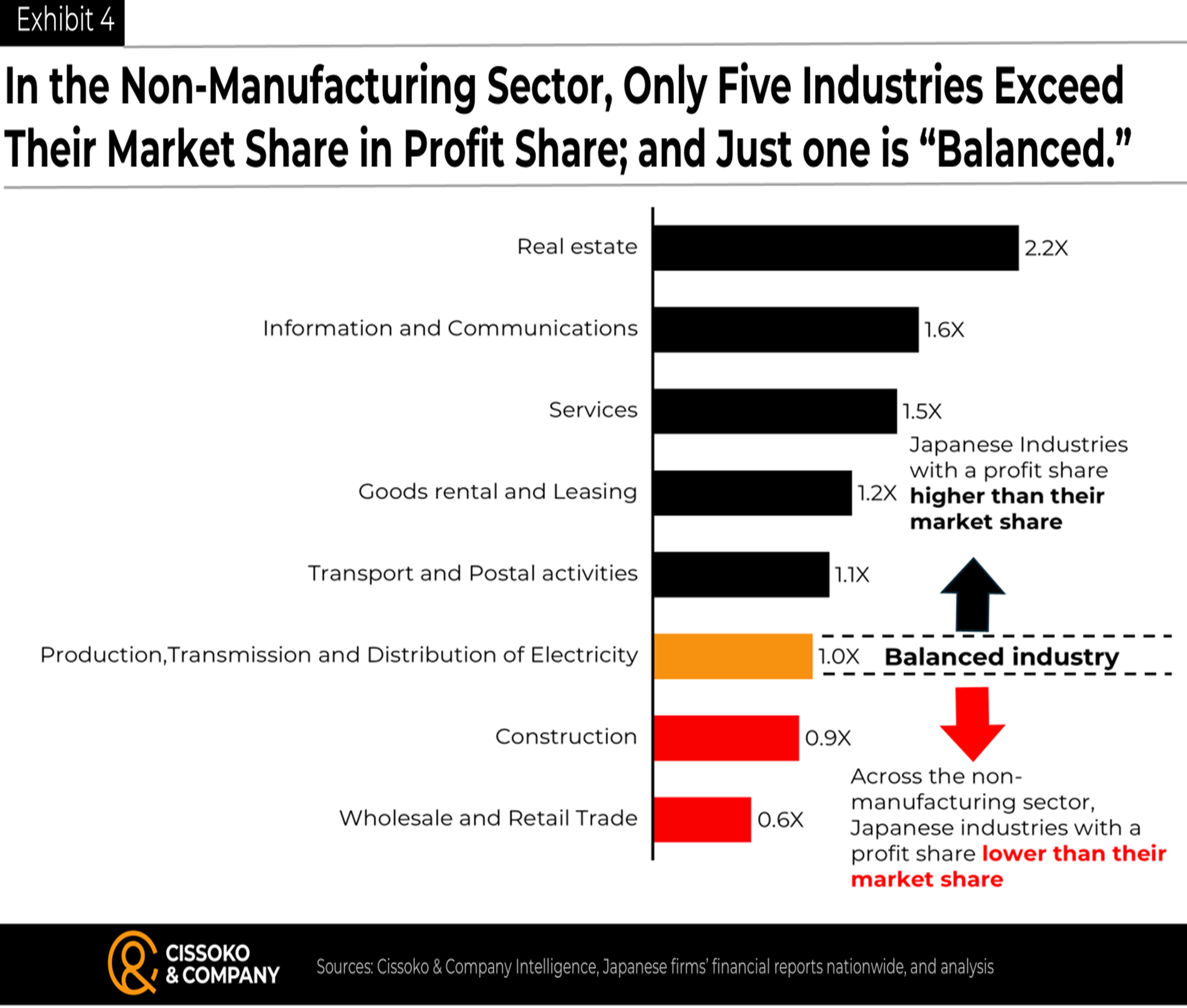
The electricity industry was the sole “balanced industry,” whereas the remaining two industries (25%) had profit shares below their market shares.
Difference Between Japan’s Manufacturing and Non-Manufacturing Sectors
Indeed, our study accounted for all Japanese industries except finance and insurance. The logical question becomes: between Japan’s manufacturing and non-manufacturing sectors, where is market share more correlated with high profit share?
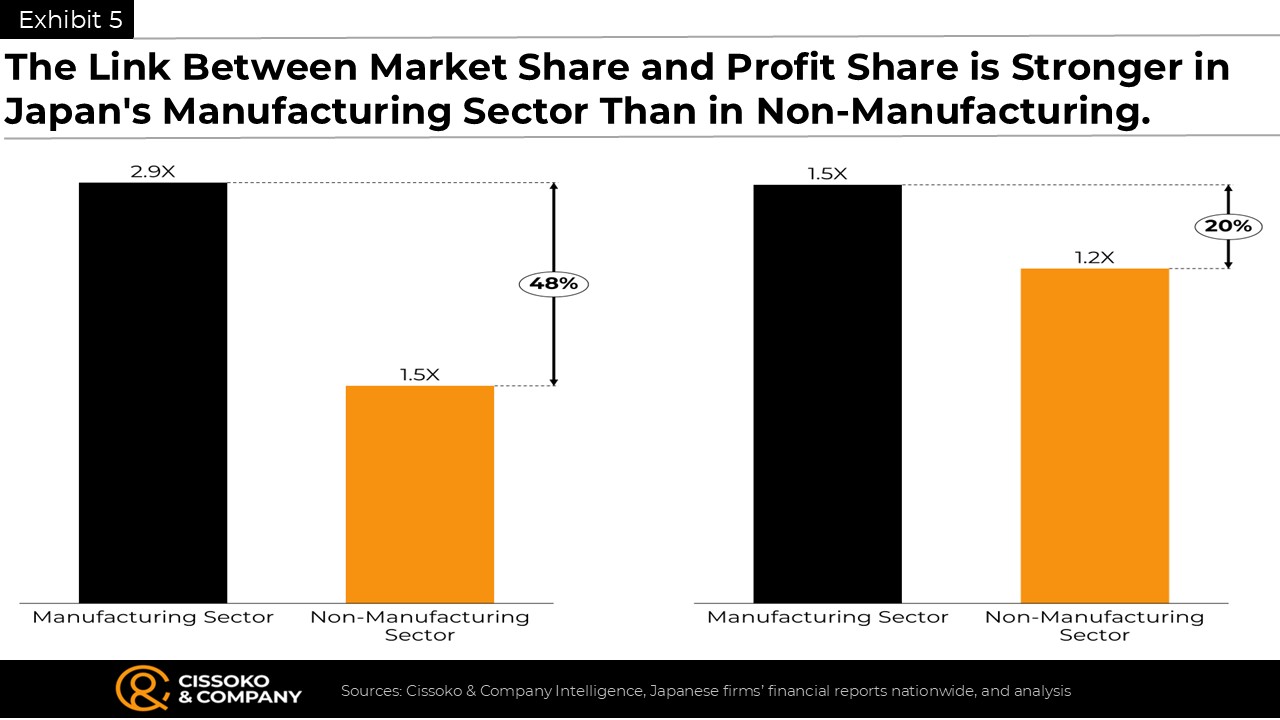
To answer this question, we will first compare the averages across all industries in which market share and profitability are correlated between the two sectors. That is, those with profit share-to-market share ratios above “1.0X.”
Through that lens, the manufacturing sector has an edge, given that the average of its four industries with profit-share-to-market-share ratios above “1.0X” is 2.9X. Similarly, when we perform the same analysis by averaging scores across all industries within each sector (manufacturing and non-manufacturing), the manufacturing sector again wins, with an average profit-to-market share ratio of 1.5X versus 1.2X for the non-manufacturing sector.
Get in Touch
We will respond to your message as soon as possible.
Insights to Win
Subscribe to our newsletter for in-depth analysis, reports, and our perspectives on business and economic issues related to the Japanese market and the global economy.