
The Growth Paradox in the age of AI: Growing While Losing the Money Game — REPORT
Growth differs from genuine growth, since not all growth rates are equal. Not all growth is created equal—a distinction that carries profound implications in the age of artificial intelligence. Our research exposes a critical growth paradox in the global economy: while executives believe their organizations are growing or winning, most companies are expanding below the threshold needed to sustain both market share and profit share.
To assess the depth of this blind spot, we surveyed hundreds of senior business leaders—spanning VP, SVP, and C-suite levels—across the industries central to this study. When presented with industry growth rates of 3% to 5% or higher over the past five years, their responses revealed a significant, systemic misalignment between perceived and actual competitive performance.
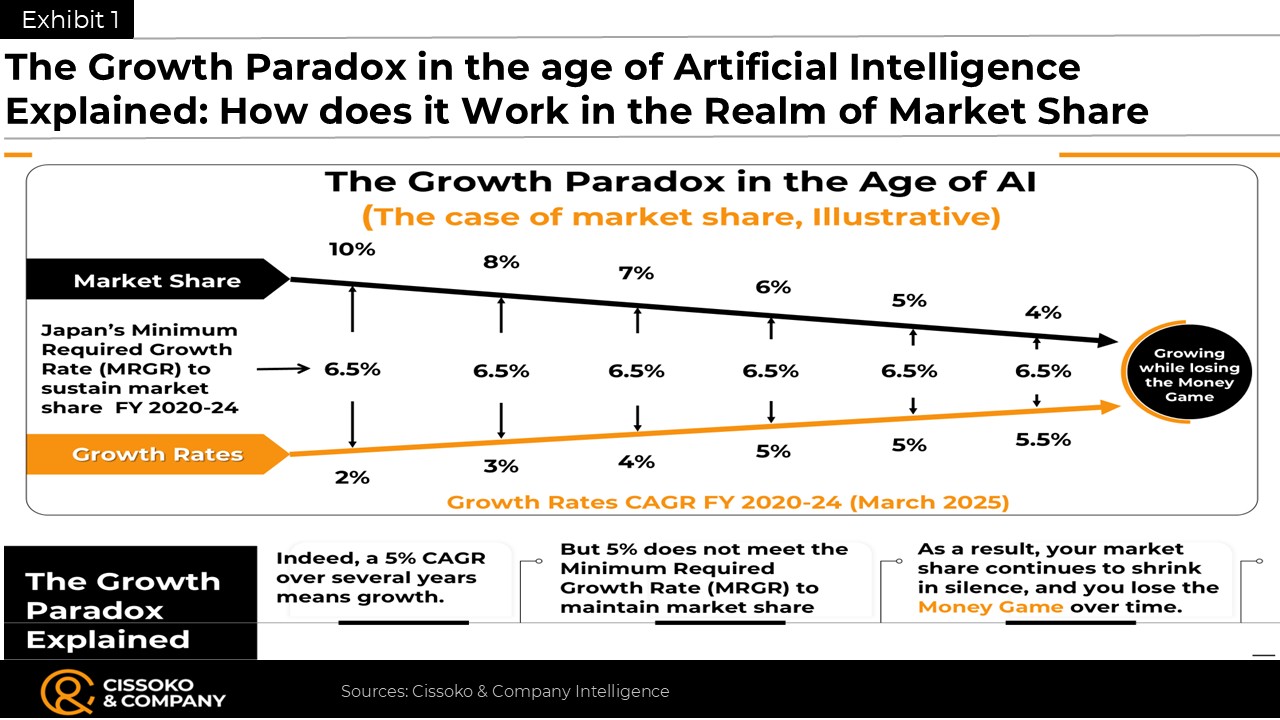
Respondents were asked to assess three dimensions: 1) Their industry’s growth trajectory over recent years; 2) The competitiveness of those growth rates; and 3) Their overall evaluation of current growth performance. Responses ranged from cautious acknowledgment—“We have made reasonable efforts given challenging economic conditions”—to measured optimism—“We are outperforming competitors” and “AI is driving productivity gains with near-term growth implications.” A minority expressed concern, noting that “Growth outcomes have fallen short of expectations relative to the promise of artificial intelligence.”
When we showed their growth rates compared with their market and profit share losses over the same period, many were surprised by how that could be, given the growth rates achieved over the past few years.
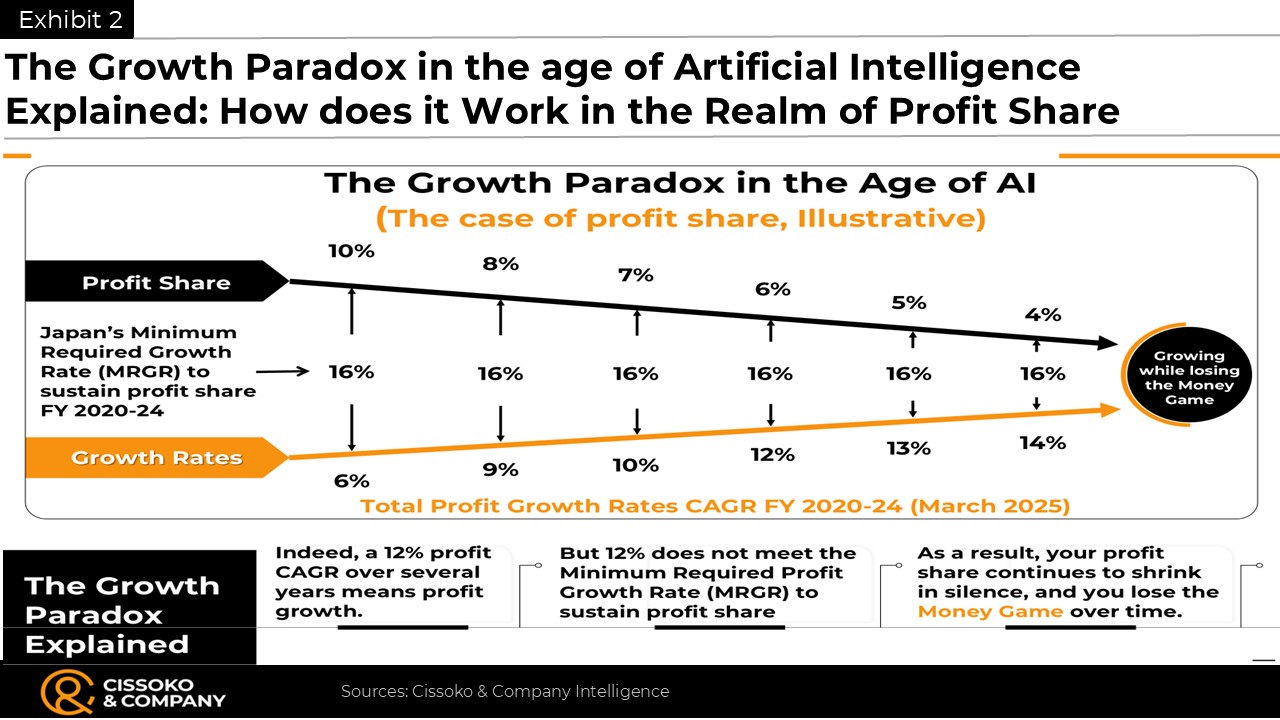
The Growth Paradox is a critical growth strategy blind spot: leadership, employees, and stakeholders perceive the organization as thriving based on positive realized growth rates, while it quietly cedes both profit share and market share — because that growth falls short of the minimum threshold required to sustain competitive position over the same period.
This report proceeds as follows. We begin with a case study of a genuinely high-performing growth trajectory—the antithesis of the Growth Paradox—within Japan’s services sector. We then examine, through targeted case studies, industries that have fallen victim to the Growth Paradox in Japan over the past five years. In doing so, we present six distinct manifestations of the Growth Paradox, enabling readers to benchmark them against a Japanese industry that has sustained truly winning growth rates, simultaneously expanding revenue, market share, and profit share.
Japan’s Services Industry: Defining Genuine Growth
Japan’s services industry stands as a compelling example of sustained, high-quality growth within the broader Japanese economy. From fiscal years 2020 to 2024 (ending March 31, 2025), the industry achieved a 9% compound annual growth rate (CAGR), with market and profit share each expanding at 4% CAGR over the same period.
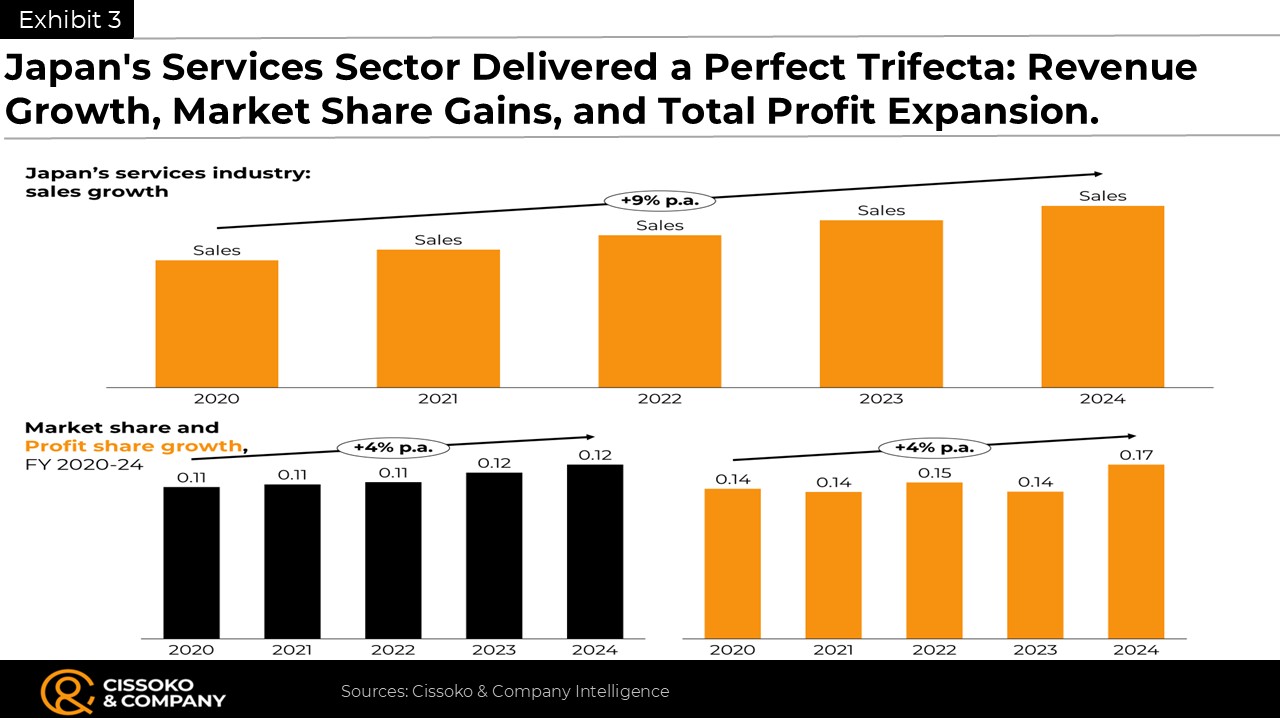
The scale of this performance underscores its significance: the industry added approximately $140 billion to its fiscal year 2020 revenue base—averaging nearly $30 billion annually—and generated over $18 billion in incremental ordinary profit.
The Most Shocking Growth Paradox: Growing While Losing Both Market and Profit Shares
First Case Study: Japan’s Information and Communications Industry (the soft side versus the hard side) FY 2020-24
The soft segment of the information and communications industry—encompassing broadcasting, software, and content—posted a 3% CAGR from FY2020 to FY2024, falling materially short of the 6.5% threshold required to sustain market and profit share.
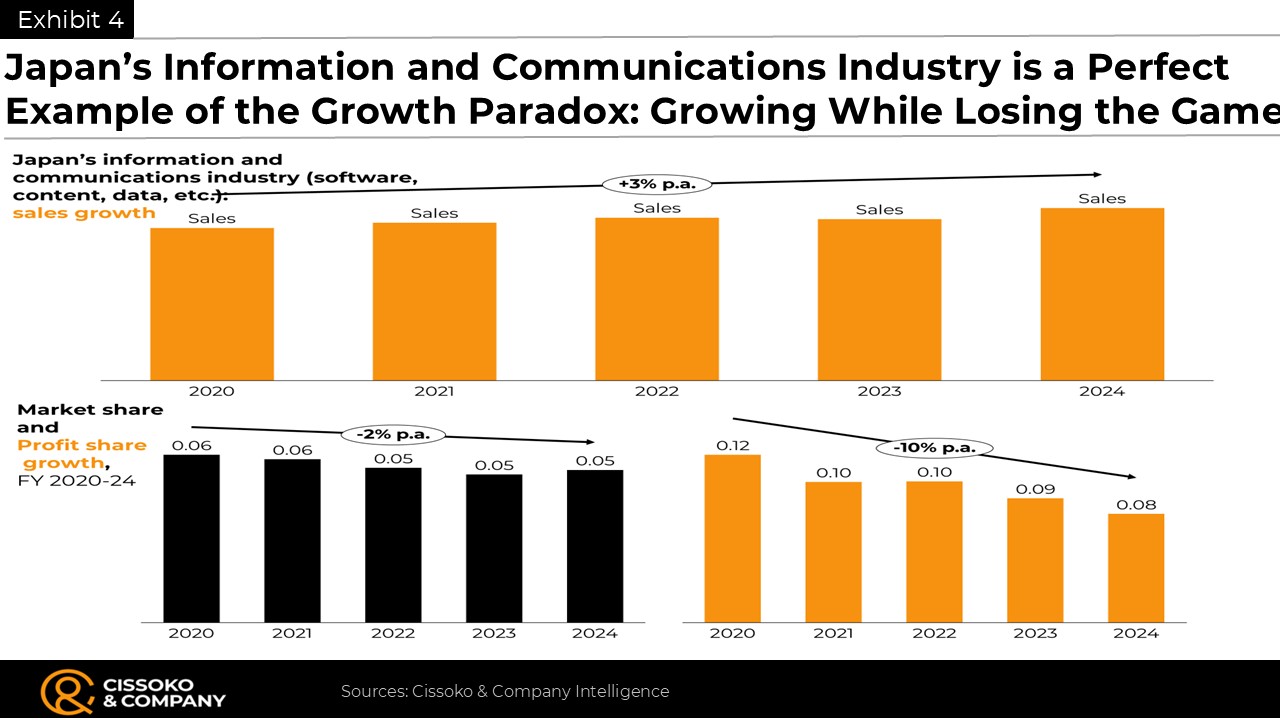
Consequently, the segment incurred a compounded market share loss of 2% and a compounded profit share loss of 10% over the five-year period ending March 31, 2025—equivalent to more than $10 billion in lost market share and $25 billion in foregone profit—which went largely undetected.
The hardware segment—comprising semiconductors and electronics equipment—delivered a 19% CAGR over the same period, driving measurable gains in both market and profit share, and generating substantial incremental revenue and earnings.
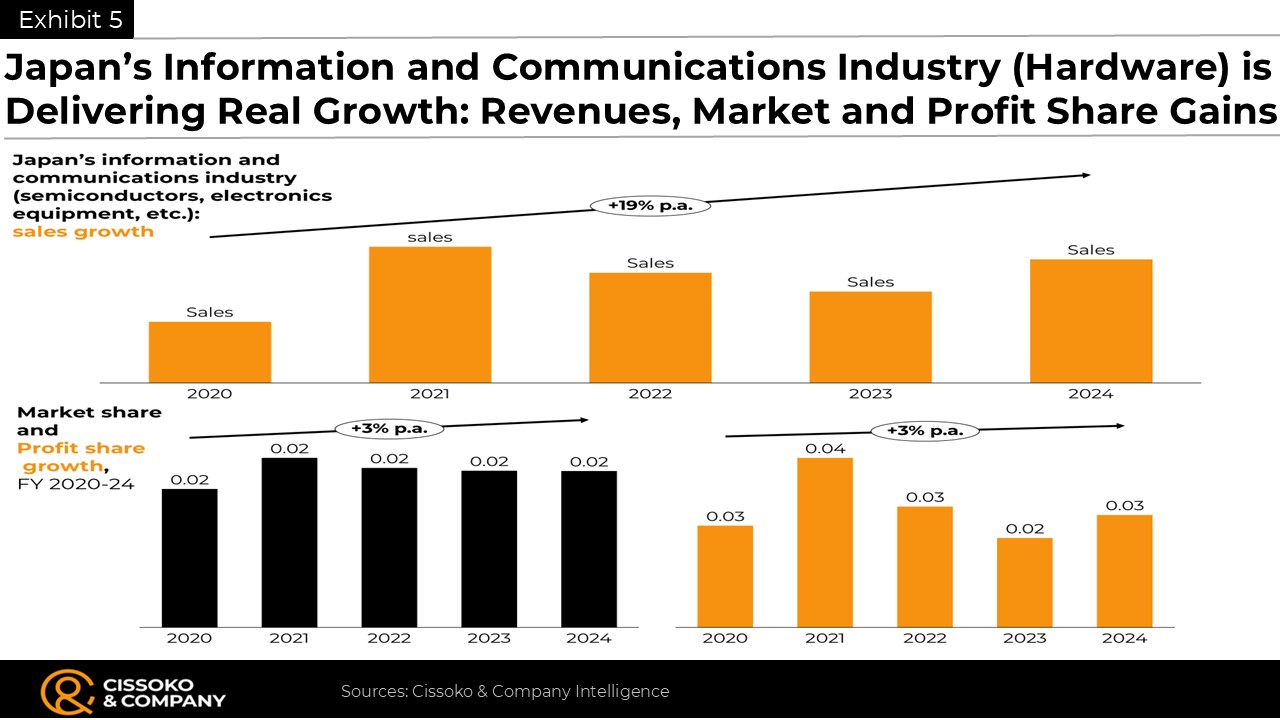
A critical question emerges: what distinguishes growth leaders from their peers? Our research identifies one definitive KPI: we call it “The Minimum Required Growth Rates of 6.5% and 16% over FY 2020–24, necessary to sustain market share and profit share positions, respectively.
Firms achieving a growth rate at or above the 6.5% threshold have successfully defended or expanded their market and profit shares. Conversely, those falling short of this benchmark gradually erode both—often undetected until they have lost significant ground.
The Growth Paradox Second Case: Growing at a Rate That Boosts Market Share While Losing Profit Share
Case Study: Japan’s Real Estate Industry FY 2020-24
Japan’s real estate sector achieved a 7% CAGR—just above the 6.5% threshold required to defend market share—yet total sales expanded at only a 2% CAGR over the study period.
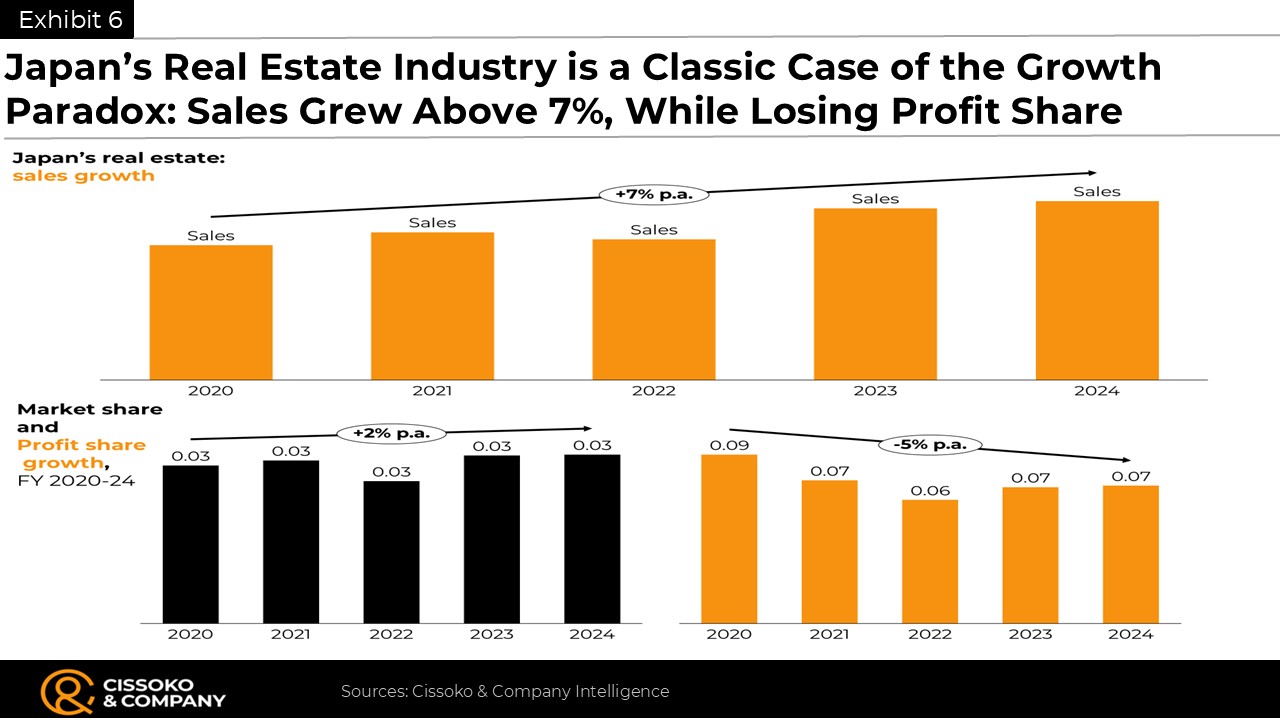
This growth proved insufficient to sustain the industry’s profit share, resulting in a cumulative 5% erosion of profit share.
The Growth Paradox Third Case: Growing at a Rate Below the Minimum Required, Losing Market Share, While Defending Profit Share
Case Study: Japan’s Wholesale and Retail Trade Industry FY 2020-24
Over the study period (FY 2020–24), Japan’s Wholesale and Retail Trade industry posted a 4% CAGR—below the 6.5% threshold required to sustain market share. Consequently, the growth achieved failed to deliver meaningful competitive impact.
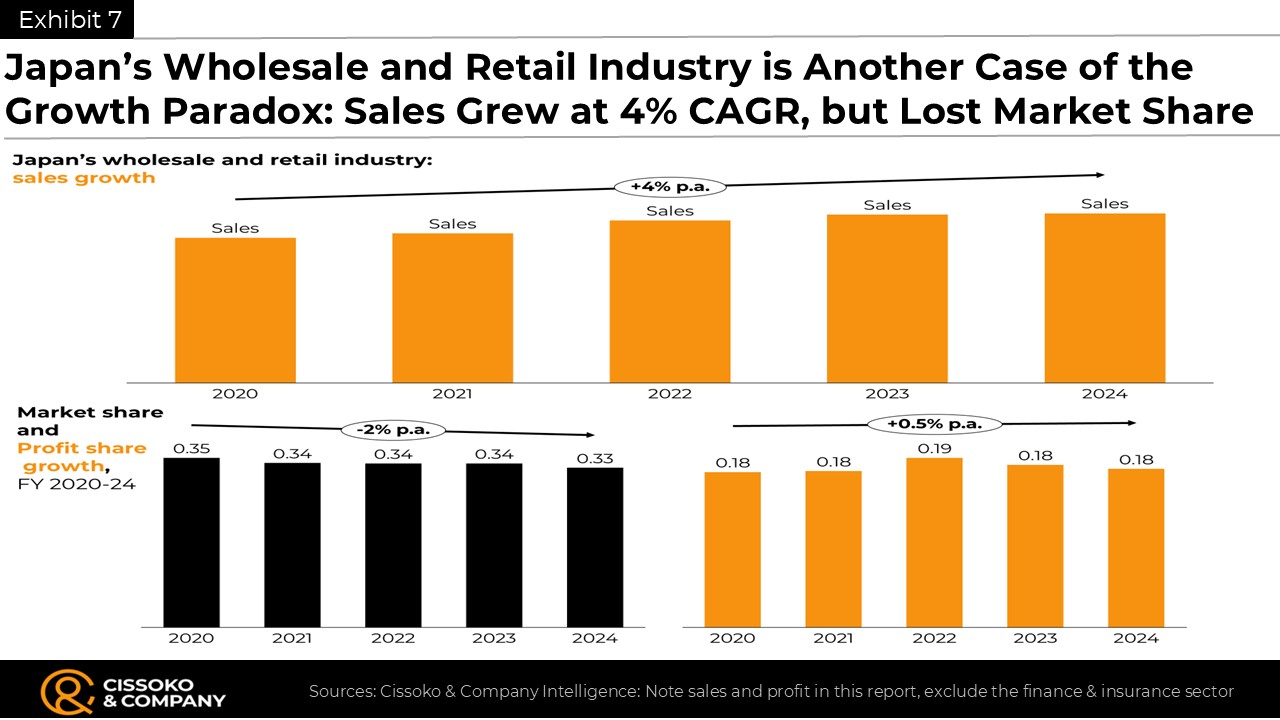
The industry’s total market share declined at a 2% CAGR through March 31, 2025. Despite efforts to defend profit share, erosion persisted—cumulative market share losses over the period are estimated at $180 billion, representing an average annual cost of $36 billion from FY 2020 through FY 2024.
The Growth Paradox Fourth Case: Growing at a Rate Below the Minimum Required and Losing Slightly Both Market and Profit Share
Case Study: Japan’s Non-Manufacturing Sector FY 2020-24
When an industry’s growth rate falls marginally below the minimum threshold required to sustain market and profit share (6.5%), the resulting erosion across both dimensions is comparatively limited relative to sectors with more pronounced shortfalls.
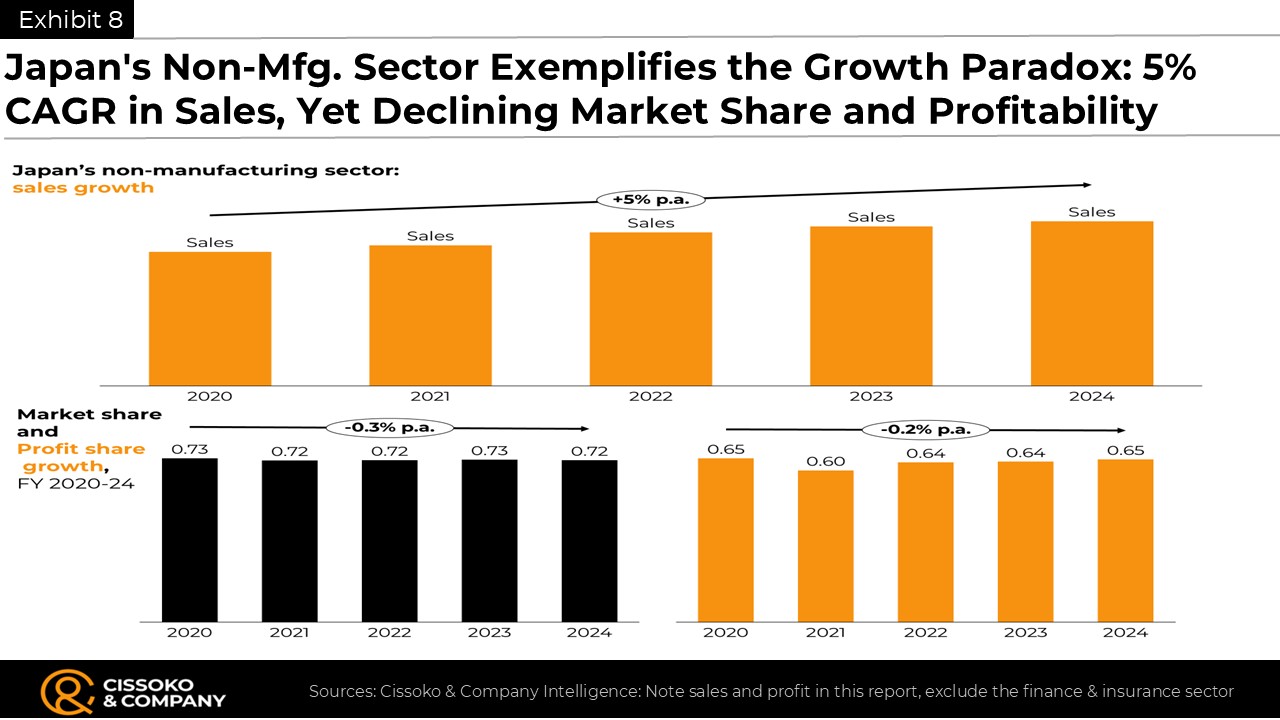
This dynamic is evident in Japan’s non-manufacturing sector, which posted a 5% CAGR over the study period—near the 6.5% threshold. Consequently, its losses in market share and profit share were relatively contained, yet still amounted to tens of billions of dollars given the sector’s scale.
The Growth Paradox Fourth Case: Growing at Almost the Minimum Required and Gaining Market Share and Defending Profit Share
Case Study: Japan’s Manufacturing Sector FY 2020-24
A 6% compound growth rate over five years, while notable, represented the minimum threshold required to sustain the sector’s market share.
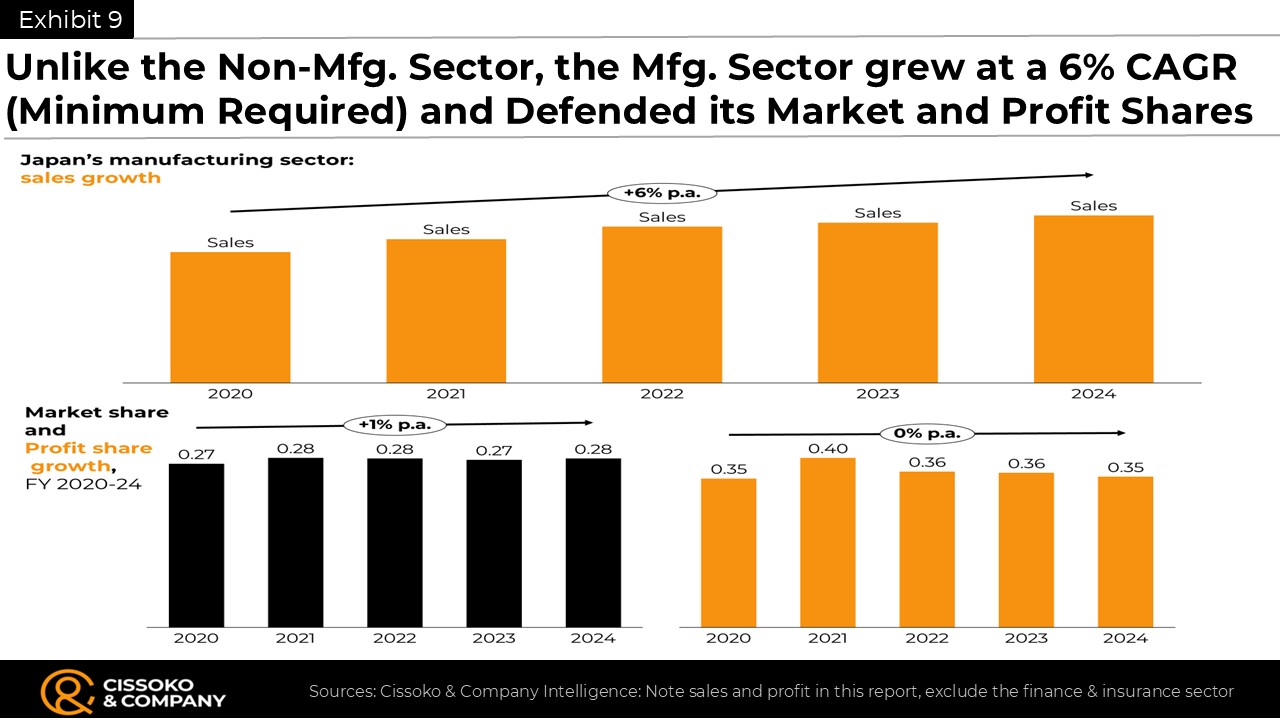
Consequently, the sector captured approximately 1% in incremental market share. Yet this rate proved insufficient to expand profit share—serving only to defend it. Failure to accelerate growth in the coming years risks a measurable erosion of the sector’s profit position.
Growth must be assessed in context. A headline growth rate that appears strong can be fundamentally misleading if it fails to meet—let alone exceed—the minimum threshold required to preserve market or profit share. True growth, as executives and business leaders define it, demands performance that meaningfully advances competitive position, not merely sustains it
Get in Touch
We will respond to your message as soon as possible.
Insights to Win
Subscribe to our newsletter for in-depth analysis, reports, and our perspectives on business and economic issues related to the Japanese market and the global economy.