
Winning Japan’s Market Share Competition: How do Smallest Firms Beat the Giants? REPORT
The gold rush to capture value through technology, innovation, and especially artificial intelligence is in full swing in Japan and beyond. At the top of many CEOs’ and business leaders’ agendas across the largest organizations is the drive to leverage these technologies for efficiency, productivity, and growth. Surprisingly, despite the global market share of artificial intelligence models showing DeepSeek leading the AI league table with nearly 28% as of August 17, 2026, followed by Google and OpenAI, according to Nikkei, our research shows that the smallest Japanese firms, with a fraction of the capital of the largest corporations, have outperformed them in both growth and market share gains over the past few years.
Understanding The Growth Paradox in the age of Artificial Intelligence: The Minimum Growth Rate to Maintain Market Share or Profit Share
Indeed, in a previous report called “The Money Game Matrix,” we explained the economics of market share and profit share over time. The problem business leaders need to know is that you can grow yet lose more market share or profit share than expected.
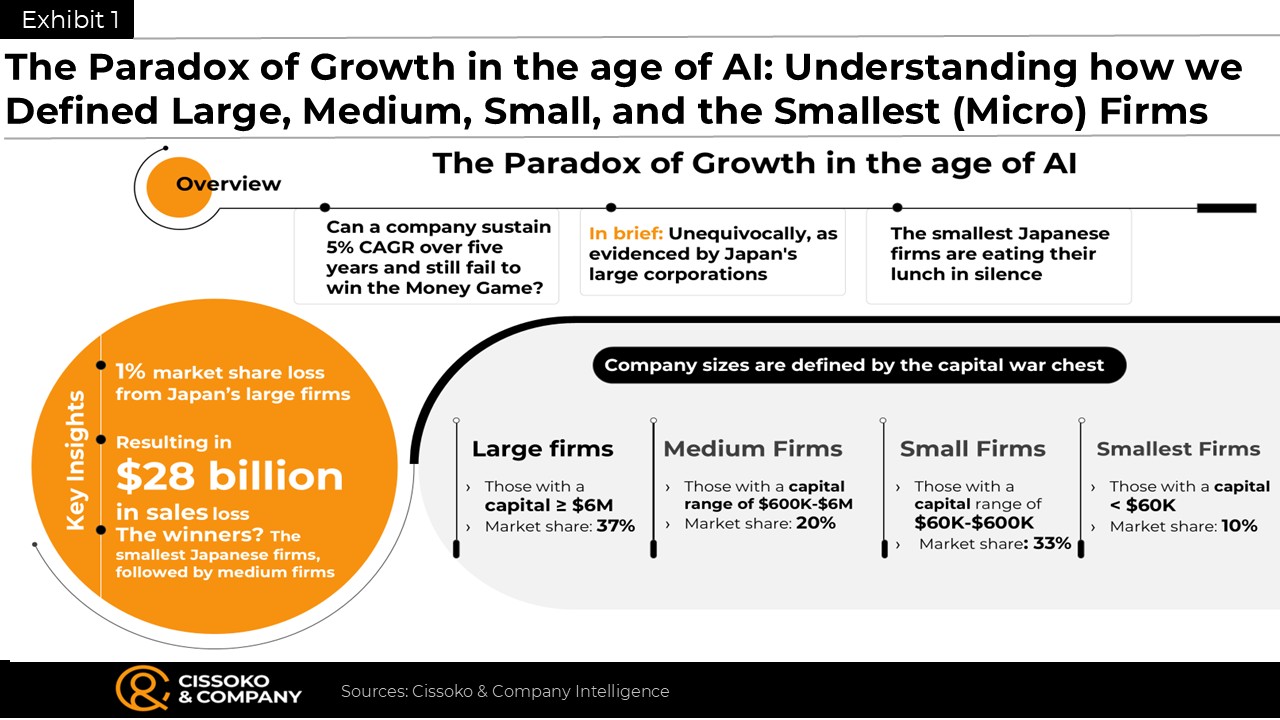
To maintain market or profit share, a company or industry must grow faster than the average growth rate of all players or industries. Thus, when growth falls below this average rate ( we call “The minimum required growth rate to maintain market and profit shares”), a firm’s or an industry’s market share or profit share shrinks. In Japan’s evolving competitive landscape from fiscal 2020 to 2024, ending on March 31, 2025, this is what happened to the largest firms with capital of at least $6 million compared with the smallest ones, the micro firms, with capital below $60,000, across the country.
Many CEOs and business leaders think they’re growing, but aren’t going anywhere. Flawed growth strategy assumptions have cost 𝗹𝗮𝗿𝗴𝗲 𝗰𝗼𝗺𝗽𝗮𝗻𝗶𝗲𝘀 𝗺𝗼𝗿𝗲 𝘁𝗵𝗮𝗻 $𝟮𝟴 𝗯𝗶𝗹𝗹𝗶𝗼𝗻 𝗶𝗻 𝗹𝗼𝘀𝘁 𝘀𝗮𝗹𝗲𝘀 in Japan alone, 𝗮𝗻𝗱 𝗰𝗼𝘂𝗻𝘁𝗶𝗻𝗴. 𝗛𝗲𝗿𝗲 𝗶𝘀 𝘁𝗵𝗲 𝗽𝗮𝗿𝗮𝗱𝗼𝘅: 𝗳𝗶𝗿𝗺𝘀 𝗰𝗮𝗻 𝗴𝗿𝗼𝘄 𝗮𝘁 𝗮 𝟱% 𝗖𝗔𝗚𝗥 𝗼𝘃𝗲𝗿 𝟱 𝘆𝗲𝗮𝗿𝘀 𝗮𝗻𝗱 𝘀𝘁𝗶𝗹𝗹 𝗹𝗼𝘀𝗲 𝘁𝗵𝗲 𝗺𝗼𝗻𝗲𝘆 𝗴𝗮𝗺𝗲 (𝗽𝗿𝗼𝗳𝗶𝘁 𝘀𝗵𝗮𝗿𝗲 𝗮𝗻𝗱 𝗺𝗮𝗿𝗸𝗲𝘁 𝘀𝗵𝗮𝗿𝗲).
Indeed, the smallest Japanese firms with a fraction of their capital are eating their lunch in silence. Why?
Because there is a huge 𝗱𝗶𝗳𝗳𝗲𝗿𝗲𝗻𝗰𝗲 𝗯𝗲𝘁𝘄𝗲𝗲𝗻 𝗴𝗿𝗼𝘄𝘁𝗵 𝗮𝗻𝗱 𝗯𝗲𝗮𝘁𝗶𝗻𝗴 𝘁𝗵𝗲 𝗿𝗲𝗾𝘂𝗶𝗿𝗲𝗱 𝗴𝗿𝗼𝘄𝘁𝗵 𝗿𝗮𝘁𝗲 𝘁𝗼 𝗺𝗮𝗶𝗻𝘁𝗮𝗶𝗻 𝗺𝗮𝗿𝗸𝗲𝘁 𝘀𝗵𝗮𝗿𝗲 𝗮𝗻𝗱 𝗽𝗿𝗼𝗳𝗶𝘁 𝘀𝗵𝗮𝗿𝗲 in this age of agentic AI.
We call this phenomenon “𝗧𝗵𝗲 𝗚𝗿𝗼𝘄𝘁𝗵 𝗣𝗮𝗿𝗮𝗱𝗼𝘅” in the global economy, where many players still 𝗰𝗼𝗻𝗳𝘂𝘀𝗲 𝗺𝗼𝘁𝗶𝗼𝗻 𝘄𝗶𝘁𝗵 𝗽𝗿𝗼𝗴𝗿𝗲𝘀𝘀.
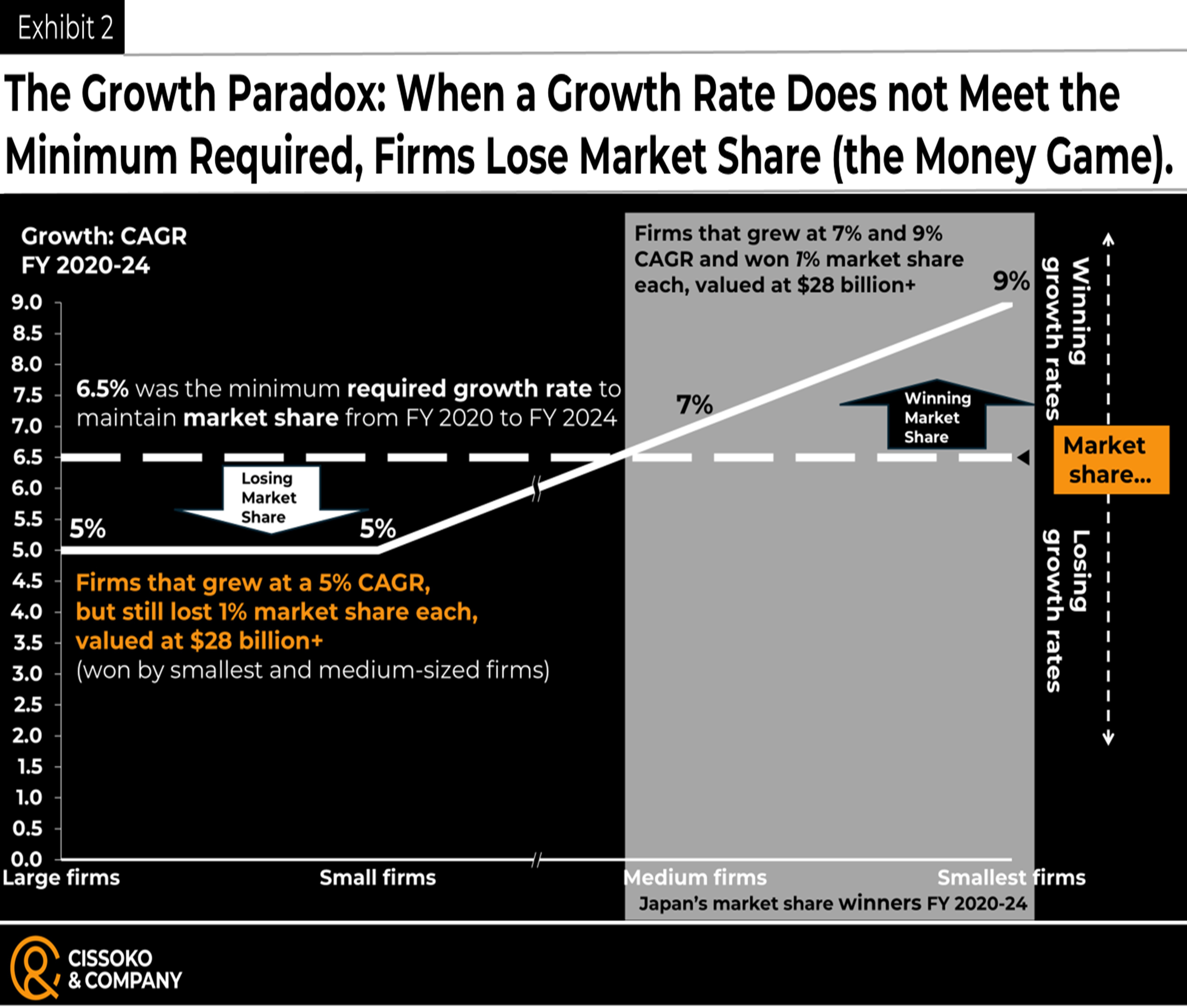
Indeed, many business leaders at the largest firms will be surprised to realize that their businesses’ growth rates were not sufficient, given how fast competitors were growing.
Large Firms’ Performance: Growth Rate and Loss of Market Share
For decades, Japan’s larger firms have commanded the lion’s share of the sales across the country. However, complacency—resting on one’s laurels — can be a dangerous gamble in this age of agentic AI. Some common mistakes of large firms include confusing productivity with profitability and growth.

Similarly, many large corporations still conflate efficiency and effectiveness. That is, they confuse efficiency gains from AI deployment and rollout with organizational effectiveness in achieving productivity and financial performance targets.
Smallest Firms’ Performance: Growth Rate and Market Share Gains
The Japanese economy is dominated by small and medium-sized companies, which account for nearly 99.7% of all businesses nationwide. In other words, SMEs are less productive, as measured by value added, and less profitable than larger firms; their combined sales exceed those of larger firms by a wide margin (64% for SMEs vs 36% for large firms, FY 2024). Indeed, the small scale of these micro firms at the individual-firm level should not be mistaken for the power of their sheer number nationwide.
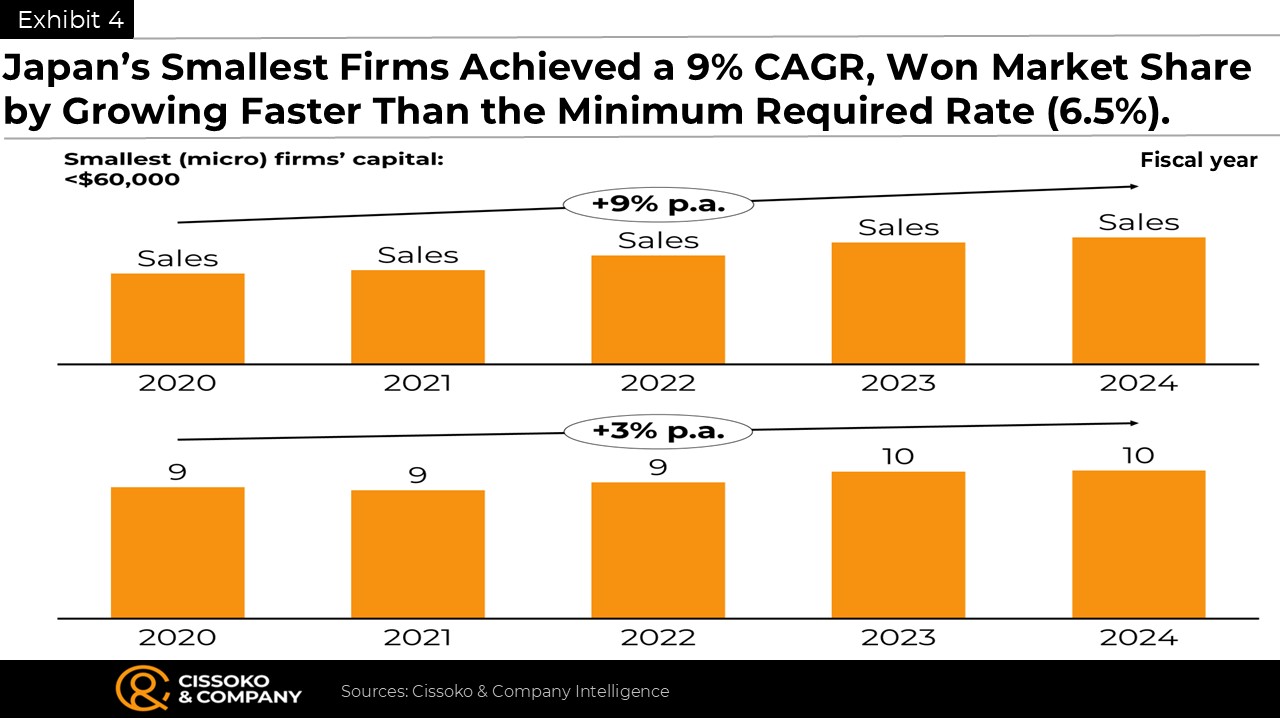
Japan has over 2,000,000 of these companies, from sole proprietorships to mom-and-pop stores and restaurants, spread across the country. Above all, they are among the most resilient and adaptive firms in Japan, as evidenced by their dominance of the league table of long-lived Japanese firms, those in business for at least a century. As such, the largest companies need to double-check the cracks appearing in their strategies by reconsidering flaws inherent in their assumptions about who can ‘eat their lunch in silence.”
Medium Firms’ Performance: Growth Rate and Market Share Gains
Like the micro firms, medium-sized companies in Japan grew at a rate above the minimum required to maintain or grow market share over the past five years through March 31, 2025.
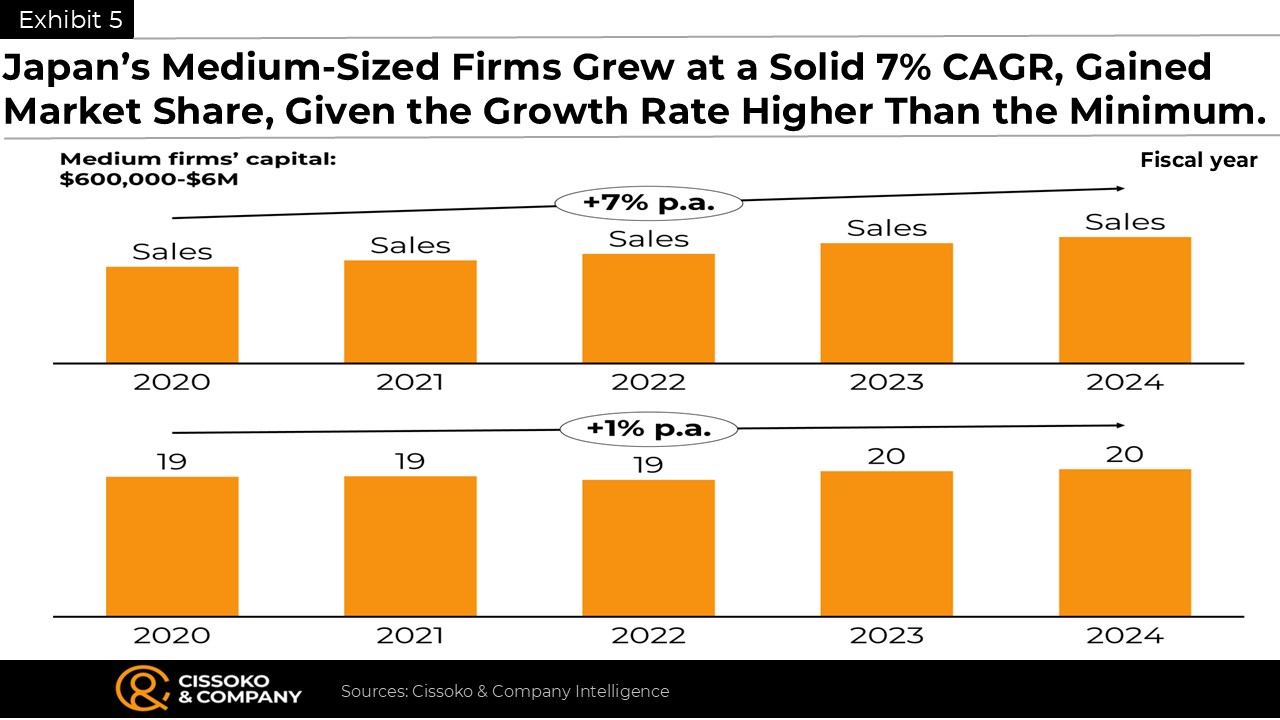
That is, they grew at a compound annual growth rate of 7% while increasing their market share by 1%, resulting in billions of dollars in value (sales gains) captured nationwide.
Small Firms’ Performance: Growth Rate and Loss of Market Share
Smaller Japanese firms are the ones likely to dethrone large firms in Japan in terms of total market share. To do so, they may need a new strategic review of the competitive landscape. Our analysis of many firms across the country suggests that, like larger firms, complacency is taking hold.
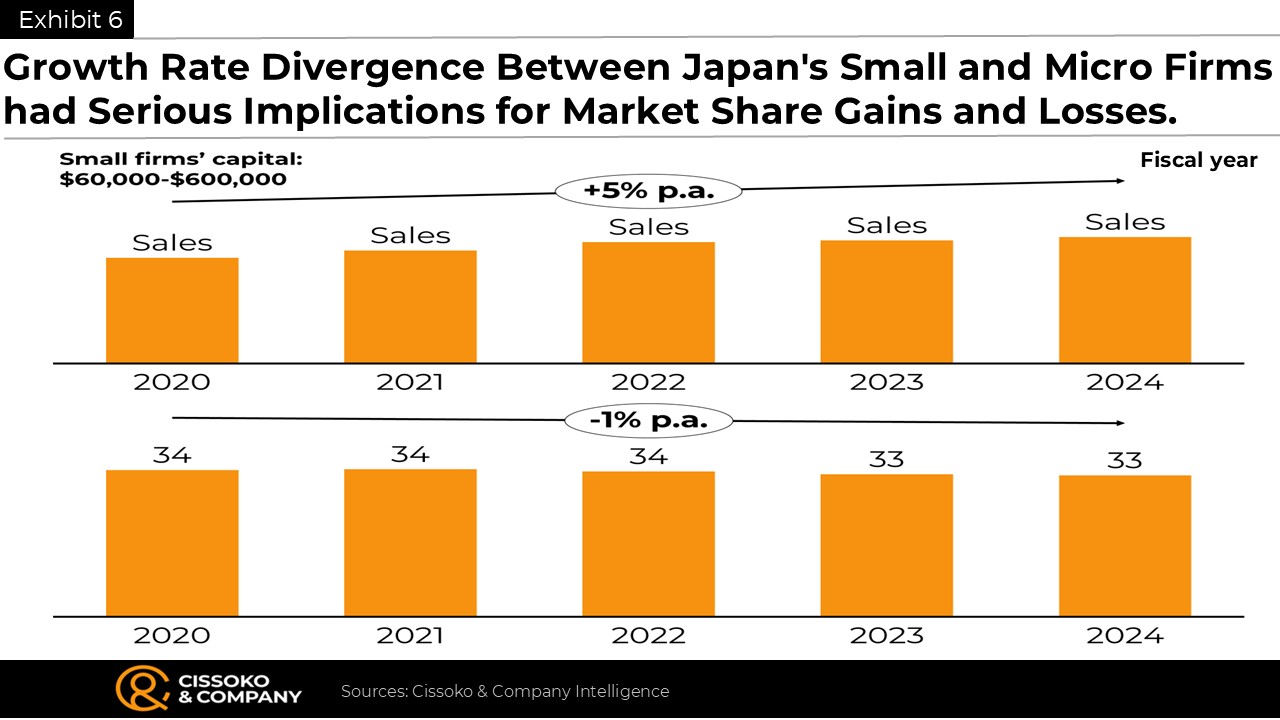
Thus, shaking up business and operating models through bold adaptation and resource allocation can reverse market share losses. Again, like their larger peers with billions of dollars, small firms do not have the luxury of waiting too long. Many will need to act now to avoid bankruptcy court.
What many small firms need to know is that in Japan, even closing a business without going bankrupt costs money. Indeed, our research reveals that 37% of those who close businesses in Japan spend less than \500,000, 18% between \500,000 and \1 million, and 7% more than \10 million. Only 9% of respondents said it did not cost anything.
Get in Touch
We will respond to your message as soon as possible.
Insights to Win
Subscribe to our newsletter for in-depth analysis, reports, and our perspectives on business and economic issues related to the Japanese market and the global economy.