
Japan’s Information Technology Industry in the age of Artificial Intelligence
In this age of artificial intelligence, the clock is ticking for Japan’s information and communication industry. Business leaders must tackle two serious issues head-on to win and remain competitive within the global economy.
Japan seems late to the artificial intelligence party, exemplified by the sheer dominance of American players across the ecosystem, from foundational models (LLMs) leadership to cloud computing resources (SaaS, IaaS, PaaS) to semiconductor chips (GPU) badly needed for faster and efficient data crunching. Beyond these areas, corporate Japan has two other battles it cannot afford to lose in the information and communication industry: winning the talent war and the R&D investments, which appear to show disruptive cracks in recent years. The industry is crucial as a new global battleground for economic competitiveness and national security. On top of that, it accounted for 10.1% of Japan’s nominal GDP (¥540.7 trillion) in 2022 – that is, ¥54.7 trillion, which was a 1.5% increase from the previous year, driven by internet-related services.

Our analysis of Japan’s information and communication industry revealed that from the mid-2000s to 2018, its patent productivity remained stagnant, while its American and Chinese counterparts produced nearly 50% and 100% more than the Japanese players, respectively. What is behind this innovation productivity gap?
The Industry’s R&D Investments on Downward Trends
To understand the reason for innovation productivity stagnation in Japan’s information and communication industry, we analyzed the trends in R&D investments over the past decade—precisely, between 2011 and 2022.
The analysis revealed two insights: On the one hand, Japan’s business enterprises’ R&D investments soared by 23% to 15.1 trillion in 2022. In other words, they accounted for 75% of Japan’s total R&D expenditure. On the other hand, the information and communication industry’s share of the business enterprises’ R&D investments has decreased in relative and absolute terms or remained stagnant. For example, around 2011, the information and communication industry accounted for 32% of Japan’s business enterprises’ R&D investments. By 2022, it accounted for just 24% — a decrease of 25% in roughly a decade.

To win and remain competitive in the cutthroat world of artificial intelligence, the industry must move in the opposite direction by increasing its technology innovation research investments. This will help close the widening gap between Japan and other advanced countries in areas such as machine learning, computer vision, satellite technology, semiconductors, and renewable energy technologies, which will be necessary for the high energy demand of artificial intelligence computing.
The Industry’s Shrinking Tech Expert Talent Pool
Like many other industries in the Land of the Rising Sun, the Tech industry faces a severe talent crunch, particularly the dearth of researchers. Like the shrinking in R&D investments, Japan’s information and communication industry has been disrupted by the lack of research expert talent across the board.
The issues related to Japan’s aging population are well documented. However, these issues need not be used as an excuse for failures to recruit international talent. For one thing, the needed skills to rescue Japanese industries do not need to be only Japanese in this age of hybrid work culture. Tackling recruitment, cultural barriers, language fluency, diversity, and inclusion can make a huge difference. The Japanese yen trends against other major currencies will make Japan unattractive to foreign talents.
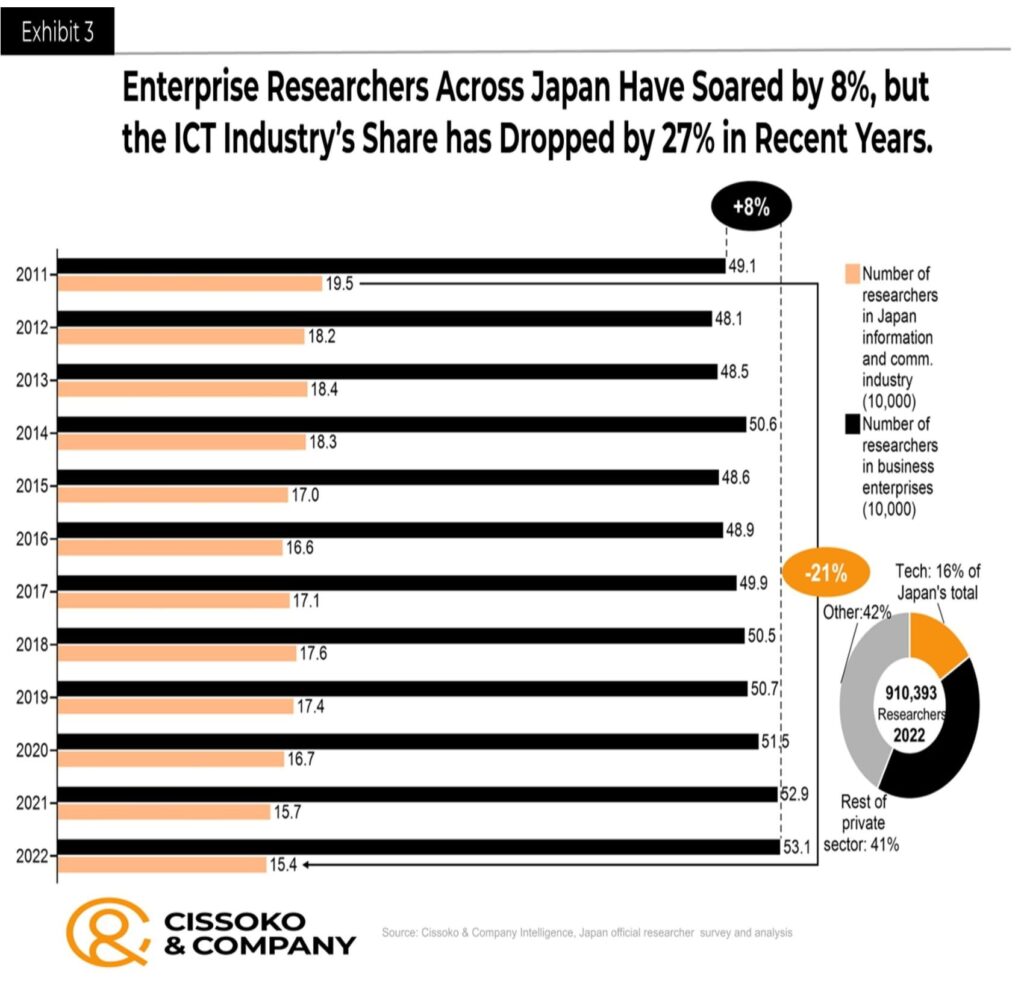
Indeed, solving the talent equation related to compensation has become a Herculean task, given that the Japanese currency depreciation affects anyone who calls the country home. Consider this: Japan’s nominal per capita GDP was 4.7 million ($33, 800) in 2023, making it the 22nd GDP per capita in the world, according to reports. Worse still, Japan was leapfrogged by South Korea and was the last country in the G7 club in terms of per capita GDP. That’s one of the reasons Japan’s fashion giant, Uniqlo, decided to increase the pay of its staff (headquarters and store employees) across the country by 40% from early March 2023 to remain competitive.
CEOs across the information communication industry, including Japan as a whole, must recognize a pressing urgency and crisis. The industry’s GDP and Japan’s future competitiveness are at stake.
Get in Touch
We will respond to your message as soon as possible.
Insights to Win
Subscribe to our newsletter for in-depth analysis, reports, and our perspectives on business and economic issues related to the Japanese market and the global economy.